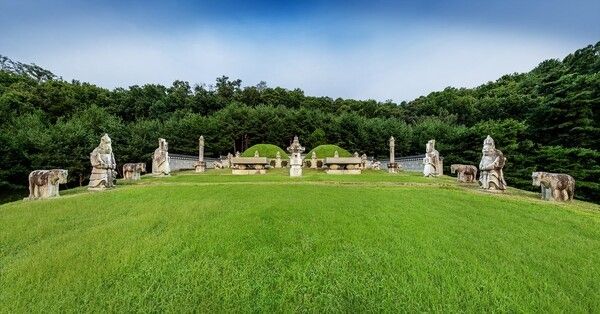
[News Culture] At the western edge of Donggureung in Guri, Gyeonggi Province, two burial mounds stand side by side within a single curved stone wall. They belong to King Hyeonjong (1641–1674), the 18th ruler of the Joseon Dynasty, and his wife, Queen Myeongseong (1642–1684). Their shared burial site, Sungneung (崇陵), is distinguished by its stone monuments and a ceremonial shrine whose roof has survived in a form no longer found at any other Joseon royal tomb.
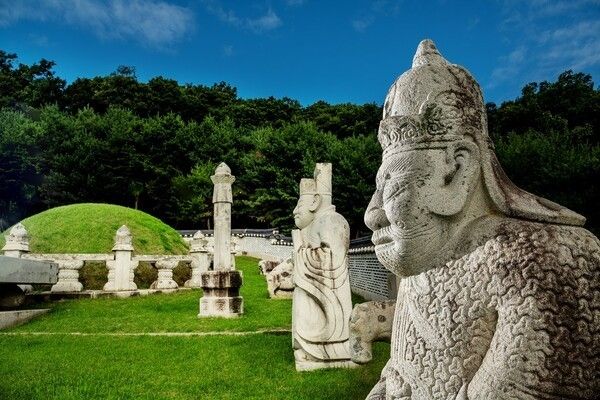
Sungneung was the fourth of nine royal tombs established at Donggureung. Its two mounds follow the traditional ssangneung, or paired-tomb, arrangement, with stone railings surrounding the graves instead of the protective stone screens used at some earlier royal burial sites. Sculptures of sheep and tigers stand around the mounds, while statues of civil and military officials occupy the terraces below. Some of these stone figures are older than the tomb itself, having been brought from the former burial site of Hyeonjong's father, King Hyojong. Beneath the graves stands a T-shaped ceremonial shrine, the only surviving example among Joseon royal tombs to retain its hip-and-gable roof form.
The monuments tell a story that extends beyond royal funerary architecture. Hyeonjong was born in Qing territory while his parents were held hostage after Joseon's defeat in war. He returned to Korea as a child, inherited the throne at 18 and spent much of his reign confronting bitter disagreements over royal mourning rites. Two major disputes divided the court, while a devastating famine brought suffering across the kingdom. He died at 33, leaving behind a reign shaped by questions of dynastic legitimacy, political authority and the limits of government during a national crisis.
Born in Shenyang, Crowned in Joseon
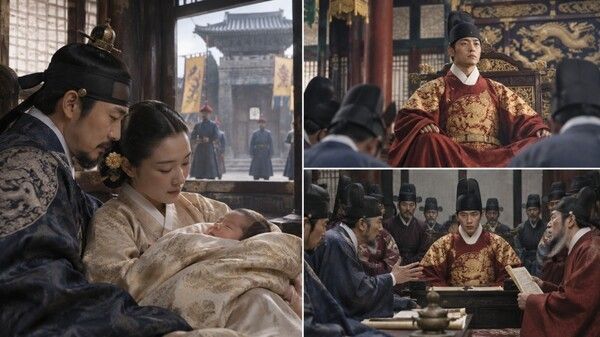
Hyeonjong's personal name was Yi Yeon (李棩). He was born in 1641 at the Korean royal hostage residence in Shenyang, then under Qing rule, where his parents, Grand Prince Bongnim and the future Queen Inseon, were being held following the Manchu invasion of Joseon in 1636. The prince would become the only Joseon monarch born outside the kingdom, a distinction rooted in the royal family's predicament after the war. His father, who had endured years of captivity alongside Crown Prince Sohyeon, later returned to Joseon and ascended the throne as King Hyojong in 1649.
Hyeonjong returned to Joseon with his family in 1644 and was designated royal grandson in 1649. After his father's accession, he became crown prince in 1651 and married a daughter of Kim U-myeong of the Cheongpung Kim clan, the future Queen Myeongseong. When Hyojong died in 1659, Hyeonjong ascended the throne at Injeongmun Gate of Changdeokgung Palace. He had no other consorts, and his children with Queen Myeongseong included Yi Sun, the future King Sukjong, and three daughters, Princesses Myeongseon, Myeonghye and Myeongan.
The new king inherited more than his father's throne. Hyojong had been the second son of King Injo, elevated to crown prince after the death of his elder brother, Crown Prince Sohyeon, despite the existence of Sohyeon's own sons. That unusual succession created an unresolved question within Joseon's Confucian ritual system: should a younger son who inherited the throne be treated as the eldest son when determining mourning obligations? The issue became central to Hyeonjong's reign, drawing the royal family into a prolonged struggle between the court's Westerners and Southerners factions.
Mourning for a King Becomes a Battle Over Succession
The first confrontation began with Hyojong's death in 1659. The court had to determine how long Grand Queen Dowager Jaui, also known as Queen Jangnyeol, should observe mourning for her stepson. Under Joseon's Confucian ritual conventions, the prescribed period depended on the deceased's position within the family. Hyojong's status was complicated by the fact that he had been born Injo's second son but had ultimately inherited the throne.
Song Si-yeol and Song Jun-gil, leading figures of the Westerners faction, argued that Hyojong's position as a younger son called for ginyeonbok, a one-year mourning period. The Southerners, represented by scholars including Yun Hyu and Heo Mok, maintained that his succession to the throne entitled him to the ritual standing of an eldest son and therefore required three years of mourning. The dispute became known as the Gihae Yesong, the first of two major controversies over royal mourning rites during Hyeonjong's reign.
Chief State Councilor Jeong Tae-hwa proposed a one-year period based on the state's established ritual code, which did not distinguish between eldest and younger sons in the relevant provision. The court adopted his interpretation, but the decision settled only the immediate question of mourning. The disagreement over Hyojong's status continued, as the rival factions disputed how Confucian principles should apply to royal succession and whose interpretation would govern future state ceremonies.
The controversy resurfaced in 1674 following the death of Hyeonjong's mother, Queen Inseon. The court now had to determine how long Grand Queen Dowager Jaui should mourn for her daughter-in-law. The Westerners supported daegongbok, a nine-month period, while the Southerners argued for one year. Hyeonjong ultimately rejected the nine-month interpretation and accepted the one-year period, bringing the Second Yesong Dispute, known as the Gapin Yesong, to a close in favor of the Southerners' position.
The decision weakened the political standing of leading Westerners and gave the Southerners greater influence. The consequences continued after Hyeonjong's death, when his successor Sukjong removed Westerners from office and appointed Southerners to prominent positions. What had begun as a disagreement over mourning obligations had developed into a struggle over royal authority, Confucian legitimacy and control of the government.
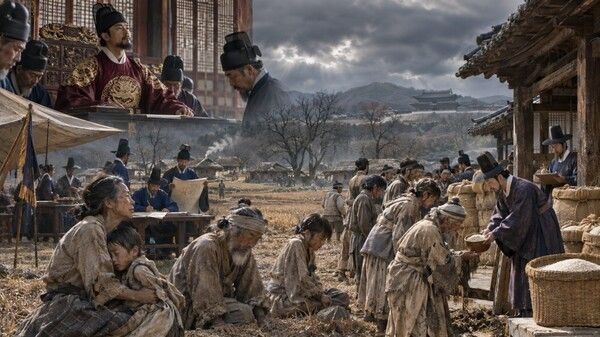
Despite the court's preoccupation with ritual disputes, Hyeonjong pursued fiscal and military reforms, extending the Daedong tax system across parts of the Honam region and seeking to improve the administration of state resources. These efforts were overshadowed by the Gyeongsin Great Famine of 1670–1671, when severe crop failures and epidemic disease devastated communities across Joseon. Hunger and illness claimed large numbers of lives, while relief efforts placed further pressure on an already strained treasury. Alongside the succession controversies, the famine became one of the defining crises of Hyeonjong's reign, exposing the difficulties of restoring stability to a kingdom still recovering from earlier wars.
A Short Reign Ends at 33
Hyeonjong died at Changdeokgung Palace on the 18th day of the eighth lunar month in 1674, little more than six months after Queen Inseon's death. He was 33 by modern age reckoning, or 34 under the traditional Korean system. His 15-year reign had been marked by two disputes over mourning rites, efforts to reform taxation and military administration, and a famine that had caused widespread suffering.
His son Sukjong inherited the throne, and preparations began for Hyeonjong's burial at Donggureung in Guri, the royal tomb complex that includes Geonwolleung, the resting place of Joseon's founder, King Taejo. The ceremony to lower Hyeonjong's coffin into its burial chamber took place in the twelfth lunar month of 1674.
Queen Myeongseong remained politically active after her husband's death. As the mother of the new king, she became queen dowager and continued to intervene in palace affairs and court politics. She died in the twelfth lunar month of 1683, corresponding to January 1684 in the Gregorian calendar, and was buried beside Hyeonjong in April 1684.
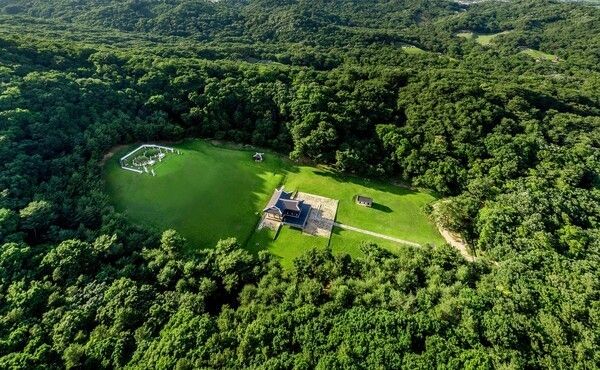
The two mounds at Sungneung stand next to each other within a single curved enclosure, forming a paired royal tomb. Although Hyeonjong and Queen Myeongseong died nearly a decade apart, the burial ground had been planned to accommodate them both. Space was reserved for the queen when the king's tomb was constructed, allowing her to be interred alongside him without fundamentally altering the original layout.
Stone Figures Given a Second Life at Sungneung
Some of the stone monuments surrounding Hyeonjong's grave had already stood watch over another Joseon king. His father, Hyojong, was originally buried at Donggureung in 1659, but repeated problems with the stonework led to the relocation of his tomb to Yeoju in 1673. When Hyeonjong died the following year, the court decided to recover and reuse selected monuments from Hyojong's former burial site.
The decision marked the first recorded reuse of stone monuments from an earlier royal tomb in Joseon's royal burial tradition. Rather than commission an entirely new set of sculptures, workers retrieved existing pieces, including stone figures and ceremonial furnishings, repairing damaged sections where possible. Stones that could no longer be restored were replaced.
Financial pressures played an important part in the decision. The royal court had already spent considerable resources on Hyojong's relocation and Queen Inseon's funeral, both of which required extensive construction work and labor. Queen Myeongseong sought to reduce the cost of Hyeonjong's burial, and Sukjong approved the reuse of materials from the old tomb. The arrangement conserved stone and reduced the need for quarrying, carving and transporting new monuments at a time when the state faced significant financial demands.
The reused sculptures also preserve features of an earlier style of royal tomb carving. On the military official statues at Sungneung, for example, the protective flap extending over the neck and shoulders from the back of the helmet retains characteristics associated with older sculptural conventions. Their presence beside newly produced stonework makes Sungneung an important site for examining changes in royal funerary sculpture and the practical decisions behind tomb construction.
The Last Royal Tomb Shrine of Its Kind
The ceremonial shrine below Sungneung's burial mounds is another important survivor of 17th-century royal architecture. Known as the jeongjagak, the building takes its name from its T-shaped floor plan, resembling the Chinese character 丁. Such shrines were essential features of Joseon royal tombs, providing a formal setting for ancestral rites and offerings to deceased monarchs.
At Sungneung, the jeongjagak is an eight-bay building with a distinctive paljak, or hip-and-gable, roof. Unlike the simpler gabled roofs seen at most surviving royal tomb shrines, this design combines a central ridgeline with sloping roof sections extending toward all four corners. Although other royal tombs once had shrines of this type, later rebuilding and repairs altered their roof forms. Sungneung's jeongjagak is the only surviving example to retain the earlier design and was designated a nationally protected Treasure in 2011.
Its unusual architecture is not limited to the roof. The eight-bay arrangement provides a larger ceremonial interior than the more common six-bay jeongjagak, reflecting the changing design of royal ritual buildings in the late 17th century. The structure also accommodated functions that might otherwise have required an additional building, helping to limit the construction work associated with the royal funeral.
The combination of reused stone monuments and an unusually designed shrine makes Sungneung an important record of how Joseon officials approached royal burial construction under financial constraints. Established forms were retained where ritual practice required them, while existing materials and buildings were adapted to reduce costs. The resulting tomb complex preserves both older sculptural traditions and architectural features associated with the period in which Hyeonjong was buried.
Hyeonjong's life began far from the kingdom he would eventually rule. Born to royal hostages in Qing Shenyang, he returned to Joseon as a child and inherited a throne shadowed by an unresolved succession dispute. His reign brought two bitter confrontations over Confucian mourning rites, administrative reforms and the devastation of the Gyeongsin Great Famine before his death at 33.
At Donggureung, the two burial mounds he shares with Queen Myeongseong remain surrounded by stone figures, some of which once stood at his father's grave. Below them, the jeongjagak retains a roof design that has disappeared from every other surviving Joseon royal tomb shrine. These monuments preserve more than the memory of a king and queen. They document the political divisions, economic pressures and architectural choices that shaped royal burial practices during one of the most troubled periods of 17th-century Joseon.
Reported by News Culture M.J._mj94070777@nc.press
Copyright ⓒ 뉴스컬처 무단 전재 및 재배포 금지


