
[News Culture] KBS1’s “A Walk Around the Neighborhood” heads to Changwon, South Gyeongsang Province, for Episode 395, traveling through Masan, Uichang and Jinhae to meet residents whose work has kept them closely tied to the city for decades.
Lee Man-gi begins at Masan Harbor before visiting Junam Reservoir, the Changwon National Industrial Complex and older neighborhoods in Jinhae. The episode moves between local food, wetlands, industry and long-running family trades, including a winter fish soup unique to the region, a haenyeo who has dived for more than half a century and a seal carver still working at 92.
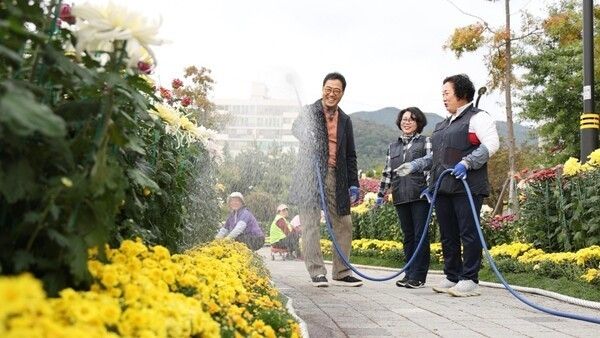
Masan Harbor is lined with chrysanthemums in autumn. The area is known as the birthplace of commercial chrysanthemum cultivation in Korea, and the Masan Gagopa Chrysanthemum Festival, first held in 2000, grew out of that long farming tradition.
When the weather turns cold, locals also return to tangsu-guk, a clear soup made with a fish known in the Gyeongsang region as tangsu and elsewhere as samsegi or kkeokjaengi. The fish has rough skin and a large mouth, but its flesh is soft and mild.
In Masan, it is usually cooked in a clear broth rather than a spicy one and has long been served as a winter meal, hangover soup and restorative dish. Lee samples the local specialty and hears why it has remained familiar to generations of residents around the port.

At Junam Reservoir in Uichang District, Choi Jong-su has spent about 40 years photographing migratory birds. More than 120 species visit the wetland, including bean geese, greater white-fronted geese and white-naped cranes.
Choi studied biology and later worked as a photographer for the South Gyeongsang provincial government. Twenty-four years ago, he built an earthen house near the reservoir so he could remain close to the birds he had been photographing for years.
He now puts up nesting boxes around his home and leaves peanuts and fruit for visiting birds while continuing to document the wetland through the seasons.
At the Changwon National Industrial Complex, the program looks at a different side of the city. Established in 1974 under South Korea’s heavy and chemical industry policy, the complex became one of the country’s major centers for machinery and manufacturing.
More recently, facilities such as Smart Up Park have brought in companies working in fields including drones, while childcare, cultural and rest spaces have been added for workers. Changwon is also taking part in drone demonstration projects that test how the technology can be used in industrial and everyday settings.
In Jinhae, Lee visits the communal washhouse in Dolsan Village beneath Jangboksan Mountain. Residents created the washing area about a century ago by channeling water from the mountain, before running water became common in individual homes.
Even now, some of the village’s older women still come there to wash clothes by hand. They sit beside the water, exchange news and talk while they work, keeping the washhouse in use long after washing machines became standard.
The coast of Jinhae is also home to Kim Mi-suk, who has worked as a haenyeo for 53 years. Born on Jeju Island, she learned to dive when she was young and later worked in Jeolla and Geoje before settling in Jinhae.
Her son-in-law drives the boat used by the divers, while her daughter runs a restaurant serving seafood Kim brings back from the water. Sea urchin bibimbap and sea cucumber mulhoe are among the dishes made with the day’s catch.
Approaching 70, Kim still goes out to dive despite her daughter’s concerns about her health and rough weather. After more than five decades, harvesting seafood from the sea remains part of her daily life.
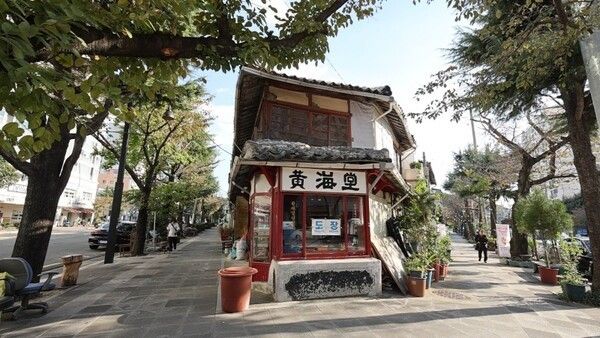
In one of Jinhae’s old Japanese-style wooden row buildings, 92-year-old Jeong Gi-won still carves seals by hand. The building is believed to have been completed around 1938, and Jeong has run his shop there since 1959.
He learned seal carving in Hwanghae Province when he was 12. During the Korean War, he joined the Marine Corps while hoping he would one day return home, but after the war he remained in the South and eventually settled in Jinhae.
Jeong named the shop Hwanghaedang after his hometown, hoping the name might help him meet someone from the same region. For nearly 70 years, he has continued carving each character by hand and regards the work as a craft rather than simply a practical service.
His remaining wish is to return to his hometown and visit his parents’ graves, a place he has not seen since leaving during the war.
“A Walk Around the Neighborhood” Episode 395 airs Nov. 21 at 7:10 p.m. KST on KBS1.
Reported by News Culture M.J._mj94070777@nc.press
Copyright ⓒ 뉴스컬처 무단 전재 및 재배포 금지


