[News Culture] In June 1981, the National Gugak Center Folk Music Group opened its first Folk Music Concert with two works that would remain in its repertory for decades. “Namdo Gutgeori, Seongjupuri and Yukjabaegi” recast vocal music for instrumental ensemble, while “Sanjo” expanded a form built around the individual soloist into music for multiple players.
Those two approaches return in Weathering, the Folk Music Group’s annual concert at Yeakdang Hall on Nov. 26 and 27. The program looks back across 45 years of ensemble practice through music derived from Namdo folk song and sanjo, now performed by musicians whose experience spans different generations.
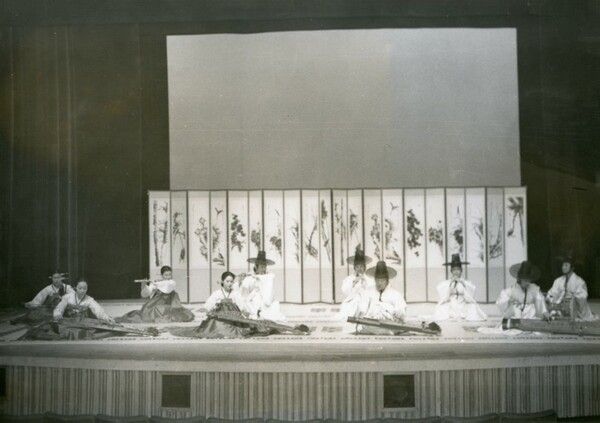
The Namdo sequence begins with repertory whose character was originally carried by the voice. “Namdo Gutgeori,” “Seongjupuri,” “Yukjabaegi” and, newly added for this program, “Heungtaryeong” rely on the strong pitch inflections and sigimsae associated with southern Korean vocal music. A low pitch may be pressed heavily, another held more steadily, while a higher note can turn sharply at the end of a phrase.
In an instrumental setting, those gestures have to be recreated through the physical language of each instrument. A bowed string, a plucked string and a wind instrument cannot bend or sustain a note in exactly the same way, so the character of the song emerges through differences in attack, vibration and release rather than through a singer’s text.
The movement of folk-song melody into instrumental repertory is not unique to this concert. Gutgeori has long appeared in hyangje julpungryu, while melodic material from “Seongjupuri” has been used in dance accompaniment. Weathering places those practices inside the Folk Music Group’s own performance history, extending the three-song sequence heard in earlier programs with “Heungtaryeong.”
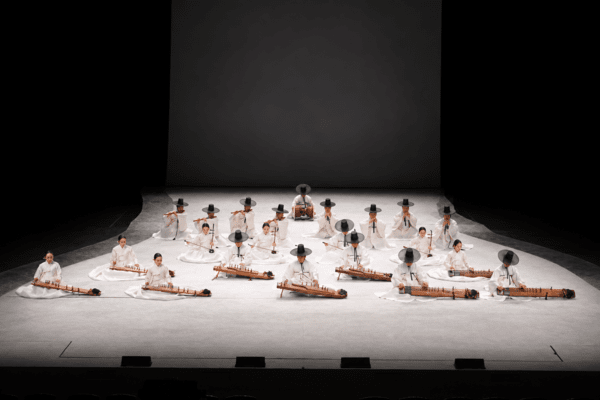
The second major strand of the program begins from sanjo. Developed as solo instrumental music, sanjo leaves room for a player’s individual pacing, ornamentation and technique, and has grown into distinct repertories for gayageum, geomungo, daegeum, piri, haegeum and ajaeng.
Once several musicians share the same material, those freedoms have to be negotiated collectively. The familiar movement from slower to faster jangdan remains, but melodic phrasing, ornament and timing must be coordinated across the ensemble. As the tempo rises, individual technique becomes more exposed at the same time that the group has to maintain a common rhythmic frame.
The Folk Music Group enlarges that texture further for Weathering. Instead of the two or three musicians per instrument often heard in sanjo ensemble, the group uses sections of six or seven players. Gayageum, geomungo, winds and bowed strings therefore produce a much broader sound, placing the details of sanjo phrasing inside a larger collective sonority.
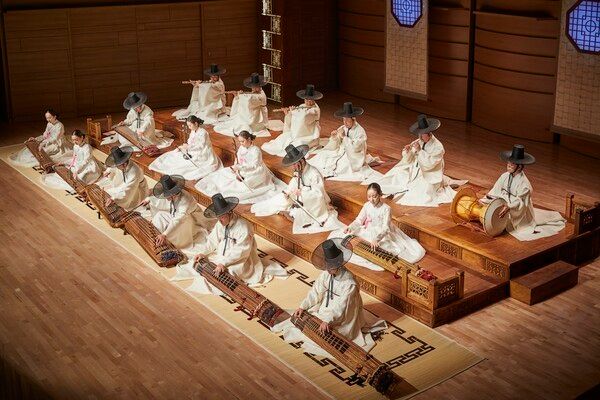
That scale also changes the way the musicians listen to one another. A phrase that might belong to one player in solo sanjo has to remain flexible while being shared by a section, and the shift from one jangdan to the next depends on a common sense of timing rather than on a single performer’s decision.
The concert brings Folk Music Group members together with younger musicians, allowing that ensemble practice to move through rehearsal as well as performance. In repertory built around jangdan, sigimsae and small variations in phrasing, much of the coordination happens by ear — through hearing how another player leans into a beat, holds a note or releases a phrase.
Acting Artistic Director Kim Jeong-rim said the musicians have spent considerable time aligning their different instrumental voices into a unified ensemble sound.
The title Weathering refers to the slow process by which rock is worn down and absorbed into the surrounding earth. The image fits repertory that has remained in use for decades, changing through repeated performance rather than surviving as a fixed historical document.
The music first heard by the Folk Music Group in 1981 now returns with a different scale, different players and decades of accumulated ensemble practice behind it. Namdo song is heard through instrumental timbre and sigimsae, while sanjo moves from the space of a soloist into the weight and coordination of a large ensemble.
Reported by News Culture M.J._mj94070777@nc.press
Copyright ⓒ 뉴스컬처 무단 전재 및 재배포 금지


