
[News Culture] Yeongwol Intercity Bus Terminal has stood in the same part of town for more than 40 years, but passenger traffic has steadily declined as mines and factories closed and routes disappeared from the timetable. About 100 people now use the terminal each day, including residents traveling to markets and hospitals, people returning home and visitors heading into Yeongwol’s mountain communities.
Episode 743 of KBS2’s “Documentary Three Days” spends 72 hours at the terminal and on buses leaving from it, following the people who still depend on a transportation network that has grown smaller with the town around it.
A waiting room where familiar faces still meet
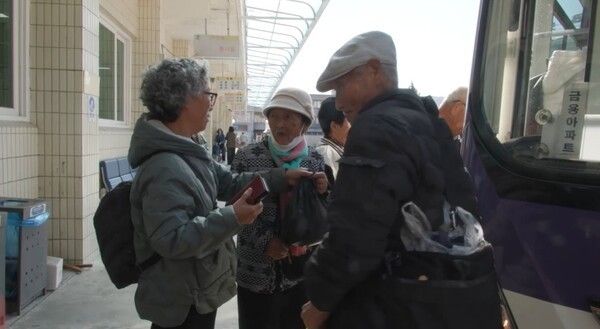
The terminal shows its age in worn doors, old furnishings and a waiting room that can remain quiet for long stretches, but regular passengers are quickly recognized when they arrive. Staff members ask about people they see often, while residents exchange news about family, neighbors and whatever has happened since their last trip into town.
The same conversations continue at nearby bus stops, where shoppers returning from the market share food from their bags and strangers begin talking while they wait. Children, neighborhood news and market prices come up easily, particularly among residents who have been using the same routes for years.
For people living in scattered villages around Yeongwol, the terminal is one of the places where they continue to run into neighbors they may otherwise see only occasionally. Many have been passing through the same waiting room and boarding buses from the same stops for decades.
From Cheongnyeongpo to mountain villages

Buses leaving the terminal travel through Yeongwol’s mountain roads toward small villages and nearby cities, with intercity services connecting places such as Jeongseon, Taebaek and Jecheon as well as Seoul, Daejeon and Gwangju. Local buses handle shorter trips between homes, markets, medical facilities and the commercial streets around the terminal.
Travelers also use the network to reach Cheongnyeongpo, the exile site of King Danjong, which has drawn renewed attention following the success of the film “The Man Who Lives With the King.” Surrounded by river and pine forest, the site remains one of Yeongwol’s best-known historical destinations.
For older residents, the bus is often part of a full day of errands. Ahead of kimchi-making season, passengers board with sacks of peppers and garlic after visiting local mills, while others stop at a pharmacy, hospital, supermarket or hair salon before waiting for the next bus home.
Some waits last several hours, but residents in outlying villages may have few alternatives, especially if they no longer drive or do not own a car. For them, the local bus still determines when they can shop, see a doctor or travel beyond their immediate neighborhood.
A timetable that keeps getting shorter

The current waiting room looks very different from the terminal remembered from the 1960s and 1970s, when Yeongwol’s thermal power plant, mines in Machari and Sangdong, and cement factories brought large numbers of workers and passengers through town. Ticket counters were busy, the waiting room filled up, and buses left throughout the day for destinations across the region and beyond.
Song Yong-hak, who runs the underground “Palace Barbershop” that opened with the terminal building, remembers that period firsthand. Information clerk Yoo Mi-jung, who began working at the terminal soon after graduating from high school and has remained there for more than 30 years, also recalls lines stretching from the ticket counters across the waiting room.
As major industrial sites closed, residents left and passenger numbers fell with them. The COVID-19 pandemic accelerated the decline, and with daily traffic now around 100 people, the terminal eventually faced closure before Yeongwol County converted it to public operation.
Behind the current information board, Yoo shows an old ticket booth that still holds equipment from an earlier period. Goyang, Uijeongbu, Seongnam, Icheon, Pyeongchang, Gangneung and Yongin are among the destinations she remembers from routes that no longer operate.
Of 286 bus terminals nationwide, 152 receive no more than 500 passengers a day, while 34 have shut down since 2020. Only seven, including Yeongwol, were converted to public operation; others closed entirely, were reduced to bus stops or were consolidated with nearby terminals.
Each lost route reduces the number of options available to residents who rely on public transportation, particularly older people traveling for medical appointments, shopping or visits to neighboring communities. In Yeongwol, that dependence remains visible every day even as the number of buses and passengers continues to fall.
KBS announcer Yoo Ji-won narrates the episode.
“Documentary Three Days” Episode 743 airs Nov. 16 at 8:30 p.m. KST on KBS2.
Reported by News Culture M.J._mj94070777@nc.press
Copyright ⓒ 뉴스컬처 무단 전재 및 재배포 금지


