[News Culture] In March 670, a Silla force of about 20,000 crossed the Amnok River and moved into Liaodong. Its opponent was Tang China, the same empire that had fought alongside Silla against Baekje and Goguryeo only a few years earlier. The alliance had collapsed after Tang sought to extend its control over the peninsula, and the fighting that followed lasted until 676, when Silla forces defeated Tang at Gibeolpo.
The season finale of KBS1’s “History Special – Time Traveler” follows that seven-year war through the attack on Ogol Fortress, the Battle of Seokmun, the fighting around Maesoseong and the final naval clashes at Gibeolpo. Episode 45 also looks at Tang’s attempt to replace King Munmu with his younger brother Kim In-mun as military confrontation spread into a struggle over Silla’s throne.
Silla crosses the Amnok and attacks Liaodong
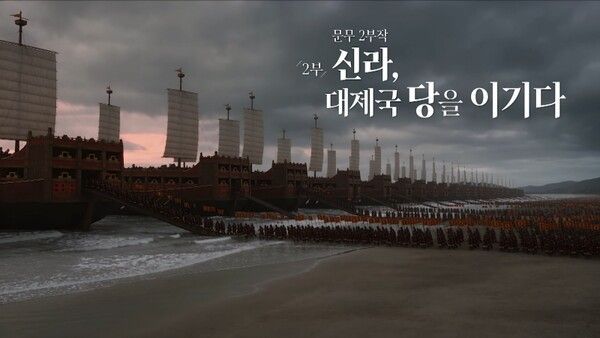
The first major Silla offensive came in March 670, when its troops joined Goguryeo restoration forces, crossed the Amnok River and attacked Ogol Fortress in Liaodong. Before Goguryeo’s fall, Silla’s northern advance had largely stopped around the Daedong River, so the move into Liaodong marked a significant expansion of its military reach.
King Munmu entrusted the operation to Seol O-yu, a member of the six-head-rank class rather than the highest jingol aristocracy, and worked with former Goguryeo forces familiar with the terrain and military conditions in the region. Joo Bo-don, professor emeritus of history at Kyungpook National University, explains that after watching Baekje and Goguryeo fall, Silla faced growing pressure from Tang and chose to strike first rather than wait for that pressure to move farther south.
Tang names Kim In-mun king of Silla
Kim In-mun, King Munmu’s younger brother and the second son of King Taejong Muyeol, Kim Chun-chu, had been sent to Tang as a royal attendant at 23 and won the favor of Emperor Gaozong. His name appears on the Wannian Palace inscription commemorating one of the emperor’s visits, where he is recorded as the only foreign figure to have left his own calligraphy on the monument.
In 674, as the war with Silla intensified, Emperor Gaozong stripped King Munmu of his Tang-bestowed titles and formally appointed Kim In-mun king of Silla. The move was designed to replace Munmu with a prince long connected to the Tang court, placing Kim In-mun in the middle of a conflict between his homeland and the empire where he had spent much of his adult life.
The episode examines how King Munmu responded to that attempt and what Kim In-mun’s position reveals about the political pressure Tang placed on Silla while the war continued.
Long spears against Tang cavalry at Seokmun
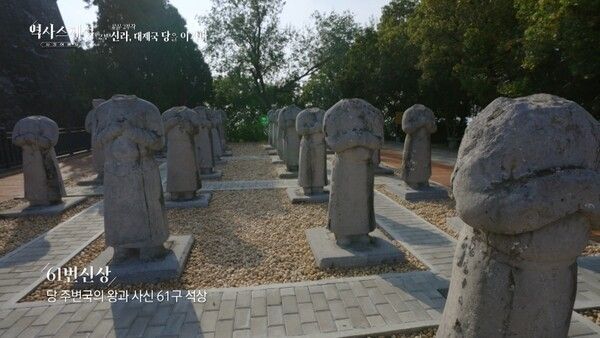
Tang cavalry gave Silla particular trouble on the battlefield, and King Munmu organized Jangchangdang, an infantry unit armed with long spears, to meet mounted charges.
At the Battle of Seokmun in 672, Jangchangdang initially held off Tang cavalry and captured about 3,000 enemy troops, although Silla later suffered heavy losses as the fighting continued. The episode uses the battle to look at how Silla tried to counter Tang’s mounted forces and where those tactics reached their limits.
Lee Sang-hoon, professor of military studies at the Korea Military Academy, discusses cavalry warfare and infantry tactics described in the ancient military text “Six Secret Teachings.” AI reconstruction is used to visualize the weapons, formations and movement of the two forces during the fighting at Seokmun.
The limited record of the Battle of Maesoseong
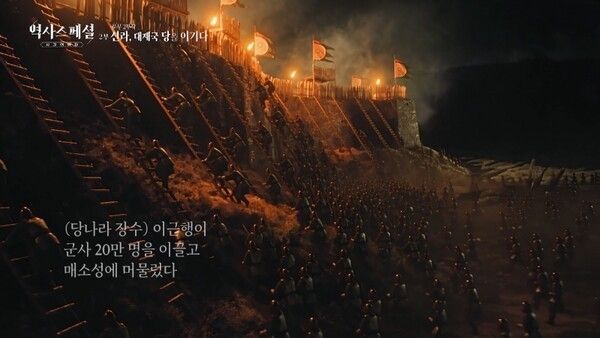
The Battle of Maesoseong in 675 is remembered as one of Silla’s major victories in the war, but the surviving sources say surprisingly little about how it unfolded. Details about commanders, troop movements and the course of the fighting are scarce, and scholars have yet to agree on the fortress’s exact location.
The program therefore places Maesoseong alongside Tang’s wider offensive of 675 and other clashes in the surrounding region, comparing the limited written record with what is known about military activity at the time. The episode focuses on what can be established from the sources rather than treating later reconstructions as settled fact.
Defeat, regrouping and the fighting at Gibeolpo
The final major stage of the war came at Gibeolpo near the Geum River estuary in 676, where Tang naval forces again confronted Silla. Silla lost the first engagement but regrouped and returned to battle, then prevailed in a series of clashes that followed.
The “Samguk Sagi” describes the response with the phrase “paejeok ujin,” meaning that the army advanced again after suffering defeat. The episode uses that record to trace how Silla’s naval forces recovered from the opening loss and continued fighting until Tang forces withdrew.
King Munmu died five years after the war ended and, according to historical records, asked to be buried in the East Sea. The program also revisits accounts surrounding his underwater tomb and the wishes he left behind after years spent fighting for Silla’s survival and independence from Tang control.
The season ends with King Munmu’s war

“Silla Defeats the Tang Empire” is the 45th episode of “History Special – Time Traveler” and the final broadcast of the current season.
The series began in December 2025 with an episode on the Battle of Salsu and has combined historical research with AI and extended-reality technology to revisit subjects ranging from prehistoric Korea and the Three Kingdoms period to political upheaval in Joseon and the independence movement under Japanese colonial rule.
For the finale, the program returns to King Munmu and the war that began with Silla troops crossing the Amnok River in 670 and ended six years later at Gibeolpo. Ogol Fortress, Seokmun, Maesoseong and the final naval fighting are presented as parts of the same conflict that followed the collapse of the Silla-Tang alliance after the defeat of Baekje and Goguryeo.
“History Special – Time Traveler” Episode 45 airs Nov. 15 at 8:10 p.m. KST on KBS1.
Reported by News Culture M.J._mj94070777@nc.press
Copyright ⓒ 뉴스컬처 무단 전재 및 재배포 금지


