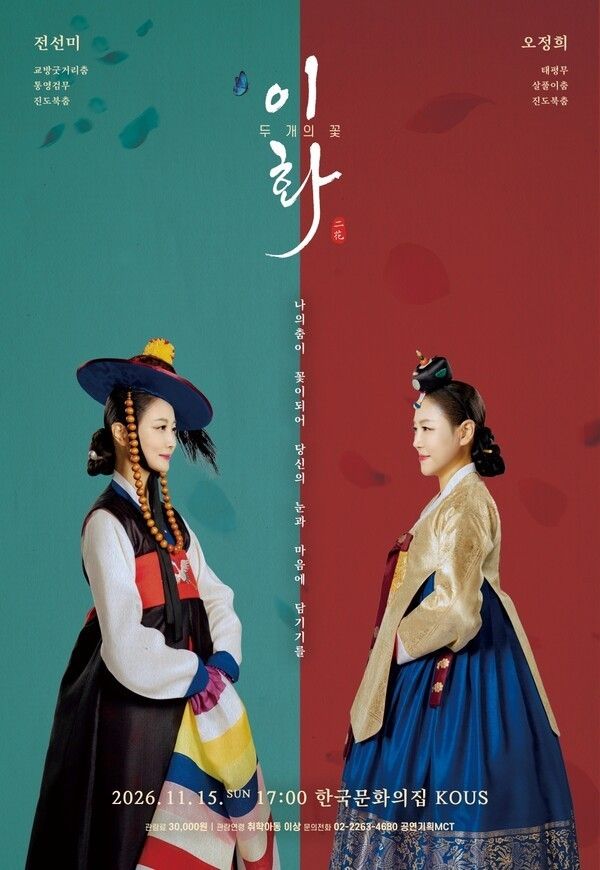
[News Culture] Korean traditional dance often carries the names of the artists who shaped and taught it. Taepyeongmu recalls Han Yeong-suk and Park Jae-hee, Salpuri is closely associated with Lee Mae-bang, and Jinju Gyobang Gutgeori Dance bears the imprint of Kim Su-ak. In Ihwa — Two Flowers, Jeon Seon-mi and Oh Jeong-hee bring those histories onto the stage through dances they have each studied for more than 38 years.
The program is built around four solos before the two dancers come together for a final bukchum. The repertory ranges from Taepyeongmu and Salpuri to Jinju Gyobang Gutgeori Dance and a solo version of Tongyeong Geommu, giving each dancer space to show how long training settles into timing, weight and phrasing. The closing drum dance then shifts the focus from individual control to shared rhythm.
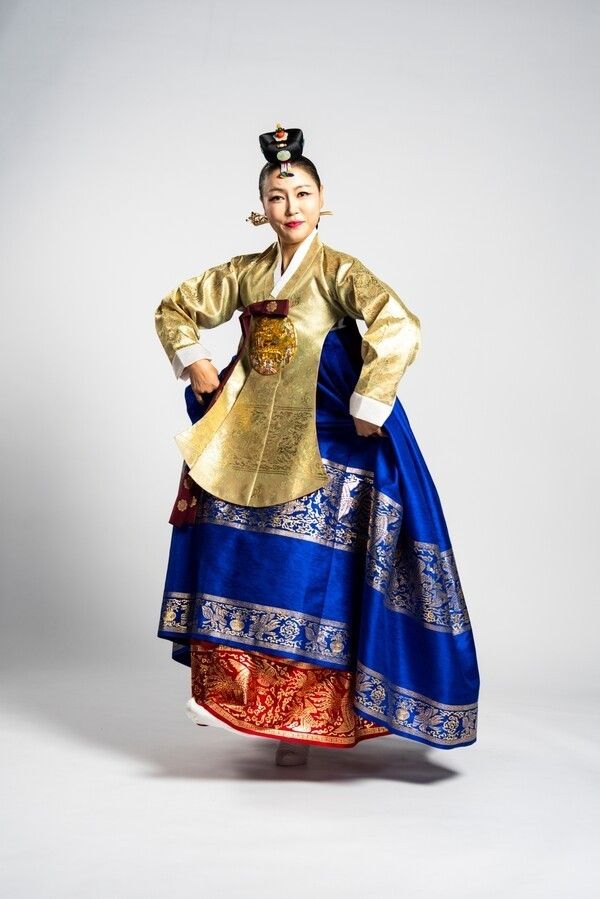
Oh performs Han Yeong-suk-style, Park Jae-hee-lineage Taepyeongmu, passed down through Han Seong-jun, Han Yeong-suk and Park Jae-hee. Danced in royal-style costume, Taepyeongmu developed among professional entertainers active in the Seoul and Gyeonggi regions, combining formal bearing with the complex rhythmic patterns of Gyeonggi music.
Its stage form has not always been the same. At a 1938 classical dance competition at Bumingwan, Taepyeongmu was performed by two dancers in the roles of king and queen. Exactly when the solo version became established is unclear, but the dance has continued to be reshaped in performance without losing its distinctive rhythmic language.
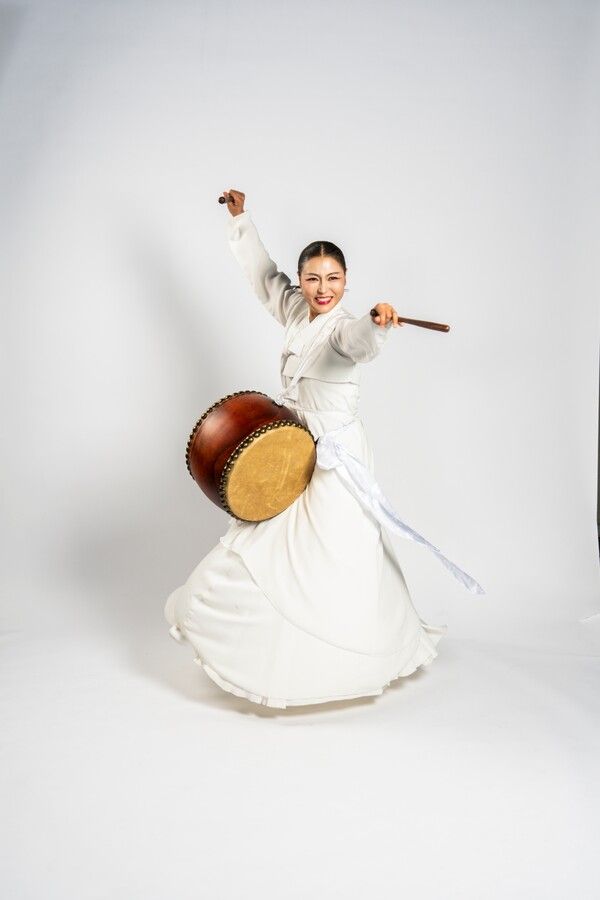
In Oh’s Taepyeongmu, attention falls on the contrast between busy footwork and a controlled upper body. The dance moves through changing jangdan after an opening accompanied by gayageum, and its character depends less on how many steps are taken than on how each movement is gathered and released through the rhythm.
Jeon’s Kim Su-ak-lineage Jinju Gyobang Gutgeori Dance offers a different vocabulary. Jeon learned the work from Cha Myeong-hee, while Kim Su-ak developed her version from the gutgeori dance she studied with Choi Wan-ja, later adding sogochum material associated with Kim Nok-ju. Wrist movements, footwork and the small-drum passages in the latter part of the dance retain traces of the gyobang tradition, where professional female entertainers were trained in song, dance and instrumental music.
Jeon’s Tongyeong Geommu places a group dance into the body of a single performer. The dance belongs to Seungjeonmu, a nationally designated intangible heritage tradition; the drum dance was designated in 1968, and the sword dance was added in 1987. Jeon is a certified practitioner of Seungjeonmu and has performed with both the Korea Cultural Heritage Foundation Dance Company and the National Jeongdong Theater Company.
In its ensemble form, Tongyeong Geommu depends heavily on spacing, facing and the changing formations of several dancers. A solo version has to create that sense of scale through one dancer’s pathway, turns and use of the sword. The tension comes from how Jeon fills the stage without the visual support of a group, while preserving the controlled force of the original dance.
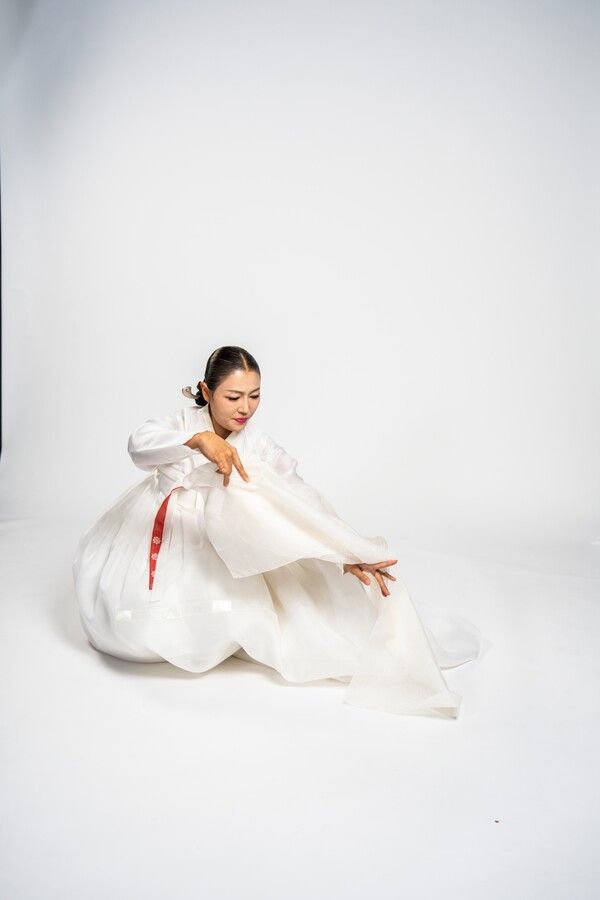
Oh’s Lee Mae-bang-style Salpuri works in a more inward register. The long white cloth extends the movement of the arms, while curved steps and shifts of weight create a continuous flow between expansion and restraint. Even when the body appears to settle, the next phrase is already being prepared through breath and balance.
Oh, a certified practitioner of Jinju Geommu and Taepyeongmu, performs both Taepyeongmu and Salpuri in the program. The pairing sets the precise footwork and changing jangdan of Taepyeongmu against the slower manipulation of cloth, weight and space in Salpuri, revealing two very different demands on the same dancer.
After the four solos, vocalist Jo Mun-ju performs the “Chunhyang’s Release and Celebration at the Government Office” passage from Chunhyangga, recounting the reunion of Chunhyang and Lee Mong-ryong. The sound of pansori briefly replaces movement as the center of attention before Jeon and Oh return together for the final work.
The closing Kang Eun-young-style bukchum was developed from Park Byeong-cheon-style Jindo bukchum. With the drum strapped to the body and sticks held in both hands, the dancer produces the rhythm directly through movement. A strike of the drum cannot be separated from the motion of the shoulders, arms and feet; what the audience hears and sees is generated by the same physical action.
That changes the balance between the two performers. In the solos, each dancer controls her own pacing. In the bukchum, Jeon and Oh have to hear one another as closely as they watch one another, matching the instant of contact with the drum while preserving their own phrasing inside the shared jangdan.
Jeon serves as secretary-general of the Park Byeong-cheon-style Jindo Bukchum Preservation Society, while Oh is a director of the organization. Their shared training gives the final duet a common rhythmic base after a program shaped largely by individual solos.
Two Flowers ends not by merging the two dancers into a single style, but by placing their separate training inside the same pulse. Taepyeongmu, Salpuri, Tongyeong Geommu and Gyobang Gutgeori Dance show how differently each body carries years of practice; the final bukchum lets those differences meet in sound.
Reported by News Culture M.J._mj94070777@nc.press
Copyright ⓒ 뉴스컬처 무단 전재 및 재배포 금지


