[News Culture] Seoul Arts Center’s November matinees will offer two very different mornings at the Concert Hall, one built around Shostakovich’s irreverent pairing of piano and trumpet and the other stretching from Mozart’s Classical poise to the dark sweep of Tchaikovsky’s Manfred Symphony.
The Nov. 19 11 O’Clock Concert features pianist Noh Hyun-jin and trumpeter Jung Tae-jin with the Gangnam Symphony Orchestra under Jung Han-gyeol. Eight days later, pianist Kim Jung-won and bass Son Hye-soo join Lee Myung-geun and the KT Symphony Orchestra for Classic with Heart. Both concerts begin at 11 a.m.

Shostakovich’s Concerto No. 1 for Piano, Trumpet and Strings in C Minor, Op. 35 gives the Nov. 19 concert its sharpest edge.
The piano carries most of the virtuoso weight, but the trumpet keeps intruding with comments that can sound sardonic, ceremonial or deliberately out of place. Shostakovich lets the two solo instruments play off one another with the timing of stage characters, shifting quickly between bravura, parody and abrupt changes of mood.
That instability is part of the work’s appeal. A phrase can begin in earnest and suddenly turn comic; a seemingly conventional concerto gesture can be punctured by a trumpet call or rhythmic detour. The chamber-sized string ensemble keeps the textures lean enough for those exchanges to remain exposed.
Noh comes to the performance after winning the 2025 Paderewski International Piano Competition, where he also received a special prize. Jung has worked as both a soloist and guest principal with orchestras in Korea and abroad.
The rest of the morning is equally colorful. Verdi’s overture to La forza del destino opens the concert, followed after the Shostakovich by selections from Massenet’s ballet music for Le Cid and Rimsky-Korsakov’s Capriccio espagnol, Op. 34.
Massenet’s dance music brings theatrical elegance and rhythmic lift, while Rimsky-Korsakov treats the orchestra almost as a succession of soloists, passing melodies from section to section and allowing individual instrumental colors to flash through the larger texture.
Actor Kang Seok-woo will provide commentary between works.
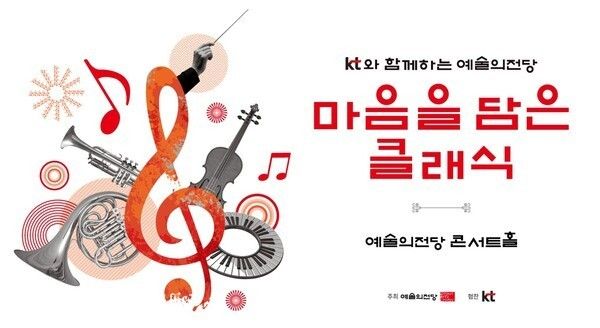
The Nov. 27 concert takes a broader route, beginning with Mozart and ending in the psychological world of Tchaikovsky.
Lee Myung-geun leads the KT Symphony Orchestra, with pianist Kim Jung-won and bass Son Hye-soo appearing as soloists. Kim Yong-bae serves as concert guide.
Mozart’s overture to The Magic Flute opens the program before Kim joins the orchestra for the Piano Concerto No. 21 in C Major, K. 467.
The concerto is often remembered for the serenity of its Andante, but the two outer movements are anything but static. Soloist and orchestra trade ideas with an ease that depends on precision and restraint rather than sheer volume, while the central movement suspends that momentum in one of Mozart’s most spacious lyrical episodes.
Son then brings the human voice into the program with Yan Frenkel’s Cranes, Schubert’s Erlkönig and Dana Winner’s I Love You.
The three songs occupy very different emotional territory. Cranes looks back toward those lost in war; Erlkönig compresses an entire drama into a feverish ride through the night; I Love You turns toward direct romantic confession.
Schubert’s Erlkönig is the most theatrical of the group. One singer must shift among narrator, father, child and Erlking while the accompaniment drives forward in relentless triplets. For a bass such as Son, the challenge is not simply range but character — making four voices distinct without breaking the momentum of the song.
Son has spent much of his career on European opera stages, including long-term engagements in Germany, and has appeared in more than 1,000 opera performances.
The morning closes with the first movement of Tchaikovsky’s Manfred Symphony, Op. 58.
Inspired by Byron’s dramatic poem, Manfred is one of Tchaikovsky’s most psychologically charged orchestral scores. Its protagonist is pursued by guilt and memories he cannot escape, and the opening movement establishes that burden almost immediately through a brooding principal idea and increasingly turbulent orchestral writing.
Hearing only the first movement still gives the concert a substantial final arc. Mozart’s brightness and formal clarity have receded completely by this point, replaced by a darker late-Romantic sound world built on obsession, conflict and scale.
The two matinees share a morning format but little else. Nov. 19 thrives on instrumental personality, quick reflexes and orchestral color, with Shostakovich’s piano-and-trumpet concerto as its most unpredictable voice. Nov. 27 moves through concerto, song and symphonic drama, widening gradually from Mozart’s elegance to the weight of Tchaikovsky’s Manfred.
Reported by News Culture M.J._mj94070777@nc.press
Copyright ⓒ 뉴스컬처 무단 전재 및 재배포 금지


