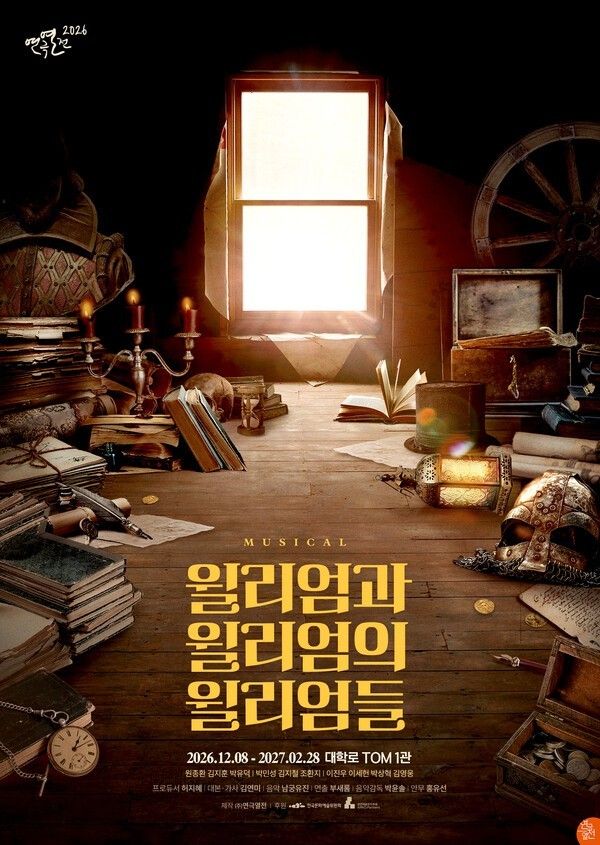
[News Culture] A famous name can change the way a work is received before anyone has properly judged the work itself. An unknown writer may struggle to be noticed, while a manuscript attached to the name of a celebrated author can arrive already surrounded by expectation and authority. The Korean musical William and William’s Williams (윌리엄과 윌리엄의 윌리엄들), an unofficial English rendering of the Korean title, takes that gap between artistic value and reputation as its starting point, drawing on one of the most notorious Shakespeare forgery scandals of 18th-century London.
At the center of the story is William Henry Ireland, who forged documents and a supposedly undiscovered play by William Shakespeare. His father, Samuel Ireland, an ardent Shakespeare admirer, embraced the material as genuine and found himself celebrated for possessing what appeared to be an extraordinary literary discovery. Henry, meanwhile, had found a way to put his own writing before an audience by placing Shakespeare’s name where his own could not command the same attention. Into that history the musical introduces the mysterious Mr. H, the supposed source of the discoveries, blurring the line between the lie Henry constructs and the reality in which others choose to believe it.
Rather than dwelling on the mechanics of forgery, the musical is more interested in how a fabrication acquires the status of truth. Shakespeare’s name becomes a form of authority in itself: once people accept that name, skepticism begins to recede. What starts as one young man’s deception grows into a public scandal because the people around him are prepared to believe what the name promises.
WHEN A NAME BECOMES PROOF OF VALUE
Henry’s deception is driven in part by a desire to be recognized as a writer. In a world where his own name carries little weight, Shakespeare’s gives his words immediate legitimacy. The musical uses that premise to separate the ability to create from the ability to be acknowledged as a creator, asking what happens when reputation begins to determine value before the work has been allowed to speak for itself.
That tension is not confined to the 18th century. In a culture flooded with new books, films, music and other creative work, audiences often encounter a creator’s reputation before they encounter the work. An established name, a familiar production company or the involvement of a celebrity can shape expectations in advance, while an unknown artist may have to overcome the absence of that recognition. Henry’s forgery therefore becomes more than a historical curiosity; it offers a way of examining how authorship, visibility and prestige continue to influence the way creative work is valued.
Samuel’s ambition gives the story another dimension. His devotion to Shakespeare makes the apparent discovery deeply personal, but it also offers him the possibility of becoming part of literary history himself. The more prestige the documents bring him, the more difficult it becomes to question their authenticity. The lie between father and son is consequently sustained not only by Henry’s need to be seen, but by Samuel’s need for the discovery to remain true.
A LIE NEEDS PEOPLE WILLING TO BELIEVE IT
Mr. H complicates that relationship further. The elusive gentleman exists somewhere between alibi, invention and theatrical presence, making it difficult to say where Henry’s fabrication ends and the musical’s imagined world begins. His line, “If everyone believes it, even a lie becomes the truth,” captures one of the work’s central ideas: deception gains power not simply because someone creates it, but because others accept, repeat and invest in it.
That dynamic shifts the focus away from the forger alone. Samuel’s certainty and the willingness of those around him to trust the Shakespeare name show how easily authority can substitute for scrutiny. Mr. H gives theatrical form to that process, widening what begins as an intimate deception between father and son into a larger question about how collective belief is made.
The three principal characters approach that question from different directions. Henry wants his writing to matter under his own name; Samuel wants the prestige that comes with standing close to Shakespeare; and Mr. H embodies the fiction that allows both desires to continue. Their motives differ, but each becomes invested in a version of events that satisfies something he wants to believe.
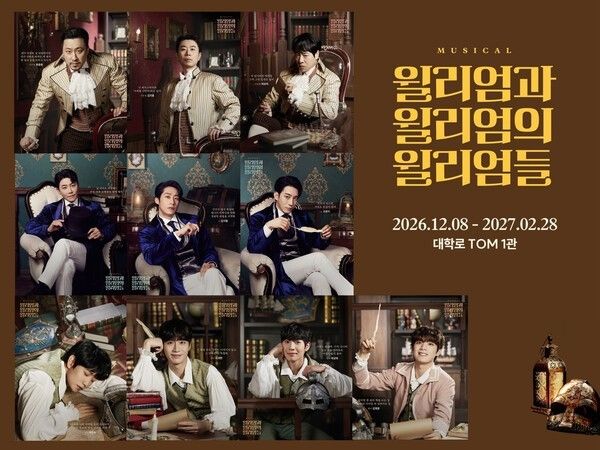
The 2026 production brings together 10 actors across those three roles. Won Jong-hwan, Kim Ji-hoon and Park Yoo-deok alternate as Samuel Ireland, portraying a father increasingly consumed by the significance of the supposed discovery. Park Min-sung, Kim Ji-chul and Jo Hwan-ji play the enigmatic Mr. H, while Lee Jin-woo, Lee Se-heon, Park Sang-hyuk and Kim Young-woong take on William Henry Ireland, balancing the young writer’s creative ambition with his growing dependence on the lie he has created.
By returning to a scandal built around Shakespeare’s name, William and William’s Williams is ultimately less concerned with proving that people can be deceived than with asking why they sometimes want to be. Henry’s forged work gains value because Shakespeare’s name has already determined how it will be seen, while Samuel’s faith in that authority gives the deception room to grow. Behind the historical episode lies a more persistent question about authorship and reputation: how much of what people value comes from the work itself, and how much comes from the name attached to it?
William and William’s Williams runs from Dec. 8 through Feb. 28, 2027, at TOM 1 in Seoul’s Daehangno theater district.
Reported by News Culture M.J._mj94070777@nc.press
Copyright ⓒ 뉴스컬처 무단 전재 및 재배포 금지


