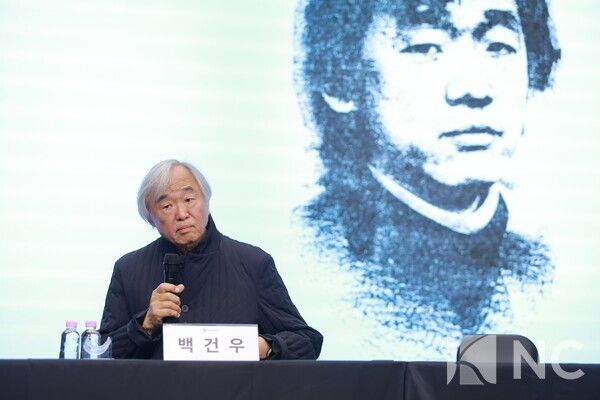
[News Culture] Seven decades into his career, pianist Paik Kun-woo is still looking for music he has yet to explore. Speaking in Seoul ahead of the publication of his first autobiography, the 80-year-old musician urged younger pianists to look beyond the standard repertoire and develop their own musical judgment. He is putting that philosophy into practice later this month, joining seven young pianists for a series of ensemble performances.
"The world of music is far broader than you might imagine," Paik said at a November 10 press conference at Shinyoung Chamber Hall in Seoul's Yeongdeungpo District. His advice to younger performers was to develop the ability to choose music suited to their individual strengths rather than confining themselves to familiar works. For a pianist who has spent much of his career studying composers in depth, finding the right repertoire remains a matter of curiosity and independent judgment.
Paik's first autobiography, Paik Kun-woo: My Story (백건우 나의 이야기), will be published by Yonhap Infomax on November 20. The book coincides with the 70th anniversary of his debut and looks back on a career that began in 1956, when he performed with an orchestra at the age of ten. He left South Korea for the United States in 1961 and studied at the Juilliard School before earning a gold medal at the 1969 Ferruccio Busoni International Piano Competition and winning the 1971 Naumburg Competition.
His performing and recording career has included extensive explorations of Beethoven, Chopin and Schumann. The new memoir, however, is concerned with more than performances and recordings. It also recounts the difficulties of building an international career at a time when South Korea was little known in European classical music circles, as well as the personal and professional choices that shaped his life abroad.
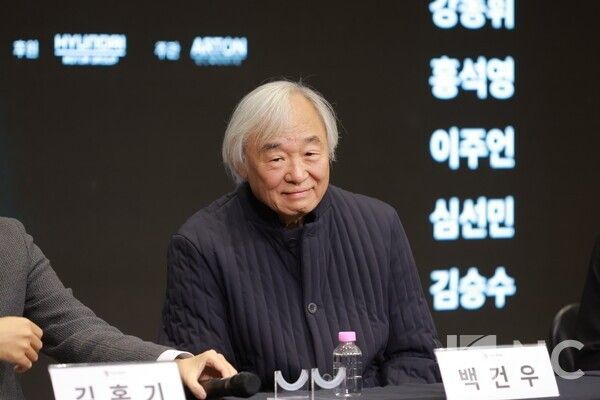
A wider musical world for the next generation
When Paik arrived in Europe in the 1960s, he encountered a musical establishment rooted in traditions that were largely unfamiliar to young Korean performers. Understanding Western classical music in its cultural setting was demanding enough, he recalled, but nationality also created practical obstacles to travel and professional opportunities.
"In Europe in the 1960s, when people barely knew Korea existed, gaining a deep understanding of Western music was no easy task," he said. He hopes the experiences recorded in his memoir will prove useful to musicians now beginning their own careers.
His concerns about the next generation are less about technical standards than the range of music young pianists choose to study. Paik suggested that some performers, despite their considerable abilities, approach the repertoire with too narrow a perspective. He wants them to discover composers and works that speak to their own musical interests rather than relying exclusively on pieces that have already become fixtures of the concert circuit.
Contemporary music deserves particular attention, he argued. Unlike the established piano repertoire, much of which comes with a long history of celebrated recordings and influential interpretations, newer works give performers opportunities to establish their own approach without being so closely bound to precedent.
Paik acknowledged that he had not devoted as much attention to contemporary music as he would have liked during his earlier years. He believes younger pianists are well equipped to take on that repertoire and should welcome the possibility of introducing unfamiliar works to audiences.
"I believe today's young musicians can engage with contemporary music more fully than I did," he said. "There is something exciting about being the first to bring an unfamiliar piece into the world. That is both the role and the value of a young performer."
His views on musical development also extend beyond the practice room. In the closing pages of his autobiography, Paik addresses the parents of aspiring musicians, arguing that a child's earliest experiences at home can be as influential as formal instruction.
"A musician's first and last teachers are their parents," he said, explaining why he wanted the book to raise questions about the foundations of music education.
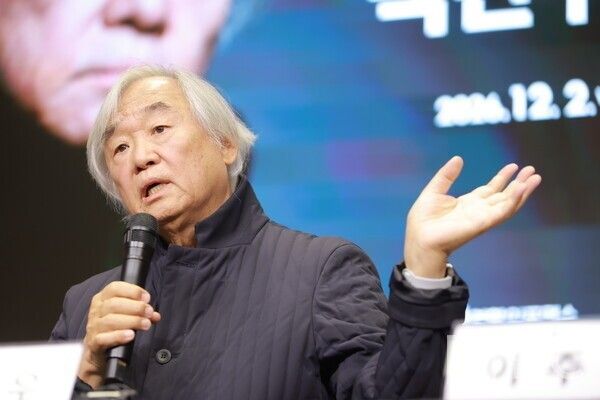
Trading the solo stage for a ten-member ensemble
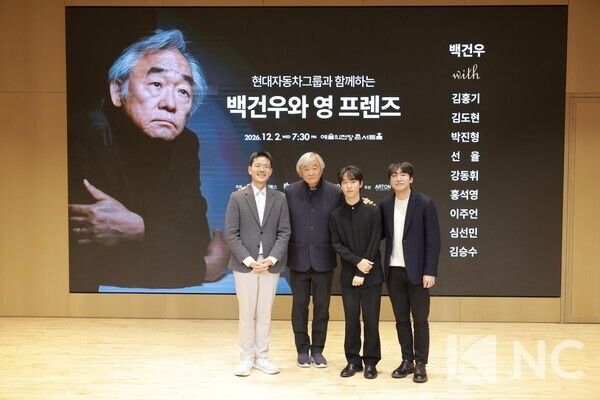
Paik's anniversary concerts will offer a practical expression of his ideas about musical exchange. Paik Kun-woo and Young Friends will be presented at Suseong Artpia in Daegu on November 29 and at the Seoul Arts Center Concert Hall on December 2, bringing together pianists from different generations in a program that moves well beyond the conventional solo recital.
Joining Paik are seven younger pianists: Kim Hong-ki, Kim Do-hyun, Park Jin-hyung, Sun Yul, Kang Dong-hwi, Hong Seok-young and Lee Ju-eon. Percussionists Shim Sun-min and Kim Seung-soo complete the ten-member ensemble.
The program brings together works for varying combinations of two and four pianos, alongside music incorporating percussion. It includes Simeon ten Holt's Canto Ostinato, Mozart's overture to The Magic Flute, Berlioz's Symphonie fantastique, George Crumb's Music for a Summer Evening and Ravel's Daphnis et Chloé.
The selection spans markedly different approaches to musical form and instrumental color. Ten Holt's Canto Ostinato develops through repeating patterns whose gradual transformations depend on close coordination among the performers. Crumb's Music for a Summer Evening, written for two amplified pianos and percussion, explores an expanded sound world through unusual instrumental techniques, resonance and rhythmic interplay.
Mozart, Berlioz and Ravel bring a different set of musical challenges, with orchestral textures and contrasting musical lines requiring the pianists to negotiate balance, articulation and ensemble precision. The program places particular emphasis on listening and collaboration, qualities that Paik considers essential to the project.
Rather than taking the role of an established master instructing younger colleagues, he wants the musicians to work together on equal terms.
"I wanted to sit across from these young musicians as equals, listening to one another and building an ensemble together," Paik said.
He explained that the concerts were conceived as an opportunity to share the stage with pianists who are developing their own musical identities. Instead of filling an entire evening with a solo performance, he hopes to learn from their approaches as they rehearse and perform together.
That attitude is striking in a musician whose career began before most of his collaborators were born. Yet Paik made clear that experience does not eliminate the need to listen, reconsider and learn, particularly when performers are working together on music that demands close interaction.
At 80, retirement is not on the program
Paik has no intention of ending his performing career. Although he recognizes that the physical demands of piano playing change with age, he sees no reason those changes should bring musical exploration to a close.
"People naturally assume that performing becomes physically difficult as you get older," he said. "But music is so vast that there is always something appropriate to every stage of life."
The greater danger, in his view, is continuing to perform the same works without finding anything new in them.
"The problem is holding on to the same repertoire without studying it further. In art, there is simply no retirement."
His autobiography also revisits episodes that shaped his life away from the concert platform. Among them are his meeting with actress Yoon Jung-hee at the 1972 world premiere of Yun I-sang's opera Sim Tjong, an attempted abduction in Yugoslavia in 1977 and his decades-long marriage to Yoon, who died in 2023.
Paik also reflects on his decision to retain South Korean citizenship despite spending most of his adult life overseas. American citizenship might have made international travel and professional arrangements easier, particularly during the earlier decades of his career, but he said changing nationality had never felt right.
"I've lived abroad for 65 years, and becoming an American citizen would certainly have made my career easier in many ways," he said. "But I have never felt I belonged to any nationality other than Korean. Changing it would have seemed strange to me."
For Paik, the autobiography is an opportunity to document a life spent largely outside his homeland without losing his sense of where he comes from. It also brings together the musicians, experiences and personal relationships that have accompanied his work at the piano.
The anniversary concerts, meanwhile, point toward what comes next. At an age when many performers have long since stepped away from the stage, Paik is preparing to rehearse with musicians decades younger than himself, navigating unfamiliar ensemble combinations and sharing responsibility for the performances.
His message to those colleagues is the same principle that continues to guide his own playing: the repertoire is too extensive, and music too varied, for any pianist to stop searching.
Reported by News Culture M.J._mj94070777@nc.press
Copyright ⓒ 뉴스컬처 무단 전재 및 재배포 금지


