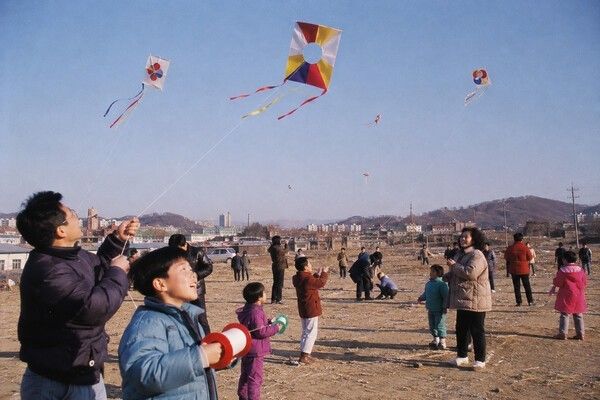
[News Culture] In winter, when cold winds sweep across open fields and bare branches cut across the sky, kites rise and turn the season into a spectacle of color and motion. Made of paper stretched over thin bamboo frames, Korean kites were more than a pastime. They embodied military ingenuity, practical knowledge of wind and balance, fierce competitive play, and ritual wishes for safety and good fortune in the new year.
Known in historical records by names such as jiyeon, pungyeon, bangyeon and punggeum, the Korean kite occupied many roles across the centuries. Early accounts associate it with battlefield tactics and communication, while later records place it firmly within seasonal recreation and folk custom. By the late Joseon period, kite flying had become one of the most recognizable winter amusements, yet its deeper meanings remained tied to strategy, craftsmanship and symbolic ritual.
A Tool of Strategy Before It Became a Winter Pastime
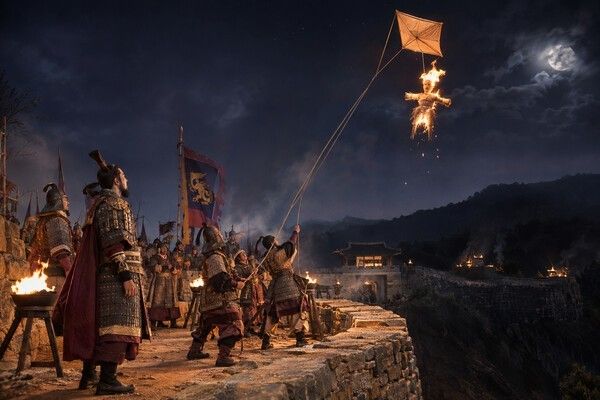
One of the earliest Korean records concerning kites appears in the "Samguk Sagi" in the biography of Kim Yu-sin. In 647, during the rebellion of Bidam and Yeomjong in the first year of Queen Jindeok's reign, a falling star reportedly caused a sharp decline in the morale of government troops. To reverse that mood, Kim Yu-sin is said to have attached a burning scarecrow to a kite and sent it into the sky, creating the illusion that the fallen star had risen again. The act unsettled the enemy and revived the confidence of his own forces, leaving behind one of the best-known episodes linking kites to military stratagem.
Other accounts also place kites within the realm of warfare. A story recorded in "Dongguk Sesigi" says that General Choe Yeong used kites during the suppression of a rebellion in Tamna, present-day Jeju, scattering reed seeds around the island and setting them alight in a tactical maneuver that helped bring down a fortress. During the Imjin War in the 16th century, Gyewolhyang is also said to have used a kite to convey information on enemy movements to General Kim Eung-seo outside the fortress, contributing to the recapture of Pyongyang. In "Jibong Yuseol," the Joseon scholar Lee Su-gwang cited an earlier Chinese case in which Emperor Wu of Liang sent out a written appeal for reinforcements by paper kite while under siege, underscoring that kites in East Asia were long associated with military communication as well as recreation.
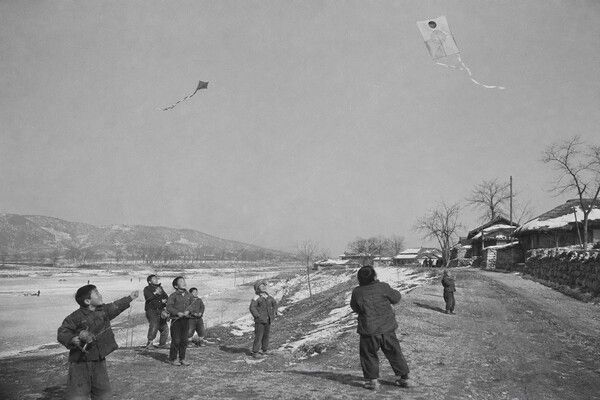
Over time, however, the function of the kite shifted. What had once served as a device of tactical utility gradually became a form of winter amusement among the general population. By the late Joseon period, flying kites between the twelfth lunar month and the first full moon of the new year had become a familiar custom, enjoyed not on battlefields but in fields, streamsides and city neighborhoods.
Shield Kites, Diamond Kites and the Science of Balance
Historical sources record a remarkable diversity of kite types and names. In shape, Korean kites were broadly divided into the rectangular bangpae-yeon, or shield kite, and the diamond-shaped gao-ri-yeon, also called solgae-yeon. Decorative features and color schemes produced many further variations, yielding names such as badukpan-yeon, meongmeori-yeon, kachikkit-yeon and yongkkori-yeon. Altogether, records preserve more than 100 such names, suggesting not only technical variety but also a highly developed kite culture.
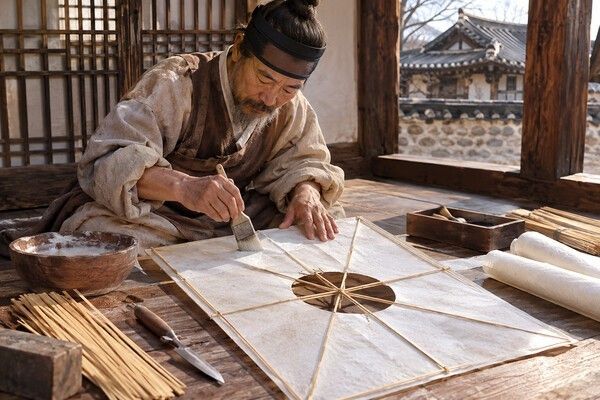
The making of a kite depended on more than attaching paper to bamboo. Its success in the air was largely determined by the placement of the beori-jul, the bridle strings that controlled its angle and response to the wind. Usually tied at three to five points, these strings had to be balanced with care. Their arrangement determined how high a kite could rise and how smoothly it could turn or perform aerial movements. Mastery of kite making therefore required a practical understanding of lightness, flexibility, tension and wind resistance.
Regional conditions also shaped design. In coastal areas and open plains, where winds were stronger, kites tended to be made larger to take full advantage of the air currents. In mountainous inland regions with weaker winds, smaller kites proved more effective. Such variations show how traditional kite making adapted to local geography rather than following a single uniform model. Even as a seasonal pastime, kite flying retained an element of empirical knowledge and technical refinement.
Kite Fighting Over the Cheonggyecheon
Kite flying was not limited to keeping a kite aloft at the greatest height. It also developed into a combative game in which participants crossed strings in an attempt to cut down their opponents' kites. Nineteenth-century sources such as "Dongguk Sesigi" and "Gyeongdo Japji" describe the crowded and exhilarating scenes around Supyogyo Bridge over the Cheonggyecheon before the first full moon of the lunar year. There, large crowds gathered to watch or take part in kite fights, and boys known for their skill could gain local fame, sometimes even being invited to the homes of wealthy families because of their prowess.
To gain an advantage, players devised ways to strengthen or sharpen their strings. Some rubbed glue onto the kite line to make it smoother, while others coated it with powdered magnetite or copper so that it would act like a fine saw against a rival's string. Regional variations added further ingenuity. In Bukcheong, South Hamgyong Province, crushed mugwort and charcoal were wrapped in paper like a cigarette, attached to the string and set alight so they could burn through an opponent's line. In parts of Jeolla Province, players tied coins and cotton to the line and ignited them in a similar attempt to strike the rival string.
These practices reveal a distinctly competitive side of kite culture. Kite flying was not merely contemplative or decorative. It could be tactical, aggressive and highly social, combining craftsmanship, bodily control and improvisation in a contest that unfolded high above the ground.
Kites That Carried Away Misfortune
The seasonal climax of kite flying came on the night of the first full moon of the lunar year. At that time, people wrote phrases such as "misfortune" or "sending away ill luck and welcoming good fortune," or else inscribed their own names and birth dates on so-called aengmagi-yeon, kites intended to ward off bad luck. These were flown high into the sky and, around sunset, deliberately released by cutting the string. The act symbolically sent away illness, calamity and misfortune with the departing kite.
This custom was serious enough to leave traces in official records. The "Myeongjong Sillok" from 1566 notes a belief that calamity would follow a house struck by a fallen kite. For that reason, a severed kite was not to be picked up but allowed to pass away together with the ill fortune it carried. The release of the kite was therefore not simply the end of a game but a ritual act that combined play with protective belief.
Just as striking is the fact that kite flying largely stopped after the first full moon had passed. Anyone who continued to fly kites beyond that point risked being criticized as a "gori baekjeong," a term suggesting someone neglectful of farming duties. The label reflected the values of an agricultural society preparing to return to work before the full onset of the farming season. In that sense, the disappearance of kites from the sky after Daeboreum was also part of the custom. Pleasure had its proper season, and restraint marked the return to everyday labor.
Though made only of paper, bamboo and string, the Korean kite carried a far broader cultural weight. It moved between battlefield ingenuity and winter recreation, between technical precision and fierce competition, and between festive amusement and ritual hope. Across those many roles, it remained a living expression of how play, craft and belief could meet in a single object lifted by the wind.
Reported by News Culture M.J._mj94070777@nc.press
Copyright ⓒ 뉴스컬처 무단 전재 및 재배포 금지


