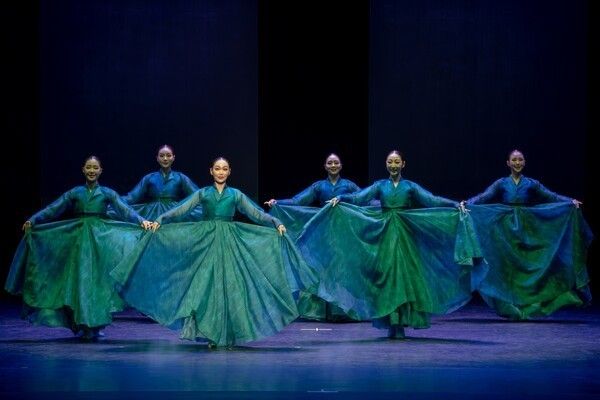
[News Culture] Court dance, improvised instrumental music, pansori and percussion-driven folk performance shared the same stage in Los Angeles as the National Gugak Center presented a 70-minute program spanning several traditions of Korean music and dance.
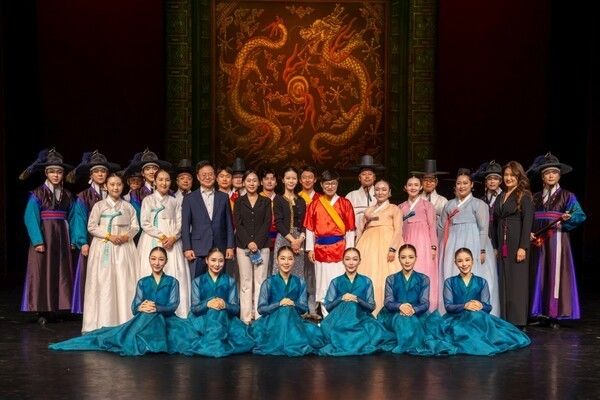
The National Gugak Center performed Korean Soundscape: The Pulse of Gugak at the Luckman Theatre in Los Angeles on Nov. 7 at 6 p.m. local time, following an invitation from the Korean Cultural Center Los Angeles. Twenty-six members of the center’s Dance Theater and Folk Music Group took part.
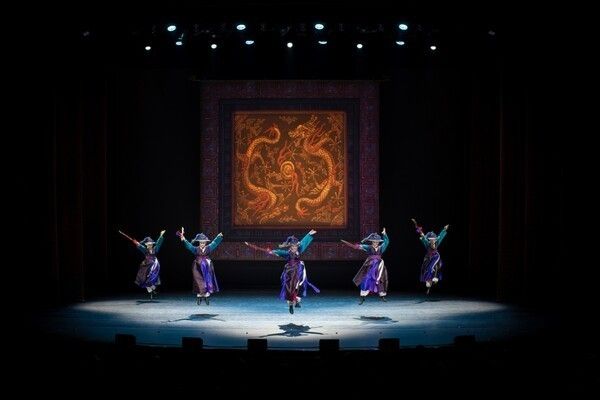
The program was organized in three sections, beginning with “Awakening the Spirit.” Hunryeongmu opened the evening with the measured movement and controlled physical line associated with Korean court dance, establishing a restrained atmosphere before the program moved into more improvisatory and folk-based forms.
The second section, “Purification & Harmony,” brought together sinawi, sanjo dance, pansori, hallyangmu and an Arirang medley. Rather than presenting each genre as an isolated sample, the sequence moved between instrumental improvisation, vocal expression and dance, showing how rhythm and melodic phrasing operate differently across Korean traditional performance.
Sinawi placed several instrumental lines within a shared rhythmic framework, allowing the players to respond to one another without reducing the music to a single dominant melody. Sanjo dance translated the shifting pulse and melodic tension of instrumental sanjo into movement, while pansori brought the human voice to the center of the program.
Hallyangmu added another dance vocabulary, and the Arirang medley connected several regional and musical variations of one of Korea’s best-known folk songs before the concert turned toward its most rhythmically expansive section.
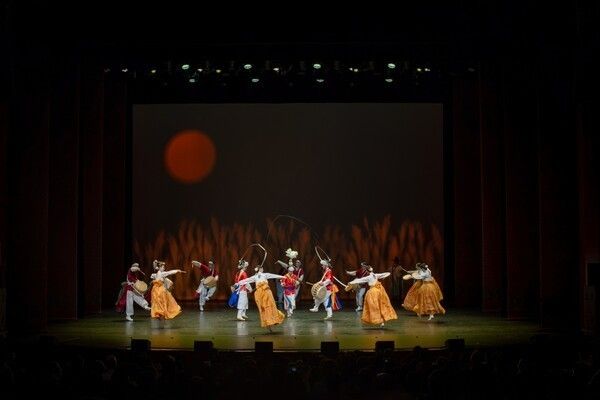
The final section, “Flight of Joy: Endless Exhilaration,” was built around pangut and dances using sogo and buk.
The change in scale was immediate. Where the earlier sections relied on controlled gesture, layered instrumental lines and vocal narrative, the finale drew its momentum from percussion, circular movement and the physical energy of the performers. The combination of strong rhythmic patterns and athletic choreography brought the performance to its most extroverted point.
Taken as a whole, the program moved through several very different performance environments within Korean traditional arts. Court dance gave way to folk instrumental music and pansori, which in turn led to pungmul-based percussion and dance. The contrasts allowed each genre to retain its own musical and physical character while still functioning as part of a single concert.
The audience responded with cheers and a standing ovation at the conclusion of the performance.
The Los Angeles appearance was presented at the invitation of the Korean Cultural Center Los Angeles, directed by Lee Hae-don. The National Gugak Center has continued to use overseas performances not only to introduce individual repertories but also to build exchanges with cultural institutions abroad.
National Gugak Center Director Seo Seung-mi said the institution plans to expand collaborative projects with international arts and cultural organizations.
Reported by News Culture M.J._mj94070777@nc.press
Copyright ⓒ 뉴스컬처 무단 전재 및 재배포 금지


