[News Culture] A jukebox musical lives or dies by what happens after the audience recognizes the song. That was the central test for Hell’s Kitchen, which ended its Korean premiere Nov. 8 at GS Arts Center after a run of just over three months. Built from Alicia Keys’ music and inspired by her own experiences growing up in New York, the musical did not simply line up familiar hits. It placed them inside the story of Ali, a teenager trying to decide who she wants to become while navigating family expectations, first love, friendship and the pull of a life beyond what others have imagined for her.
The Korean production opened July 24 as the first licensed staging of Hell’s Kitchen anywhere in the world, making the Seoul run more than a local adaptation. It was also the first test of how a musical so closely tied to Keys’ voice, language and New York background could travel into another language without losing its dramatic shape.
WHEN ALICIA KEYS’ HITS BECOME PART OF THE STORY
Set in Manhattan’s Hell’s Kitchen neighborhood in the 1990s, the musical follows Ali through a period when independence is less a clean break than a gradual negotiation with the people around her. Family, friendship, mentorship and romance all influence the choices she makes, and that is where Keys’ songs begin to do more than provide recognition. “Fallin’,” “If I Ain’t Got You” and “No One” arrive with years of familiarity already attached to them, but the musical places each song inside a new dramatic situation, allowing a lyric about love or longing to take on a different weight depending on what has just happened between the characters.
The strongest moments come when the audience stops waiting for a hit to arrive and begins hearing the song through Ali’s experience instead. A familiar melody can suddenly sound less like a catalog favorite and more like a continuation of the scene that came before it. That distinction is what keeps Hell’s Kitchen from becoming an Alicia Keys concert with a plot wrapped around it. The songs retain their original identity, but they are asked to carry character, conflict and consequence as part of a larger dramatic structure.
BUILDING 1990s NEW YORK THROUGH MUSIC AND MOVEMENT
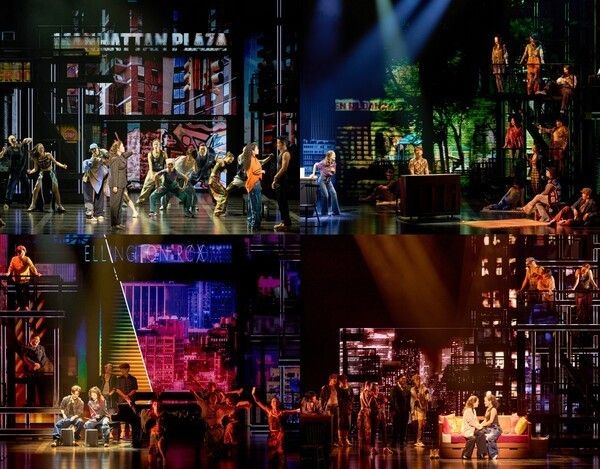
The production extends that approach beyond the score. Street-dance-based choreography gives the ensemble a physical language tied to the neighborhood, while the live band keeps the pop and R&B material immediate and rhythmically flexible. LED screens and shifting scenic elements move the action through streets, apartments and other corners of Hell’s Kitchen without interrupting the momentum, giving New York a presence that feels active rather than decorative. The city becomes part of Ali’s coming-of-age story—crowded, restless, seductive and at times difficult to escape.
For the Korean company, the challenge was even more complicated because Keys’ music had to retain its rhythmic character while working naturally in Korean. Son Seung-yeon, Kim Soo-ha and Park Ji-won alternated as Ali, each bringing a different balance of vocal power and dramatic detail to a role that demands both. The score calls for considerable range and control, but the larger task is making Ali feel like the same person in dialogue and in song. The Korean lyrics therefore had to preserve the momentum of the original music while still allowing the audience to follow her emotional shifts without feeling that the words had simply been fitted around an existing beat.
Alicia Keys herself was present at the beginning of that process. She attended the final rehearsal and appeared at the opening performance, later joining the curtain call and speaking about the emotion of seeing music and experiences rooted in her own life reach audiences through another language and another company. Her presence gave the Seoul premiere an unusual proximity to the work’s source, reinforcing that this was not only a licensed recreation but the first attempt to see how the musical might live beyond its original linguistic and cultural setting.
WHAT KOREA’S FIRST ‘HELL’S KITCHEN’ LEFT BEHIND
The Korean premiere ultimately showed why the distinction between a jukebox musical and a musical built from existing songs matters. Keys’ catalog remained recognizable throughout, but the production was most persuasive when familiarity became secondary to character. An audience member could know “Fallin’” before entering the theater and still hear it differently once the song belonged to a particular moment in Ali’s life, while someone less familiar with Keys’ music could follow the story through Ali’s relationships without needing a personal history with every number.
That is where the production’s broader significance lies. Popular music does not automatically become theater because actors sing it onstage; it becomes theatrical when a song changes the direction of a scene, reveals something dialogue cannot or alters the way an audience understands a character. Hell’s Kitchen had to accomplish that in Korean while preserving the identity of a score inseparable from Alicia Keys, and its first licensed production demonstrated that the songs were capable of carrying more than nostalgia or recognition.
The Seoul run is now over, but it leaves behind a useful example of how contemporary pop can be reorganized around character, place and dramatic consequence rather than simply reproduced for the stage. The music remains unmistakably Alicia Keys, yet within Hell’s Kitchen it belongs just as much to Ali and to the particular story unfolding around her.
Hell’s Kitchen concluded its Korean premiere Nov. 8 at GS Arts Center in Seoul.
Reported by News Culture M.J._mj94070777@nc.press
Copyright ⓒ 뉴스컬처 무단 전재 및 재배포 금지


