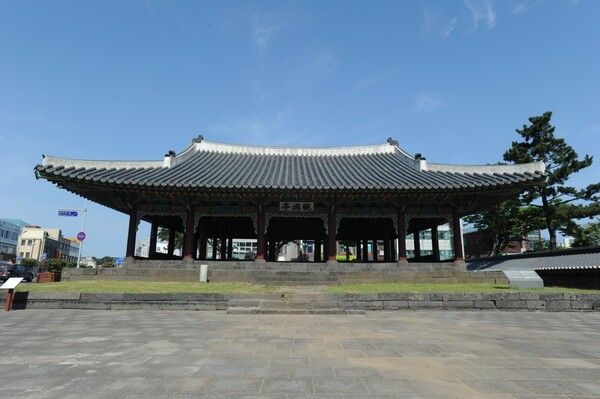
[News Culture] Standing in the historic center of Jeju City, Gwandeokjeong has witnessed nearly six centuries of change. Built in 1448 as a military training facility during the Joseon Dynasty, the wooden pavilion later became a center of public life and a setting for some of the island's most consequential historical events. Now, 578 years after its construction, Jeju is seeking to restore the landmark's status as a National Treasure.
The effort carries an unusual historical dimension. Gwandeokjeong was designated a National Treasure in 1959 but was reclassified as a Treasure in 1963 following changes to South Korea's cultural heritage designation system. Its proposed return to the country's highest heritage classification will depend not on that earlier designation, but on a new assessment of its architectural distinction, historical importance and surviving fabric.
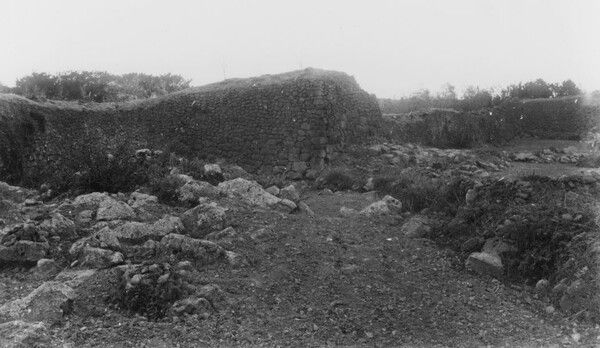
The question extends beyond the building itself. Gwandeokjeong served as a public space within the administrative center of Joseon-era Jeju, while its surrounding square later became associated with resistance, political upheaval and the violence that preceded the Jeju April 3 tragedy. Its significance lies partly in the relationship between the pavilion, the old walled city and the generations of residents who gathered there.
These issues were examined at an academic seminar held in Jeju on November 6 under the theme "Gwandeokjeong, a Square That Remembers Jeju." Organized by the Jeju provincial government, the Jeju Studies Research Center and the Jeju Journalists Association, the event brought together perspectives on architectural heritage, urban history and the preservation of collective memory.
Participants emphasized the importance of examining Gwandeokjeong in relation to Jeju's former walled administrative center rather than assessing the structure in isolation. Jeju authorities plan to begin further academic reviews with specialists in 2027, alongside discussions with local residents about the site's preservation and future use. Establishing a credible case for National Treasure status will require historical documentation, architectural comparisons and a detailed assessment of the building's condition and restoration history.
A Military Training Ground at the Heart of Old Jeju
Gwandeokjeong was constructed in 1448, the 30th year of King Sejong's reign, under the direction of Shin Suk-cheong, a senior official responsible for Jeju's administration and military affairs. Considered the oldest surviving building on the island, the single-story wooden structure measures five bays across its front and four bays in depth. Its open-sided design and extended roof eaves provided a setting suited to military training and public gatherings.
The pavilion originally formed part of a larger administrative landscape. The nearby Jejumok Gwana complex housed the offices responsible for governing Jeju, while Gwandeokjeong and its adjoining square accommodated military activities, ceremonies and public assemblies. Together, the two sites reflected the organization of political authority and civic life within the Joseon-era walled town.
Archery competitions, civil service examinations and seasonal rituals were among the activities associated with the square. It also hosted Ipchungut, a traditional ceremony marking the beginning of spring, and inspections of horses intended as tribute to the royal court. Over time, a structure built for military purposes became an important setting for the island's administrative ceremonies and communal traditions.
This combination of functions distinguishes Gwandeokjeong from historic buildings valued primarily for their architectural form. Its significance also resides in the open space before it and the surrounding streets, where public events brought officials and residents together.
The square later became a setting for some of Jeju's most painful episodes. It was associated with the Sinchuk Uprising of 1901, a period of violent conflict involving local residents, officials and Catholic communities. On March 1, 1947, police opened fire during an Independence Movement Day commemoration near Gwandeokjeong, an incident widely recognized as one of the events that contributed to the tensions preceding the Jeju April 3 Incident.
The pavilion therefore occupies an unusual position in Jeju's historical landscape. It preserves evidence of the island's early administrative and military institutions while remaining closely connected to the political conflicts and collective memories of the modern era. Any comprehensive assessment of its cultural significance must take account of both dimensions.
Why a Former National Treasure Must Qualify Again
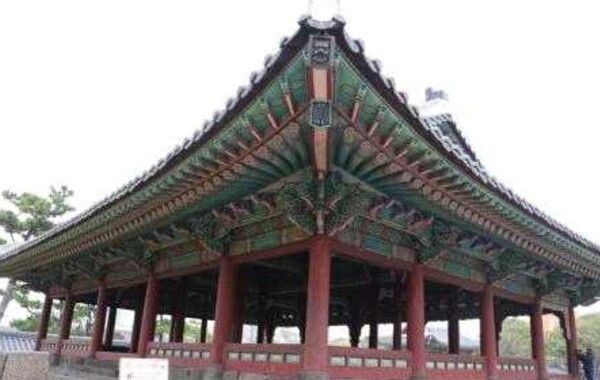
Gwandeokjeong's designation history adds another layer to the current proposal. The building was recognized as National Treasure No. 478 in 1959, before being reclassified as Treasure No. 322 on January 21, 1963, following the enactment of the Cultural Properties Protection Act in 1962 and the subsequent reorganization of the national designation system.
Although the classification changed, Gwandeokjeong retained its importance as one of Jeju's principal architectural and historical landmarks. Its earlier National Treasure status, however, does not automatically establish eligibility under contemporary designation standards.
A successful application would need to demonstrate the building's exceptional architectural and historical value in comparison with other nationally significant monuments. Researchers must examine the techniques used in its original construction, subsequent structural alterations and the extent to which its present form reflects the building erected in the 15th century.
That investigation is particularly important because Gwandeokjeong has undergone substantial changes.
In 1924, during Japanese colonial rule, sections of its extended eaves were shortened because they encroached on an adjoining road. A renovation in 1969 introduced doors around the structure, altering the open configuration that had defined its architectural character. Further repairs and restoration projects eventually brought the pavilion to its present appearance in 2006.
These interventions raise questions central to any new heritage assessment. Researchers will need to distinguish original architectural components from later modifications, evaluate documentary evidence of earlier configurations and establish how restoration work has affected the building's historical authenticity.
The challenge is not simply to determine whether Gwandeokjeong resembles its original form. It is also to understand how successive alterations reflect changing approaches to historic architecture and how much of the structure's earlier character can be substantiated through architectural research.
An examination of the pavilion's construction methods, roof structure and relationship to Jeju's local environmental conditions could provide further evidence of its distinctive qualities. Such interpretations, however, must be supported by comparative research rather than assumptions about the island's architectural traditions.
Lessons From Three Pavilions Elevated to National Treasure Status
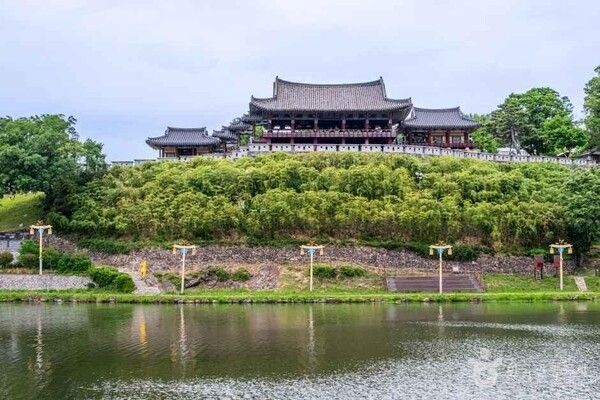
Recent National Treasure designations elsewhere in South Korea offer useful precedents for Gwandeokjeong's proposed reassessment.
Yeongnamnu Pavilion in Miryang, South Gyeongsang Province, and Jukseoru Pavilion in Samcheok, Gangwon Province, were elevated to National Treasure status in December 2023. Both had previously been designated Treasures and were subsequently recognized for their exceptional architectural and historical significance.
Gwanghallu Pavilion in Namwon, North Jeolla Province, followed in July 2026, gaining National Treasure status 63 years after its original Treasure designation.
Gwanghallu's designation process is particularly relevant to Jeju. A proposal to elevate the pavilion's status was deferred in 2023 because the available research had not sufficiently established aspects of its construction chronology and architectural style. Additional investigation eventually provided the supporting evidence required for designation.
The case illustrates the distinction between a monument's established reputation and the level of documentation necessary to demonstrate its exceptional national significance. Historical longevity, local importance and architectural distinction may all contribute to an application, but they must be supported by rigorous research.
For Gwandeokjeong, this means identifying features that distinguish it from comparable historic pavilions and establishing their significance within the development of Korean architecture. Its original function as a military training facility, open structural arrangement and position within Jeju's former administrative center will be important subjects for investigation.
The influence of Jeju's natural environment may also warrant closer examination. Researchers could consider whether the island's wind conditions, climate and available building materials contributed to architectural decisions that distinguish Gwandeokjeong from similar structures on the mainland. Such possibilities remain subjects for scholarly assessment rather than established grounds for designation.
Jeju has previously encountered the difficulties involved in securing National Treasure recognition. The provincial government sought to elevate Tamna Sunryeokdo, an illustrated record of Jeju during the Joseon Dynasty, but the proposal was rejected in 2022 after the Cultural Heritage Committee determined that the work had not met the required criteria.
That outcome demonstrated that the historical importance of a regional cultural asset and its eligibility for National Treasure status are separate questions. Gwandeokjeong's application will likewise require evidence capable of supporting a national-level assessment.
Jeju's First National Treasure and the Preservation of Collective Memory
Jeju remains the only one of South Korea's 17 first-tier administrative regions without a designated National Treasure. Gwandeokjeong's proposed elevation therefore carries symbolic significance beyond the recognition of a single historic building.
Yet the absence of a National Treasure should not be treated as a measure of Jeju's cultural importance. The more substantial opportunity lies in documenting the island's distinctive architectural heritage and strengthening the research, conservation and public interpretation of places that have shaped its history.
For Gwandeokjeong, conservation questions are inseparable from the way the site continues to function within Jeju City. Having served as a gathering place for centuries, the pavilion and its surrounding square remain part of a historic urban environment rather than an isolated monument.
Future planning could examine ways to connect Gwandeokjeong with the Jejumok Gwana complex and surrounding neighborhoods through heritage interpretation, historical education and cultural programs. Such initiatives would need to respect conservation requirements while allowing residents and visitors to engage with the different periods of history represented at the site.
Jeju authorities intend to pursue academic reviews in 2027 and consult local communities on potential uses of Gwandeokjeong following any change in its designation. Kim Tae-gon, a cultural heritage official with Jeju's World Heritage Headquarters, has emphasized the need to substantiate the building's distinctive architectural qualities and historical significance while building public understanding of the proposal.
The process will require more than assembling evidence of the pavilion's age or recovering its former classification. Architectural investigations must be considered alongside historical records and the broader urban setting, including the square's role in the island's political, social and cultural history.
Since its construction in 1448, Gwandeokjeong has been a military training ground, a place of civic assembly and a witness to events that profoundly shaped modern Jeju. Its wooden structure and surrounding public space preserve different dimensions of that history, from the administrative practices of the Joseon Dynasty to the experiences of communities affected by conflict and political violence.
The effort to restore National Treasure status is therefore also an opportunity to reconsider how Jeju's history should be researched, preserved and presented to future generations.
Whether Gwandeokjeong ultimately receives the designation will depend on the strength of the evidence assembled in the coming reviews. Regardless of the outcome, the renewed investigation could provide a more comprehensive understanding of one of Jeju's most enduring historical landmarks and its place in the island's collective memory.
Reported by News Culture M.J._mj94070777@nc.press
Copyright ⓒ 뉴스컬처 무단 전재 및 재배포 금지


