
[News Culture] Plant-based burgers have become a familiar option for consumers looking to eat less meat. Made primarily from ingredients such as soy, peas and wheat protein, they promise the taste and texture of conventional meat while appealing to people concerned about health, animal welfare and the environment.
Yet replacing beef with a plant-based patty doesn't necessarily mean cutting back on sodium or saturated fat.
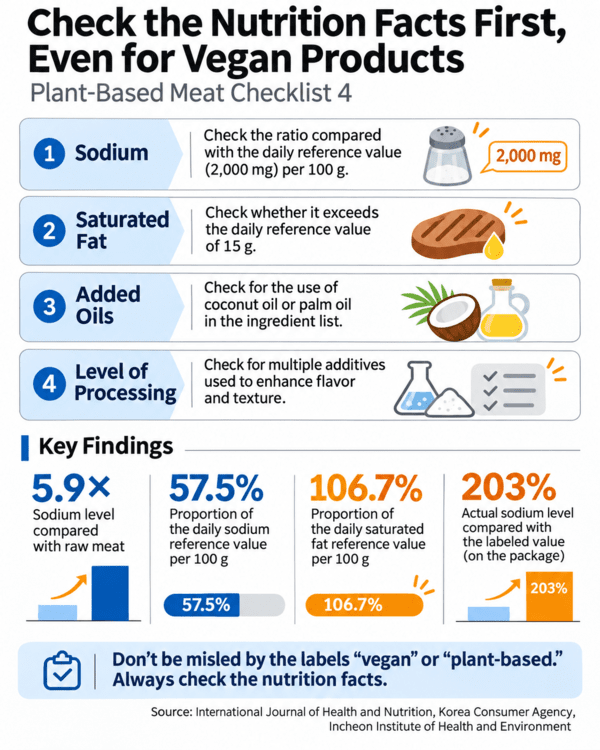
Research published in 2026 found that plant-based meat alternatives sold in Australia contained nearly six times as much sodium as unprocessed meat. Consumer testing in South Korea has also identified products with enough saturated fat to exceed the daily reference value in a 100g portion.
The findings don't suggest that plant-based meat is inherently unhealthy. They reveal considerable nutritional differences among products that share the same meat-free label.
Nearly Six Times the Sodium of Unprocessed Meat
A 2026 Australian study examined the nutritional composition of 1,515 plant-based meat alternatives alongside 246 unprocessed meat products, 104 processed meat products and 11 traditional plant protein foods.
The plant-based alternatives contained an average of 563.7mg of sodium per 100g, compared with 95.1mg in unprocessed meat. That's approximately 5.9 times as much. Added salt was present in 95% of the plant-based products.
Manufacturers use salt and other ingredients to help reproduce the savory flavor and familiar eating experience of meat. But those additions can produce nutritional profiles quite different from the original ingredients.
The Australian findings also require context. While plant-based alternatives contained substantially more sodium than unprocessed meat, they had less sodium, on average, than processed meat products. They also generally contained less saturated fat than unprocessed meat.
The problem, in other words, isn't that every plant-based product is nutritionally inferior. It's that replacing one type of meat with another food can involve trade-offs that aren't immediately apparent.
South Korean consumer testing provides a closer look at the differences between individual products.
In a 2022 assessment of 15 commercially available plant-based meat alternatives, the Korea Consumer Agency found sodium concentrations as high as 1,150mg per 100g.
That amount represents 57.5% of South Korea's daily sodium reference value of 2,000mg. Three products contained between 715mg and 1,150mg per 100g, prompting recommendations to reduce their sodium content.
Label accuracy has also emerged as a concern.
In June 2025, the Incheon Metropolitan Government reported the results of testing 35 foods marketed as vegan. Two contained sodium levels equivalent to 203% and 135% of their declared amounts, respectively. A separate product contained only 48% of its labeled protein content.
Regulatory action followed the labeling violations, highlighting the importance of reliable nutrition information for consumers making dietary choices.
Why Plant-Based Burgers Can Still Be High in Saturated Fat
Salt isn't the only ingredient worth watching.
To mimic the juiciness and mouthfeel of beef, some manufacturers incorporate coconut oil, palm oil or other plant-based fats into their products.
Coconut oil is particularly useful in meat alternatives because it remains relatively firm at room temperature and softens when heated. But unlike many other vegetable oils, it consists predominantly of saturated fatty acids.
That distinction matters for consumers who assume that fat derived from plants must be low in saturated fat.
The Korea Consumer Agency's 2022 testing found that four of the 15 products contained between 6g and 16g of saturated fat per 100g. At the upper end, a 100g serving exceeded South Korea's daily saturated fat reference value of 15g.
Most of the products performed considerably better. Ten contained just 1–3g of saturated fat per 100g, demonstrating that the nutritional differences were largely product-specific.
Those differences are also evident in the American market.
According to their published U.S. nutrition information, Impossible Beef contains 6g of saturated fat in a 113g serving, while the avocado-oil-based Beyond Burger contains 2g in an equivalent serving.
Impossible Beef uses coconut and sunflower oils, while Beyond Meat's newer burger formulation uses avocado oil. The products deliver comparable amounts of protein, but their saturated fat levels differ threefold.
The comparison illustrates how ingredient selection and reformulation can alter a meat alternative's nutritional profile. A product's plant-based status alone offers little indication of its saturated fat content.
It also explains why older comparisons may no longer reflect products currently on sale. Recipes and nutritional information can change as manufacturers develop new formulations.

Choosing Plant-Based Foods Beyond the Marketing Claims
There are nutritional advantages to plant-based meat alternatives, and they shouldn't be overlooked.
The Korea Consumer Agency found that the 15 products it tested contained no detectable cholesterol and provided an average of 17g of protein per 100g. The Australian study also found that plant-based alternatives generally contained more dietary fiber than processed meat.
But these benefits don't make every product an equally suitable choice for someone managing blood pressure, cholesterol or overall dietary quality.
For consumers concerned about sodium, comparing the amount per 100g can reveal substantial differences between similar products. Those monitoring saturated fat should examine both the nutrition panel and the types of oils listed among the ingredients.
Serving size also matters. Sauces, seasonings and other accompaniments can increase the sodium content of a meal that already contains a heavily seasoned plant-based patty.
Nor should packaged meat substitutes be confused with plant-based eating as a whole. Beans, lentils, tofu and other minimally processed plant proteins offer different nutritional profiles and can provide alternatives without necessarily relying on products designed to imitate meat.
The distinction is important for consumers making changes to their diets for health reasons.
Plant-based meat can be a useful substitute for conventional meat, but its nutritional value depends on the ingredients and the finished product—not simply the absence of animal meat.
Reported by News Culture M.J._mj94070777@nc.press
Copyright ⓒ 뉴스컬처 무단 전재 및 재배포 금지


