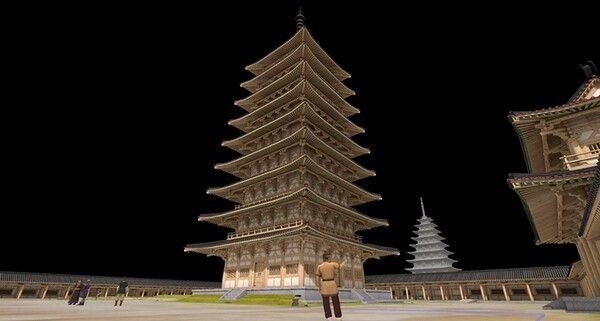
[News Culture] Visitors to the ruins of Mireuksa Temple in Iksan can now see a digital reconstruction of what was once the largest Buddhist temple complex in the Baekje Kingdom. A nine-story wooden pagoda, monumental gates and connecting corridors appear over the surviving archaeological remains through an outdoor extended reality (XR) experience, offering a new way to explore the architecture of the seventh-century temple.
The Korea Heritage Service and the National Research Institute of Cultural Heritage unveiled the technology on November 6 at the Mireuksa Temple Site in North Jeolla Province. The project, titled Baekje's Aspiration – Mireuksa 639, uses head-mounted displays (HMDs) to place digitally reconstructed buildings within the landscape where they originally stood.
A public demonstration was scheduled to begin at 1 p.m., followed by an introduction for invited guests and journalists. Free sessions for general visitors were arranged from 3:30 p.m., allowing participants to experience the reconstructed temple while walking through the archaeological site.
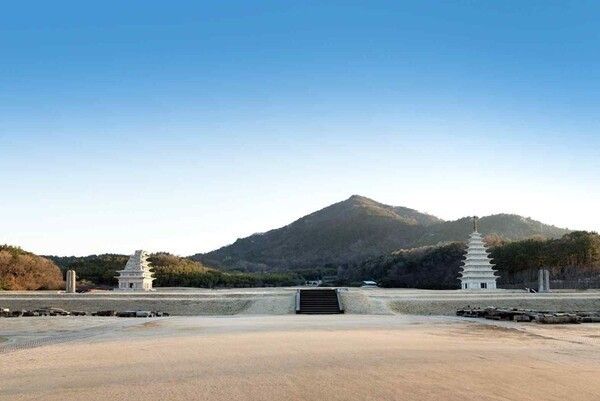
Mireuksa was established during the reign of King Mu of Baekje (600–641) on the southern slopes of Mireuksan Mountain. The complex was distinguished by an unusual arrangement of three pagodas and three main worship halls, with separate structures occupying the eastern, central and western sections of the grounds.
Although most of the original buildings have disappeared, the surviving stone pagoda, stone flagpole supports and excavated foundations provide evidence of the temple's former scale. The Mireuksa Temple Site is also part of the Baekje Historic Areas, which were inscribed on the UNESCO World Heritage List in 2015.
Reconstructing a Temple Through Archaeological Evidence
The number 639 in the project's title refers to the year recorded on a gold inscription plate discovered during the dismantling and restoration of Mireuksa's western stone pagoda in 2009.
The artifact, known as the Gold Plate with Inscription of Sarira Enshrinement, documents the enshrinement of Buddhist relics in 639 and provides important information about the temple's royal patrons and religious purpose.
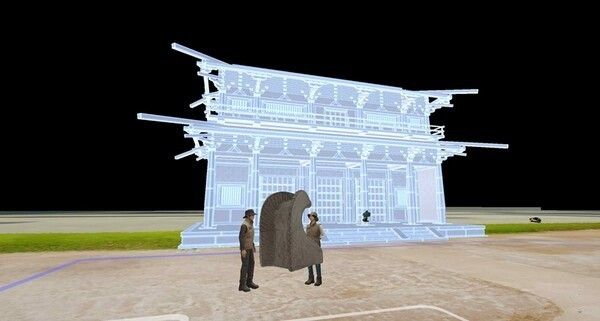
That archaeological evidence forms part of the historical foundation for the XR reconstruction. The new experience recreates architectural features that can no longer be seen at the site, including the central nine-story wooden pagoda, the main entrance gate and the corridors connecting the temple's principal buildings.
Visitors wearing the headsets can examine the reconstructed pagoda at its intended scale and move through the grounds to understand how the different structures were arranged. Artifacts excavated from Mireuksa are also digitally reproduced at their original dimensions, accompanied by explanations of the evidence used to reconstruct the buildings.
Rather than presenting the temple as an isolated computer-generated model, the system places the reconstructed architecture directly over the existing archaeological landscape.
The experience uses passthrough technology, which displays the surrounding environment through cameras mounted on the headset. Digital structures are then superimposed on that live view, enabling visitors to see the surviving ruins and the reconstructed buildings together.
A spatial alignment system positions the virtual architecture according to the actual locations of the ancient structures without requiring separate external tracking devices or sensors. The images adjust as visitors turn their heads or walk through the site, maintaining the relationship between the digital reconstruction and the physical surroundings.
The technology also accounts for changes in environmental lighting and shadows, helping the reconstructed buildings appear consistent with conditions at the site.
A Shared Experience Across the Temple Grounds
The XR program includes a virtual guide that introduces the temple's architectural features, historical background and religious significance. The character also directs visitors toward the next point of interest, allowing them to follow the experience without a separate human guide.
Multiple participants can access the content simultaneously. Families and groups can therefore explore the same reconstructed environment while wearing individual headsets, with the system synchronizing their experiences across the site.
Satellite-based network connectivity supports communication between devices and the synchronization of digital content.
The new program builds on an earlier augmented reality (AR) service introduced in 2024 by the National Research Institute of Cultural Heritage and the Iksan city government.
That service allowed visitors to view reconstructed temple buildings through tablets by scanning QR codes installed at designated locations. The new XR system moves beyond fixed viewing points, enabling participants to walk through the archaeological grounds while the digital environment responds to their movements.
The approach also differs from conventional immersive heritage displays, which are generally installed inside museums or exhibition halls. By applying the technology outdoors, the project allows visitors to encounter the reconstructed architecture in direct relation to its original geographical and archaeological setting.
The November 6 demonstration included six free public sessions, scheduled at 20-minute intervals beginning at 3:30 p.m. Each experience was designed to last approximately 30 minutes, with registration available on-site on a first-come, first-served basis.
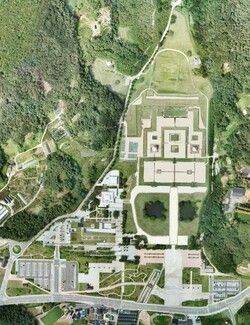
The project illustrates how digital reconstruction can expand access to archaeological sites where the original architecture has largely disappeared. Instead of relying solely on foundation stones, explanatory panels or drawings, visitors can examine the spatial relationships between buildings and experience the scale of structures that once dominated the temple grounds.
At Mireuksa, the technology makes it possible to study a vanished architectural complex without physically rebuilding it. The surviving ruins remain intact, while the digital reconstruction provides an additional means of interpreting the temple's history.
The Korea Heritage Service and the National Research Institute of Cultural Heritage plan to refine the experience based on feedback collected during the demonstration. Working with the Iksan city government, they aim to begin regular operation in the first half of 2027.
The initiative offers a new model for interpreting ancient architectural heritage, connecting archaeological research with an experience that allows visitors to explore the past at the very place where it once stood.
Reported by News Culture M.J._mj94070777@nc.press
Copyright ⓒ 뉴스컬처 무단 전재 및 재배포 금지


