[News Culture] In September 1897, as King Gojong prepared to declare himself emperor, craftsmen completed a new state seal intended to give official authority to imperial decrees. It was finished on September 19, just 23 days before Gojong's enthronement ceremony at Hwangudan Altar in Seoul.
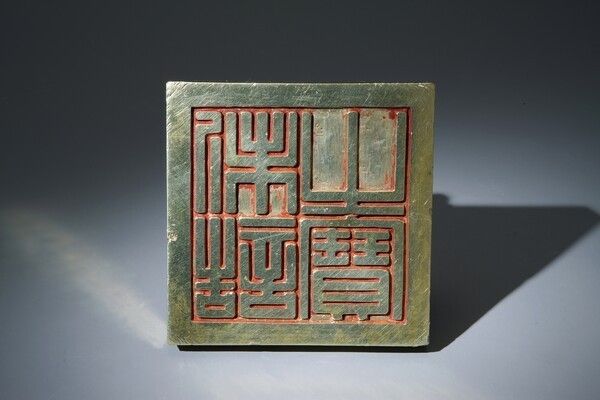
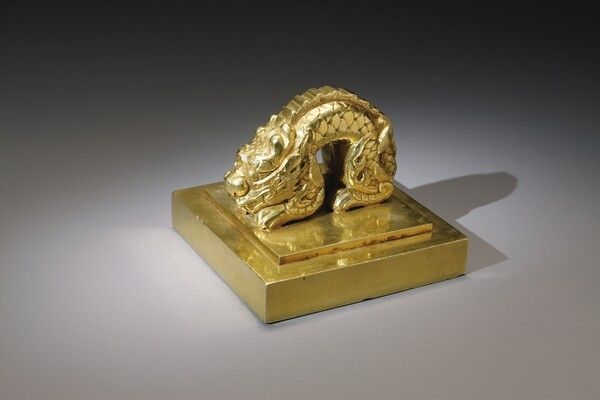
The seal marked a change in Korea's political order. On its square base, measuring 11.1 centimeters on each side, stood a sculpted dragon holding a flaming pearl in its mouth. Four Chinese characters engraved beneath it read Jegojibo (制誥之寶), identifying it as a seal for imperial decrees.
The artifact was more than a ceremonial expression of royal prestige. It served a practical function in the administration of the Korean Empire, particularly in authorizing appointments to senior government positions. Its form, inscriptions and documented history provide evidence of Gojong's efforts to establish the institutions of an independent imperial state.
One of ten state seals produced for the founding of the Korean Empire, the Jegojibo later became a witness to the country's loss of sovereignty. Taken to Japan following the annexation of Korea in 1910, it was returned after liberation, disappeared during the Korean War and resurfaced in 1954.
Now preserved by the National Museum of Korea, the seal was designated a Treasure in August 2021, recognizing both its historical significance and its craftsmanship.
A New Seal for a New Imperial State
On October 12, 1897, Gojong formally assumed the title of emperor at Hwangudan Altar and proclaimed the establishment of the Korean Empire, or Daehan Jeguk. The declaration asserted Korea's sovereign status and marked a departure from its longstanding diplomatic relationship with Qing China, in which Korean rulers had traditionally held the title of king.
The new empire adopted the era name Gwangmu and introduced changes to official titles, court ceremonies, administrative procedures and symbols of state authority.
Imperial seals formed part of that institutional transformation.
Between September 17 and 19, 1897, ten new state seals were completed for different imperial functions. They included the Daehan Guksae, Hwangje Jisae, Hwangje Jibo, Chingmyeong Jibo and Jegojibo.
Each carried a distinct inscription corresponding to its intended use. Together, they established a system of documentary authority appropriate to Gojong's new imperial status.
The term jego refers to an imperial decree. The Jegojibo was used to authenticate documents issued under the emperor's authority, including appointments of high-ranking officials.
This distinguished it from royal ceremonial seals, known as eobo, which were often produced to commemorate royal titles, honor members of the ruling family or recognize achievements after death.
The Jegojibo was an instrument of government. Its impression on a document confirmed the authority behind an official decision, making the seal an essential part of the empire's administrative machinery.
Why the Turtle Gave Way to a Dragon
The Jegojibo also reveals how Gojong's new status transformed the visual language of state authority.
Earlier Joseon seals commonly featured turtle-shaped handles, reflecting conventions associated with kingship. The Daegunjubo, produced in 1882, followed that tradition.
The Jegojibo instead features a dragon, an established symbol of imperial authority in East Asian political culture.
The creature rises from a platform above the seal's square body, its back curving into a pronounced arch. Scales cover its surface, while antler-like horns extend from its head. Small dotted patterns decorate its crown, and stylized auspicious motifs appear around its nose and mouth.
Two prominent teeth project from its open jaws, which hold a flaming pearl. Additional ornamentation surrounds the mouth, emphasizing the dragon's association with power and auspiciousness.
A hole beneath the creature's body once accommodated a decorative cord attached to the seal. The cord itself has not survived.
The changes extended beyond the sculpted handle.
The seal's square face was approximately two centimeters wider than those of earlier Joseon royal seals. Its inscription also adopted a different calligraphic style.
Previous seals frequently used gucheopjeon, a highly elaborate form of seal script characterized by repeatedly folded and angular strokes. The Jegojibo employed sojeon, or small seal script, with comparatively slender, regular lines.
These differences in size, lettering and decoration were deliberate expressions of the changing status of the Korean monarchy. The new imperial identity was communicated through objects used in government as well as through formal ceremonies.
The Craftsmen Behind the Emperor's Seal
The Jegojibo was produced under the direction of Jeon Heung-gil, one of the leading specialists in royal seal manufacture during the late Joseon period.
Jeon worked on precious-metal royal seals for 47 years, from 1851 to 1897. He belonged to a family that maintained specialized knowledge of seal production across generations, alongside craftsmen including Jeon Su-myeong, Jeon Eok-man and Jeon Il-man.
Such artisans were known as bojang, craftsmen responsible for producing seals used by the royal household and the state.
The seal's production can be traced through the Daerye Uigwe, the official illustrated records compiled in connection with Gojong's imperial enthronement in 1897.
A special office was established to oversee the production of imperial seals and ceremonial documents. Sim Sun-taek served as its senior supervising official, while Min Byeong-seok was responsible for the seal-script calligraphy used in the inscriptions.
Craftsmen specializing in different stages of production worked under this administrative structure.
The Daerye Uigwe records the types and quantities of seals commissioned, along with their materials, forms and inscriptions. Another historical compilation, Boin Busin Chongsu, preserves illustrations, measurements and weights of official seals.
These documents allow researchers to compare the surviving artifact with contemporary records of its manufacture.
The Jegojibo is therefore significant not only as a product of skilled metalworking but also as an example of how the Korean imperial government organized the creation of its official symbols.
Its physical characteristics can be examined alongside written evidence identifying the officials, calligraphers and craftsmen involved in its production.
Taken to Japan, Lost During War, Found in a Safe
The Jegojibo's later history reflects the political upheavals that followed the establishment of the Korean Empire.
After Japan annexed Korea in 1910, imperial state seals were confiscated. In March 1911, the Jegojibo was transferred to Japan's Imperial Household Ministry along with other seals, including the Chingmyeongjibo and Daewonsubo.
Objects that had once authenticated the authority of Korea's emperor were now held by institutions associated with the Japanese imperial household.
The seals remained in Japan until after Korea's liberation in 1945.
On August 15, 1946, the United States military government recovered six Korean imperial seals from Japan and transferred them to the Korean authorities responsible for their custody.
They were publicly displayed in a special exhibition organized by the Office of Government Administration in 1949. Their whereabouts subsequently became uncertain during the Korean War.
Three of the seals resurfaced in 1954.
The Jegojibo, Chingmyeongjibo and Daewonsubo were discovered inside a safe at the South Gyeongsang provincial government offices, then located in Busan. The precise circumstances under which they had been placed there during the war remain unknown.
On June 28, 1954, the three seals were transferred to the National Museum.
The Jegojibo is now catalogued under accession number Sinsu 239 in the National Museum of Korea's collection.
Its designation as a Treasure on August 24, 2021, acknowledged its historical importance, artistic qualities and significance as cultural heritage recovered after removal from Korea.
The seal embodies several distinct chapters of Korean history. It was created as Gojong prepared to establish the Korean Empire, used to authenticate imperial authority, removed following the loss of national sovereignty and eventually recovered after years of uncertainty.
Its dragon-shaped handle and carefully engraved inscription preserve the political aspirations of 1897, while the circumstances of its return and rediscovery reflect the turbulent decades that followed.
The Jegojibo remains both an official instrument of a short-lived empire and a material record of Korea's struggle to preserve its historical heritage through annexation, liberation and war.
Reported by News Culture M.J._mj94070777@nc.press
Copyright ⓒ 뉴스컬처 무단 전재 및 재배포 금지


