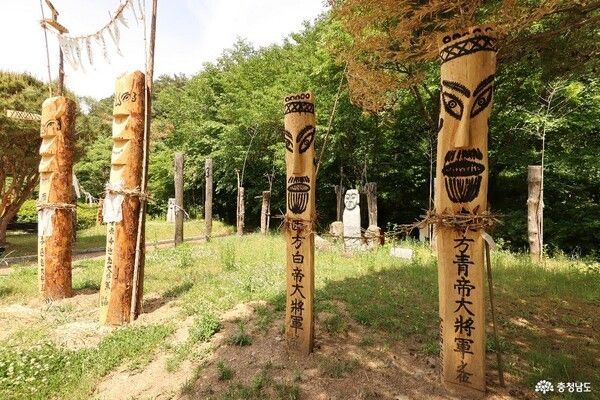
[News Culture] For generations, jangseung stood at the entrances to Korean villages, marking the boundary between the familiar world within and whatever might lie beyond it. Carved from wood or stone, they were more than roadside figures: villagers treated them as guardians, placing rice cakes and alcohol before them while praying for healthy families, abundant harvests and an uneventful year. The belief that jangseung could block harmful forces and protect a settlement helped make them an important part of communal religious life.
The folktale “The Jangseung and Misfortune” grows out of that world of belief. It follows two men whose treatment of a fallen jangseung could hardly be more different: a traveler who treats it as little more than a convenient piece of timber and a scholar who restores it with care. Yet the story does not unfold as a simple lesson in reward and punishment, and much of its humor comes from the way good intentions, bad luck and divine repayment become entangled.
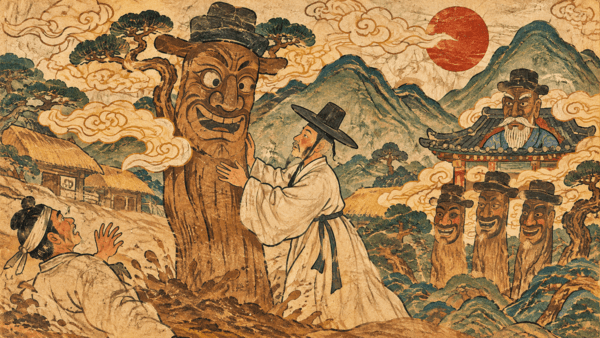
The trouble begins on a muddy road, where a traveler becomes irritated by the difficulty of crossing the path. Rather than find another way around, he pulls a nearby jangseung from the ground, lays it across the mud and walks over it as if it were a plank, then continues on without putting it back. For the village that had erected the jangseung, however, the act would have carried a meaning far beyond damage to a wooden carving, because the traveler had reduced a sacred guardian to a tool for his own convenience.
That distinction between an ordinary object and a sacred presence lies at the center of jangseung belief. A jangseung might physically be made of wood, but once it stood at the village boundary and became part of communal ritual, it occupied a different place in local life. Damaging or humiliating it could therefore be understood not merely as disrespect toward an object, but as an affront to the shared beliefs and order that surrounded it.
Later, a scholar traveling along the same road finds the jangseung lying in the mud. Without worrying about dirtying his clothes, he lifts it upright, wipes its face clean, makes a proper support and restores it to its original place before moving on. No one is there to praise him and he expects no reward; he simply treats the fallen guardian as something that should not have been left in such a state.
The contrast between the two men is clear, but the story becomes far less predictable once the jangseung decides to respond. Furious at the traveler who humiliated it, the guardian heads to Heukseok-dong in Gwacheon, which the folktale imagines as a kind of headquarters for jangseung, and brings its complaint before a senior figure known as the daebang. The premise is deliberately comic, turning village guardian spirits into an organized body with a hierarchy, a chain of command and even a place to take grievances.
After hearing the complaint, the daebang considers punishing the traveler but decides that the man is so unruly that even serious misfortune might fail to teach him anything. Instead, he orders that bad luck be sent to the scholar, the very person who helped the jangseung, so that the scholar can undergo an act of aekttaem and later prepare ritual food and pray before the guardian. The decision immediately overturns the moral outcome listeners might expect.
The traveler who behaved badly escapes untouched, while the scholar who did the right thing is suddenly struck by pain and hardship. That reversal is part of the tale’s humor, but it also draws on the older folk concept of aekttaem, the belief that misfortune might sometimes be met in advance, diverted or weakened so that a greater calamity could be avoided. In that context, bad luck is not always something that simply arrives without meaning; it can become something to be negotiated through ritual.
The scholar eventually prepares offerings and prays before the jangseung, attempting to drive away the calamity that has fallen upon him. His actions are not framed as a legal correction of some wrongdoing, but as a ritual effort to restore balance between a human being and the sacred force caught up in his suffering. The episode reflects a world in which misfortune could be understood not only as chance, but as something connected to ritual relationships and spiritual order.
The jangseung, meanwhile, begins to feel guilty. The man who showed it respect is now suffering because of a punishment devised in its name, so it returns to the daebang and asks that the scholar and his family instead be granted great fortune. The request is accepted, the household begins to prosper, and the family becomes even more devoted to honoring the jangseung.
In this way, the story eventually returns to the familiar logic of repayment, though by a much more circuitous route than a straightforward moral tale would allow. Kindness is remembered, a favor creates an obligation and even a sacred guardian is expected to recognize a debt. The relationship between villagers and jangseung is therefore imagined not as entirely one-sided, but as something sustained through offerings, respect, protection and reciprocal care.
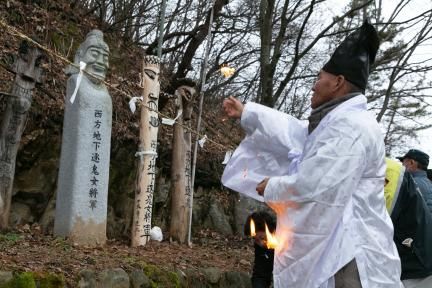
The jangseung’s role in village life can still be traced through surviving rituals. In Soraesil Village in Songhak-ri, Tancheon-myeon, Gongju, residents have long held a jangseungje to pray for the community’s peace and well-being, and the practice has also been known locally as jangseungchigi. It developed not only as a religious ceremony but as an event in which the village gathered and participated together, combining prayer, ritual and communal festivity.
At Anseom in Dangjin, jangseung also form part of the local dangje, or village shrine ritual. Before the ceremony, three male-female pairs, six jangseung in all, are erected, and after the main shrine rite come ceremonies for the jangseung and the Dragon King, followed by jisinbalgi, in which performers move through the village invoking blessings for the land and its households. Once the formal rites are over, a percussion troupe visits homes one by one, carrying prayers for good fortune through the community.
Such practices help explain why jangseung cannot be understood only as unusual carvings placed beside a road. They stood where the village met the outside world and gave that boundary spiritual meaning, gathering around them hopes for healthy families, productive fields, safe fishing and protection from calamity. At the same time, the rituals surrounding them brought residents together and reinforced a shared sense of belonging.
“The Jangseung and Misfortune” turns that religious background into comedy by giving the supernatural world a structure that looks suspiciously like the human one. There are senior officials, complaints, questionable decisions and attempts to repair the consequences afterward, while the jangseung itself becomes angry, feels gratitude, makes a mistake and then tries to make amends. Sacred beings remain powerful, but they are also brought closer to everyday experience through emotions and social behavior that listeners would immediately recognize.
This is one reason the folktale works as more than a simple lesson in good and evil. The rude traveler avoids immediate punishment, the considerate scholar suffers before he is rewarded, and the jangseung itself fails to foresee what its complaint will cause. Yet the story eventually circles back to the idea that kindness creates a debt worth remembering and that respect for the sacred is bound up with the way people treat one another.
Jangseung are no longer as common at village entrances as they once were, but their image remains one of the most recognizable symbols of Korean folk culture. “The Jangseung and Misfortune” preserves more than the memory of a wooden guardian; through its comic mixture of sacred beings, bad luck, ritual and repayment, it records the way village communities imagined protection as a relationship that had to be maintained rather than a force that simply existed on its own.
For generations, people placed food and drink before these guardians and asked for the same things communities have always wanted: that their families remain healthy, their livelihoods hold and no great harm cross the village boundary.
Reported by News Culture M.J._mj94070777@nc.press
Copyright ⓒ 뉴스컬처 무단 전재 및 재배포 금지


