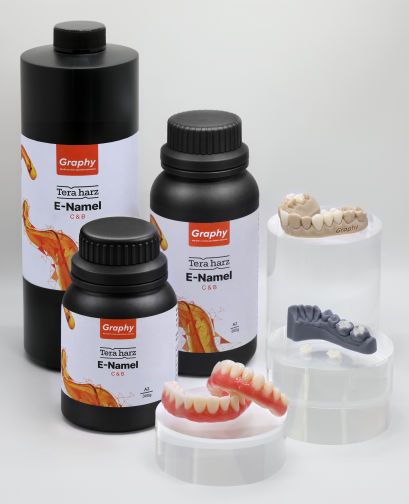
The company plans to position its aesthetic restorative material, Tera Harz E-Namel, as a key pillar of future growth. Overseas, Graphy is preparing to establish a company-operated production lab in Brazil while conducting product validation with U.S. partners ahead of Food and Drug Administration (FDA) clearance, laying the groundwork for expansion across the Americas.
|
◇Local Production in Brazil to Support Expansion Across the Americas
Graphy is pursuing local production in Brazil to reduce tariffs and logistics costs, the company said Oct. 21.
The company concluded that exporting finished products from South Korea would make it difficult to maintain competitive pricing in Brazil. Rather than relying solely on local distributors, Graphy plans to operate its own production facility.
Graphy has already completed registration with Brazil's National Health Surveillance Agency (ANVISA) for five dental 3D-printing resins used in shape-memory aligners and permanent dental crowns.
Building on those approvals, the company plans to establish a production lab that will receive patients' intraoral scan data from local dental clinics, develop orthodontic treatment plans, and manufacture and supply aligners.
"Brazil has high tariff barriers, making it difficult to establish a competitive position through exports alone," said Un-seob Sim, chairman of Graphy Group. "Instead of signing a local distribution agreement, we plan to operate our own production lab."
Preparations for the facility are advancing.
"We have completed our search for potential locations and are selecting personnel to work locally," Sim said. "We are now preparing for recruitment and a site contract."
The Brazilian operation is expected to serve not only the domestic market but also provide treatment planning and customer support services across the Americas.
Developing orthodontic treatment plans based on patient scan data requires real-time communication with dental professionals. However, the time difference between South Korea and the Americas makes it difficult to provide immediate support from the company's headquarters.
"Brazil will be an important base for targeting the South American market while also providing real-time support to customers in North America," Sim said. "It will also offer cost advantages compared with maintaining all treatment planning and support personnel in the United States."
In the United States, Graphy is pursuing the FDA's 510(k) clearance process for Tera Harz E-Namel while conducting preliminary product evaluations with local partners.
Tera Harz E-Namel is a 3D-printable aesthetic restorative material designed for dental crowns, bridges and implant-supported crowns.
"Our partners cannot purchase the product yet because FDA clearance has not been completed," Sim said. "However, they are evaluating its performance and practical usability ahead of clearance. The response so far has been very positive."
◇Challenging Conventional Zirconia Restorations With 3D Printing
Graphy aims to diversify its business beyond clear aligners by expanding into dental restorative materials through Tera Harz E-Namel.
Conventional zirconia restorations are typically produced by milling solid blocks or discs into the desired tooth shape, followed by high-temperature sintering to achieve the required strength and durability.
Graphy's approach, by contrast, uses liquid resin to directly 3D-print restorations based on patients' digital oral scans. The process could reduce material waste and eliminate several manufacturing steps, according to the company.
Sim said the dental restorative materials business could eventually generate more revenue than Graphy's flagship shape-memory aligners.
"Dental restorations could actually become a bigger business than SMA," he said. "Orthodontic treatment typically takes one to two years to produce results, while restorative treatment can deliver results within months. The restorative market is also less seasonal than orthodontics."
The success of Graphy's expansion, however, will depend on how quickly dental clinics and laboratories adopt new manufacturing methods.
Zirconia is already widely established in dental practices, meaning 3D-printed materials will need to demonstrate comparable performance in mechanical properties, aesthetics and long-term durability through clinical validation.
Graphy plans to expand evaluations with leading dental clinicians and laboratories while combining equipment, materials and process training to encourage adoption.
"Changing the way dental restorations are manufactured could have a significant impact, but if we fail to drive that change, the opportunity could amount to little more than a flash in the pan," Sim said.
"We will expand validation with leading clinicians and dental laboratories and integrate equipment, materials and manufacturing training to establish dental restorations as Graphy's next growth engine."
Copyright ⓒ 이데일리 무단 전재 및 재배포 금지


