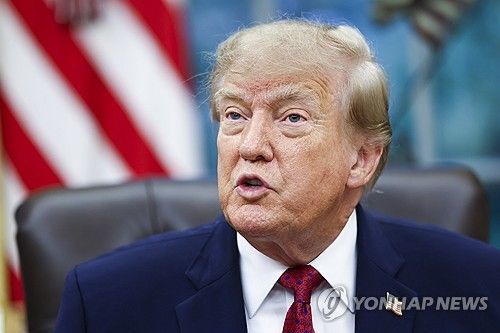
WASHINGTON, Nov 6 (Yonhap-Reuters) – U.S. President Donald Trump on Thursday threatened tariffs of “up to 300%” on foreign firms that do not build factories in the United States, signaling he will not soften his hardline trade stance despite a heavy Republican defeat in the midterm elections.
Speaking to reporters at the White House, Trump argued that high tariffs were driving a wave of foreign investment into U.S. manufacturing and warned that lifting them would abruptly halt construction of what he said were more than 3,000 factories and production facilities being built by overseas companies.
“If I eliminate tariffs right now, all of these factories will stop construction,” Trump said, adding that foreign firms were moving production to the United States largely to avoid steep border taxes. “Ninety-nine percent of it is because if they don’t, they’d have to pay 50%, 100%, 150%, or 250% tariffs,” he said. “It could be up to 300%.”
Once plants are built and operating in the United States, he said, companies would no longer face tariffs on their products and consumer prices would fall sharply. He dismissed critics calling for tariff rollbacks as “foolish people.”
Trump’s remarks broadly echoed his longstanding defense of protectionist trade measures, but drew particular attention because they came just two days after Republicans suffered a crushing loss in congressional elections, a setback many analysts linked to voter anger over high inflation exacerbated by tariffs and the war with Iran.
The comments were widely interpreted in Washington as a declaration that Trump intends to press ahead with, and potentially escalate, his tariff strategy regardless of the political costs. While a “300% tariff” is seen by many observers as characteristic Trumpian hyperbole, it was also read as a signal that substantial additional duties remain on the table.
Asked how he planned to use executive authority over the next two years and how he intended to preserve his political legacy, Trump said his administration had a series of actions in the pipeline. “We are going to do a lot of things. You’re going to see a lot of things over a week or two. We have a lot being prepared,” he said, without providing details.
Trump repeatedly argued that removing tariffs would lead foreign manufacturers to abandon projects midstream. “You’ll have half-built factories all over the country,” he said, warning that the United States would again be importing finished goods from China, Japan, South Korea and the Philippines instead of producing them domestically.
The president’s insistence on the benefits of tariffs comes amid growing concern among economists and business leaders that prolonged trade tensions and elevated duties are feeding price pressures for U.S. consumers and disrupting global supply chains.
On Iran, Trump suggested he was weighing starkly different options as he confronts Tehran over its nuclear program and regional activities. He said he faced a choice “between an agreement and an attack,” adding, “If possible, I don’t want to destroy the rest of (Iran), but we might have to.”
He asserted that Iran would not move ahead on its nuclear program without U.S. consent. “They’re not going to do anything on nuclear without our approval,” Trump said, offering no evidence for the claim.
Trump also brushed aside speculation about a shake-up in his national security team following the election setback. Asked whether Defense Secretary Pete Hegseth might be replaced, he replied, “He is doing a fantastic job,” publicly reaffirming his support.
The combination of combative rhetoric on trade and Iran and Trump’s promise of a flurry of executive actions in the coming weeks has fueled worries among critics that a weakened president could turn more aggressively to areas such as foreign policy, national security and trade, where the White House enjoys broad unilateral authority.
Analysts say that with Congress more hostile after the midterms, Trump may find it harder to advance his domestic agenda through legislation, increasing the temptation to rely on executive orders and regulatory moves that do not require congressional approval.
Diplomats and investors are now watching closely for signs of fresh tariff measures or steps that could heighten tensions with Iran, moves that could unsettle global markets already jittery over inflation and geopolitical risk.
Copyright ⓒ 뉴스로드 무단 전재 및 재배포 금지


