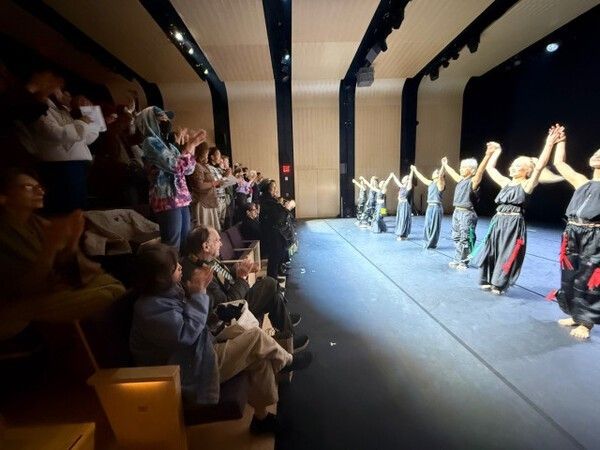
[News Culture] The dancers crouch low, their shoulders rising and falling as movements rooted in bent knees give way to rapid footwork and exaggerated gestures. Humor, tension and collective energy emerge through bodies in motion. These are elements of talchum, Korea's traditional mask dance, reworked for a contemporary stage.
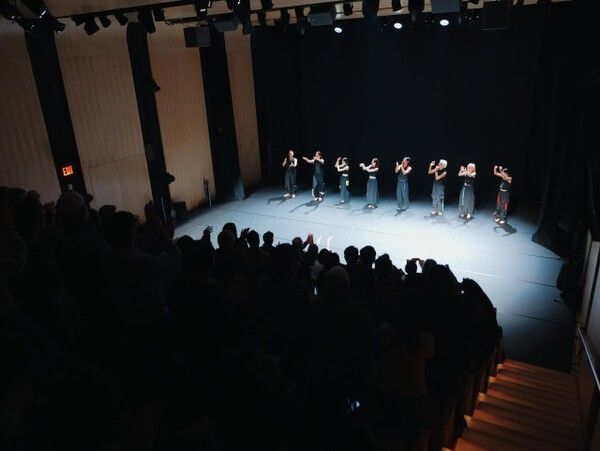
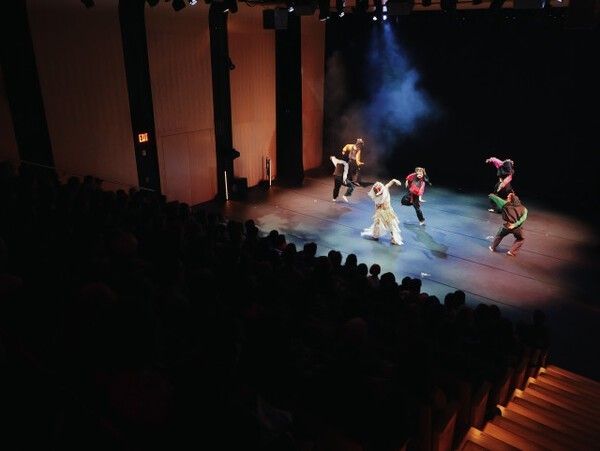
The National Dance Company of Korea brought this approach to New York with Mask Off, a contemporary dance production choreographed by company member Lee Jae-hwa. Presented at the Korean Cultural Center New York on October 31 and November 1, the two performances drew fully booked audiences and standing ovations, according to the National Theater of Korea.
The production takes the physical vocabulary of talchum, historically associated with popular entertainment and social satire, and uses it to explore identity, transformation and the relationship between individuals and groups. Rather than reproducing traditional masked dance as a historical form, Lee examines how its movement principles can generate a contemporary choreographic language.
The New York engagement formed part of the 2026 Touring K-Arts program, supported by South Korea's Ministry of Culture, Sports and Tourism and the Korean Foundation for International Cultural Exchange (KOFICE). The U.S. itinerary also included a November 4 performance at Zipper Hall at the Colburn School in Los Angeles.
Beyond the Mask, a New Language of Movement
At the center of Mask Off is the changing relationship between the face, the body and the identities people assume.
Putting on a mask conceals a familiar face while creating the possibility of another persona. It can provide freedom to express emotions or challenge established social roles. Removing it brings the performer back into contact with an identity that may have changed through the experience.
Lee develops these ideas through choreography that traces shifts in physical behavior and emotional expression before, during and after the use of a mask.
The work draws on talchum's history as a popular performance tradition in which humor, parody and physical exaggeration were used to challenge social authority. During the Joseon Dynasty, masked performers frequently ridiculed the pretensions of the upper classes and exposed contradictions within the prevailing social order.
That critical spirit informs Mask Off, although its expression is primarily physical rather than narrative.
Lee concentrates on the mechanics of traditional Korean movement: lowered centers of gravity, flexed knees, undulating breath patterns and rhythms shaped by abrupt pauses and renewed bursts of energy.
These elements are broken apart, accelerated or redirected to produce movement that shifts between individual expression and coordinated ensemble passages. The resulting choreography retains the grounded physicality of talchum while extending it through contemporary dance techniques.
The interaction between solo movement and group formations is particularly significant. Traditional masked dance developed within communal settings, where performers and spectators shared an immediate relationship. In Mask Off, that collective dimension emerges through the changing dynamics among dancers.
Movements initiated by individual performers expand into larger formations, establishing moments of connection, tension and collective momentum.
Lee's interest in the work also reflects a broader question concerning the identity of Korean dance in contemporary performance.
When introducing the production at the National Theater of Korea in May, the choreographer described a creative process shaped by the tension between preserving inherited forms and allowing them to change.
Rather than treating tradition as a fixed set of recognizable gestures, Lee approaches it as embodied knowledge that can be examined, altered and developed through present-day movement.
Geomungo, Electronic Sound and an Expanding Stage
The production's musical and visual design extends this investigation beyond choreography.
Geomungo musician Park Da-ul serves as composer and music director, combining the sound of the traditional Korean string instrument with electronic textures and contemporary band arrangements.
For the production presented at the National Theater of Korea's Daloreum Theater in June, the score incorporated geomungo and a five-piece live band. Traditional rhythmic structures interacted with amplified instruments and electronic sounds, creating contrasting musical layers that shaped the dancers' movement.
The score moves between sustained rhythmic patterns and more forceful passages, allowing changes in musical density and tempo to interact with the choreography's abrupt transitions and ensemble sequences.
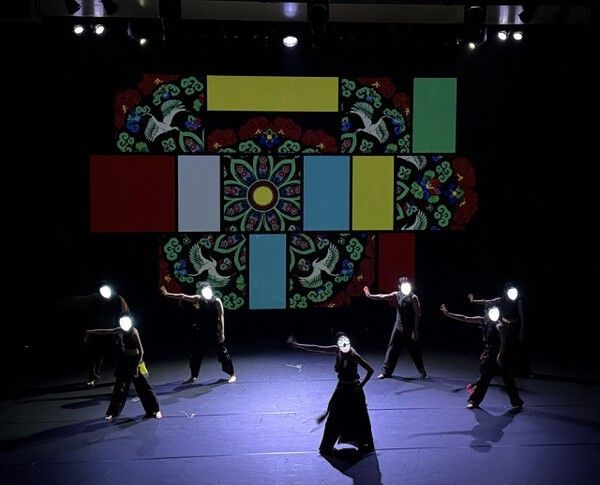
Stage designer Shin Seung-yeol developed a visual environment centered on an oversized mask-like structure.
The design enlarges the mask beyond its conventional role as a costume accessory. At different moments, the structure suggests an enclosed interior or recalls the open communal spaces in which traditional masked dance was performed.
This expansion of the mask into the surrounding stage environment reinforces the production's investigation of identity, concealment and transformation.
The creative team also includes costume designer Kim Ji-won, lighting designer Won Jae-sung, sound designer Lee Sang-hyun and video designer Lim Young-sun.
Together, the design elements place traditional movement within an environment shaped by contemporary sound, lighting and stage technology.
Mask Off has developed through several stages since its initial creation.
The work was selected as an outstanding production in the National Dance Company of Korea's 2024 Choreographer Project. It was subsequently invited to close the 44th International Modern Dance Festival (MODAFE) in 2025.
Its development continued with an expanded, hourlong production presented at Daloreum Theater from June 19 to 21, 2026. The performances brought National Dance Company members into a newly developed staging before the work was introduced to American audiences.
That progression reflects the company's efforts to develop original repertory rooted in Korean dance traditions while engaging with contemporary choreographic practice.
New York Audiences Respond to the Dancers' Physicality
The New York performances attracted representatives from several major cultural institutions, including Lincoln Center, the Metropolitan Museum of Art and New York City Center.
The Korean Cultural Center New York presented the production on October 31 at 7:30 p.m. and November 1 at 5 p.m. Both performances were offered free of charge with advance registration, and reservations filled before the events.
According to the National Theater of Korea, audience interest remained strong through the performance dates, with additional inquiries continuing after reservations had closed.
Responses from local arts professionals highlighted the dancers' technical abilities and the production's capacity to communicate without requiring detailed knowledge of Korean traditional performance.
Dance critic Carla Escoda, who attended without prior familiarity with talchum, praised the production as an accomplished work in its own right and singled out the performers' technical skill.
BJ Sung, a board member of New York City Center, identified the choreography's originality and distinctive appeal as qualities that could resonate within New York's performing arts scene.
Lee Jung-mi, director of the Korean Cultural Center New York, also pointed to the standing ovations as evidence of the audience's response to the dancers' energy and technical command.
The reception suggests an important aspect of the production's international presentation. Although the choreography originates in a culturally specific performance tradition, its principal means of communication are movement, rhythm, physical interaction and theatrical imagery.
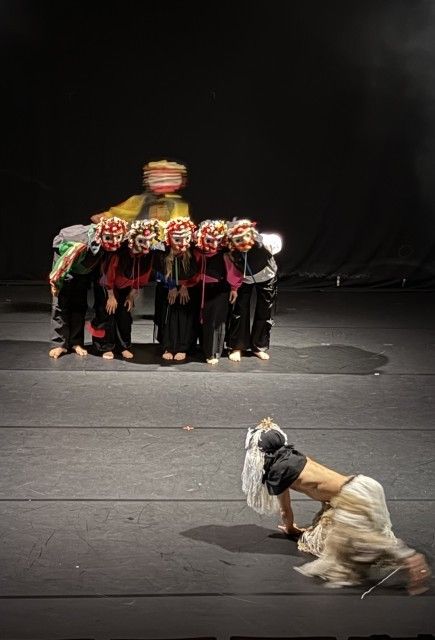
Traditional talchum frequently relies on verbal exchanges, recognizable characters and satirical situations. Audiences familiar with its historical context can identify the social relationships and targets of ridicule embedded in those performances.
Mask Off takes a different approach.
By emphasizing the physical structures underlying traditional masked dance, the work makes room for audiences unfamiliar with those references to engage with the choreography on its own terms.
Exaggerated movement, sudden changes of direction and shifting ensemble formations establish relationships that can be understood through the performance itself.
The dancers' ability to negotiate these transitions is central to the work. Its physical demands require control of grounded movement, precise timing and rapid changes in intensity, particularly as individual gestures develop into complex group sequences.
The New York response therefore offers a measure of how effectively this approach can communicate across different cultural contexts, without requiring the production to abandon its Korean choreographic foundations.
A U.S. Tour Built Around Contemporary Korean Dance
The American tour extended to Los Angeles, where Mask Off was scheduled for November 4 at Zipper Hall at the Colburn School.
Organized in cooperation with the Korean Cultural Center Los Angeles, the performance was intended to introduce West Coast audiences to a work that combines traditional Korean movement principles with contemporary choreography and stage design.
The engagement was part of a broader international presentation of Korean performing arts through the Touring K-Arts program.
Founded in 1962, the National Dance Company of Korea has developed a repertory that encompasses the preservation of traditional dance and the creation of new works. Its productions have increasingly brought Korean movement traditions into dialogue with contemporary music, theatrical design and choreographic techniques.
Mask Off represents this direction through a work developed by a dancer within the company itself.
Its progression from an internal choreographic project to a major repertory production, an international dance festival presentation and a U.S. tour illustrates how experimentation within a national performing arts institution can reach audiences beyond its original context.
The production's international significance lies not simply in presenting Korean traditional dance abroad, but in demonstrating how that tradition can function as a source of contemporary artistic development.
Lee does not attempt to preserve the recognizable appearance of talchum at every moment. Instead, the choreography examines the weight, breath, timing and expressive freedom embedded in its movements.
The mask becomes both a theatrical object and a means of questioning identity. Individual gestures develop into collective patterns, while the traditional relationship between satire and physical freedom takes on a new choreographic form.
For audiences in New York, the result was a performance grounded in Korean dance yet capable of communicating through the movement itself.
In that respect, Mask Off offers a view of Korean dance not as a fixed inheritance, but as a living practice whose physical language continues to evolve.
Reported by News Culture M.J._mj94070777@nc.press
Copyright ⓒ 뉴스컬처 무단 전재 및 재배포 금지


