[News Culture] A Joseon royal wedding robe hangs beside ceramic forms based on saekdong jackets and embroidered shoes. Elsewhere, Princess Deokhye appears on a digital screen, reconstructed through AI.
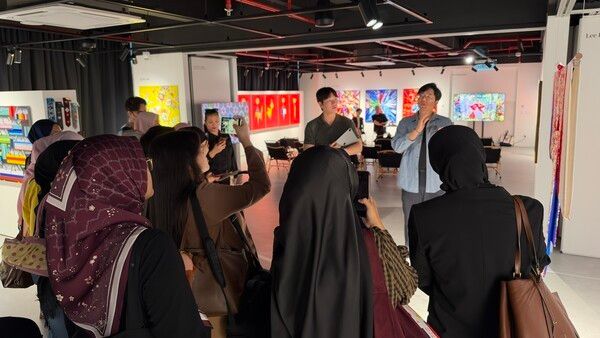
At “Hanbok, Reborn as Art” in Kuala Lumpur, hanbok is no longer treated only as clothing. Its colors, cuts, fabrics and motifs move into painting, ceramics, glass, textiles, lenticular imagery, video and artificial intelligence, becoming material for artists to examine history, memory, human relationships and technological change.
The exhibition opened Oct. 30 at the Korean Cultural Center in Malaysia as part of events marking the center’s launch. Organized by Savina Museum of Contemporary Art, it presents 46 works by 18 artists and collaborators, including Kwon Ki-soo, Kim Si-hyun, Kim Chang-kyum, Nam Kyung-min and Lee Yum. The exhibition runs through Jan. 8, 2027.
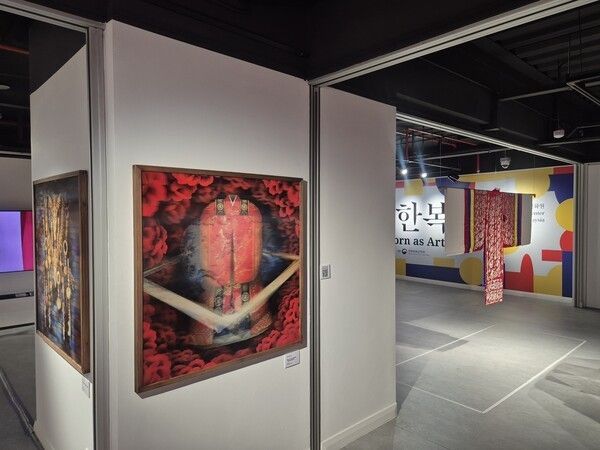
Royal Dress Rebuilt, Saekdong Recast
Lee Bong-yi’s reconstruction of Princess Bokon’s hwarot, a ceremonial wedding robe, begins with the techniques of traditional sewing and embroidery.
Princess Bokon, the second daughter of King Sunjo of Joseon, married Kim Byeong-ju in 1830. A surviving ensemble associated with her is held by the National Palace Museum of Korea, although alterations made by later generations mean the existing garments cannot simply be treated as untouched examples of what she wore at the time of her marriage.
Lee approached the robe through historical research, cutting flat fabric into three-dimensional form and reconstructing the placement of embroidery, colors and motifs associated with royal wedding dress.
Other artists move further away from reconstruction.
Kim Sun-mi’s “Saekdong and Flower Shoes Box” translates the forms of a striped saekdong jacket, traditional embroidered shoes and socks into porcelain clay, colored glaze and gold. Soft textiles become hard ceramic objects, shifting attention from wearability to form.
Lee Su-in’s “Saekdong-Bok” uses jacquard fabric and silk to reorganize striped color arrangements and auspicious characters into geometric structures. Lee Hoo-chang’s “Peace for All” combines glass, iron, wood and gold leaf, drawing on the five traditional directional colors associated with hopes for peace and prosperity.
Together, the works show two different ways of approaching dress. One reconstructs how royal clothing was made; the others detach color, pattern and familiar forms from the body and rebuild them through new materials.
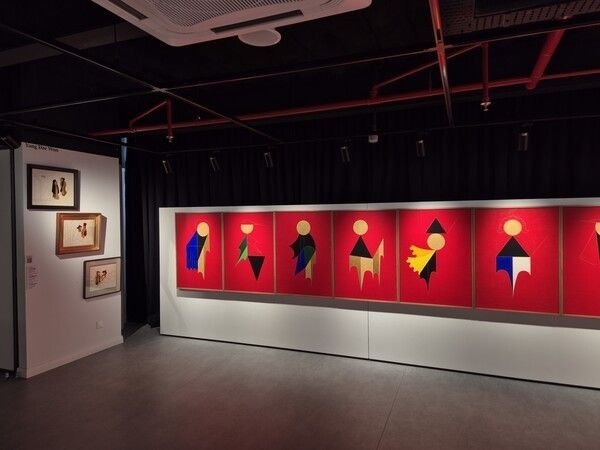
Bojagi, Hwang Jini and the Lives Around Clothing
Elsewhere, hanbok and related textile traditions become ways of considering memory and human relationships.
Kim Si-hyun’s “Precious Message” takes the bojagi, the Korean wrapping cloth traditionally used to cover and carry objects, as the subject of an oil painting. Folded fabric and soft surfaces transform its practical function into an image of protection and emotional containment.
Nam Kyung-min’s “Hwang Jini’s Room — Dream of a Gisaeng” imagines the private space of Hwang Jini, the celebrated Joseon-era poet and gisaeng. Clothing, accessories and objects associated with artistic activity are arranged to evoke the social position and inner life of a historical woman.
The work does not reconstruct an authenticated room. It instead builds an imagined interior from the artist’s reading of Hwang Jini’s life.
Yang Dae-won turns to the construction of hanbok itself. In “Lovers — Lovers Under the Moon,” the straight lines created through cutting and the curves formed when clothing meets the body become a way of thinking about relationships between people.
Jeong Hae-yoon similarly works with silk threads used in traditional clothing in “Plan B,” using the material to explore how human relationships are formed and connected.
Across these works, clothing is less an object to be displayed than a cultural form carrying associations with memory, intimacy and social identity.
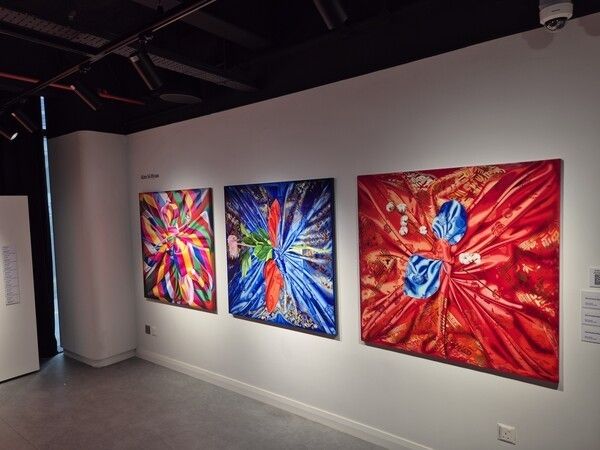
Traditional Motifs Begin to Move
Other artists focus on symbols once attached to rank, ceremony and movement.
Kwon Ki-soo brings his familiar character Dongguri into visual systems derived from traditional Korean landscape painting and dress. In works using hyungbae — embroidered rank badges once worn on Joseon officials’ robes — and silk hair ribbons, the formal symbols of status are interrupted by a contemporary cartoon-like figure.
Lee Don-ah’s “Prosperity-Silla Dynasty” changes according to where the viewer stands. Using lenticular imaging, the work reconstructs clothing and cultural imagery associated with the Silla period, making the viewer’s movement part of the act of seeing.
Lee Seol’s video “Sarak Sarak” begins with nobang, a thin, translucent silk traditionally used in Korean dress. The sensation of fabric brushing against itself becomes a metaphor for people meeting and passing through one another’s lives.
Lee Jung-keun takes another route in “Bell,” converting traditional dance costumes and masked-dance movements into computer-generated patterns before using AI to insert his own face into the image.
Here, neither pattern nor movement remains fixed. Elements once attached to physical garments are extracted, repeated and set in motion through contemporary image-making technologies.
Princess Deokhye Enters a Digital Hanbok Landscape
The exhibition’s digital works push that separation from physical clothing even further.
Kim Chang-kyum’s “Hanbok Garden — Beautiful Hanbok” constructs a virtual garden in 3D graphics, combining flowers, hanbok forms and traditional patterns in an environment unconstrained by the weight, stitching or structure of real fabric.
Lee Yum’s “Princess Deokhye, True-View Inner Portrait” uses AI to reimagine Princess Deokhye, daughter of Emperor Gojong of the Korean Empire. The historical figure appears in images combining contemporary and speculative hanbok with hanok architecture.
The work does not claim to restore a historical appearance. It deliberately creates an artistic image through technology, placing a figure from royal history within an invented visual environment.
A collaborative work by Geo Choi, Lee Jong-ho, Lee Dong-ho and Park Ji-sun, “Yeomida, Memories of Color Connected by Lines,” combines projection mapping, sound and choreography. Its title draws on the Korean verb yeomida, meaning to bring together and close the overlapping edges of clothing.
Instead of producing an actual garment, the artists translate that action into line, color, sound and bodily movement.
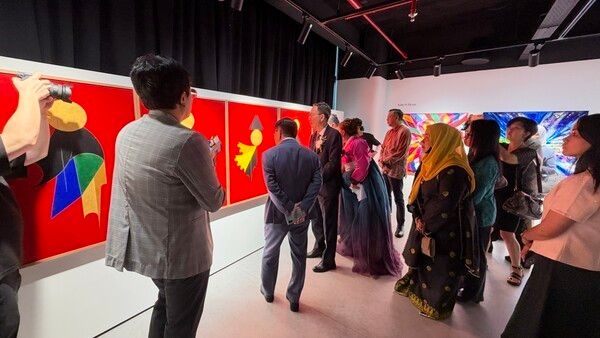
Hanbok as Material for Contemporary Art
“Hanbok, Reborn as Art” has traveled steadily beyond Korea. Following presentations in Astana, Abuja, Suzhou, Shanghai and Manila, the Kuala Lumpur exhibition continues an international touring project that has used contemporary art to introduce different aspects of Korean dress. Earlier official presentations have likewise framed the project around the reinterpretation of hanbok’s patterns, colors, materials and forms.
What changes from work to work is the distance each artist places between the original garment and its new form.
A royal wedding robe can be reconstructed through historical sewing techniques. Saekdong can become ceramic. A wrapping cloth can become painting. A rank badge can absorb a contemporary character, while Princess Deokhye can reappear in an AI-generated moving image.
The exhibition does not present a single definition of contemporary hanbok. Instead, it shows how the visual and material language surrounding Korean dress can continue after the garment itself has disappeared from view.
Color, pattern, fabric, gesture and symbolism remain recognizable, but their functions change as they move into different media. What once belonged to clothing becomes a vocabulary for contemporary art.
“Hanbok, Reborn as Art” runs through Jan. 8, 2027, at the Korean Cultural Center in Malaysia in Kuala Lumpur.
Reported by News Culture M.J._mj94070777@nc.press
Copyright ⓒ 뉴스컬처 무단 전재 및 재배포 금지


