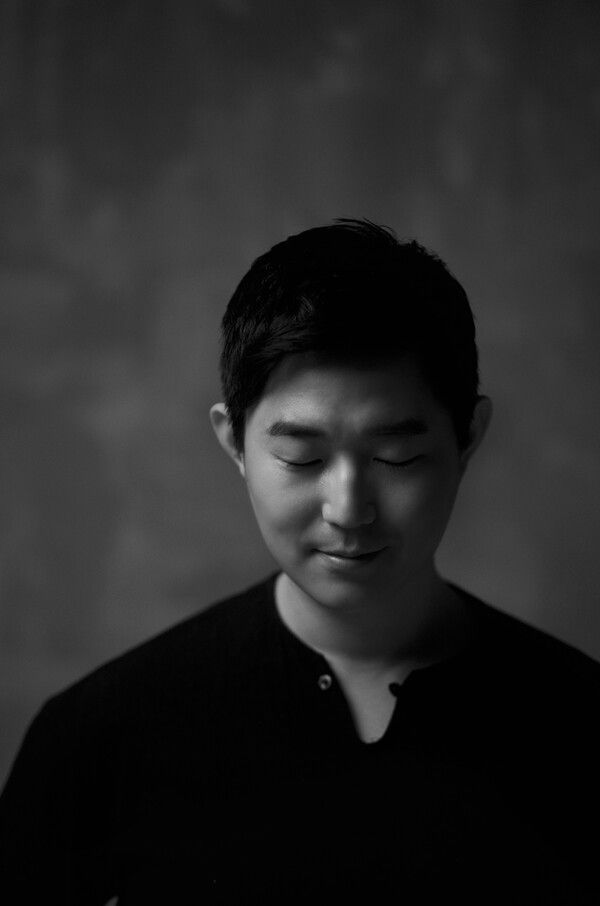
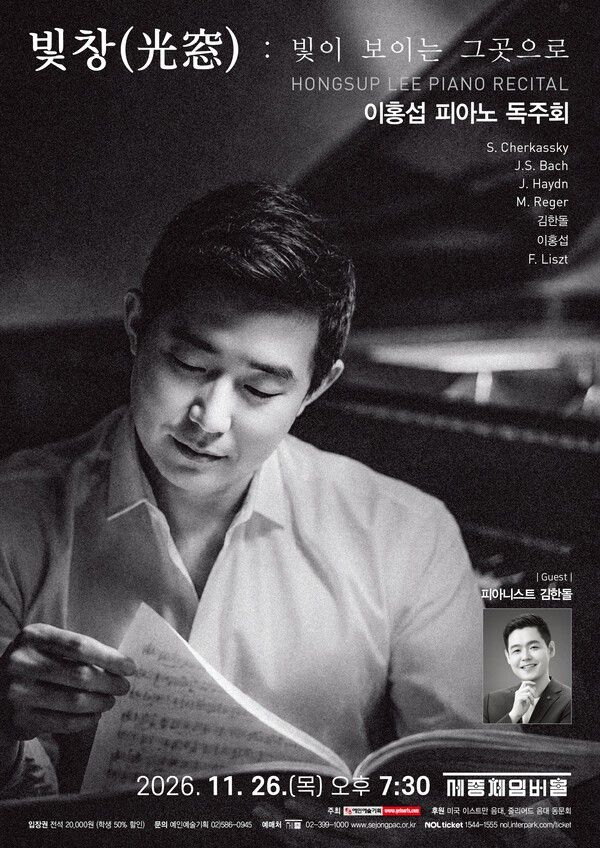
[News Culture] Pianist Lee Hong-seop will place his own music alongside Bach, Haydn, Reger and Liszt in a Nov. 26 recital at Sejong Chamber Hall, moving between the roles of interpreter and composer over the course of a single program.
Guest pianist and composer Kim Han-dol will also appear, performing three of his own works. Together, the two musicians contribute six original pieces to an 11-work program that otherwise ranges from Baroque variation and Classical sonata writing to late-Romantic chromaticism and Liszt’s large-scale Dante Fantasy.
The recital is titled Window of Light, a phrase drawn from Lee’s own composition of the same name. Rather than organizing the evening chronologically, Lee places historical repertory beside contemporary works shaped by memory, everyday images and personal experience.
The first part begins with Shura Cherkassky’s Prélude pathétique.
Written when Cherkassky was still in his teens, the piece offers a glimpse of the pianist as composer before his later international career as one of the distinctive keyboard personalities of the 20th century.
Bach’s Aria variata alla maniera italiana, BWV 989 follows.
One of Bach’s early keyboard variation works, it begins with a compact aria and reshapes the material through a series of increasingly varied textures and figurations. The piece provides an early example of the variation procedures that would become central to Bach’s mature keyboard writing.
Haydn’s Piano Sonata in E-flat Major, Hob. XVI:25 then brings the program into a more concentrated Classical framework.
The two-movement sonata is notable for its concise proportions and contrapuntal detail. Haydn creates momentum through thematic economy and rhythmic clarity rather than scale, allowing small shifts in texture and voice-leading to carry much of the musical argument.
Max Reger’s Nacht, WoO III/18 moves the recital into a darker harmonic world.
Dense chromatic writing and constantly shifting tonal relationships give the short work a sense of instability and suspended direction, setting up the transition from established repertory to newly written music.
The center of the recital belongs to Kim and Lee as composers.
Kim will perform three of his own pieces — Spoon March, Shooting Star Variations and Cat’s Dance Variations.
The works draw on ordinary objects and familiar images, using compact forms and variation techniques to turn them into character pieces with distinct rhythmic and narrative profiles.
Lee follows with three compositions of his own: That Summer, Sudden Shower and Window of Light.
These pieces bring a more personal register into the recital, drawing on memory and atmosphere rather than historical style. Their placement beside Bach, Haydn and Reger allows Lee to move directly from interpreting other composers’ scores to presenting music built from his own musical language.
Window of Light also gives the recital its central image. The title suggests a movement toward illumination, providing a loose conceptual thread through music that shifts repeatedly between darker and more open sonorities.
Liszt’s Après une lecture du Dante: Fantasia quasi Sonata closes the program.
The work, included in the second volume of Années de pèlerinage, takes its inspiration from Dante’s Divine Comedy and stands among Liszt’s most ambitious single-movement piano works.
Its opening is built around the tritone, an interval historically associated with instability and later known by the phrase diabolus in musica. Liszt uses it as a recurring structural idea, sending the piano into its lowest register before expanding into violent chords, rapid figurations and increasingly dense textures.
Against this darker material, Liszt introduces a broad lyrical idea in a major key.
The contrast has often been associated with the larger trajectory of Dante’s poem — suffering and damnation set against love and redemption — but Liszt does not simply illustrate scenes from the text. Instead, he transforms recurring motives across a large single-movement structure, allowing the work’s conflicting musical worlds to develop and eventually converge.
Its position at the end of the recital gives the program its largest dramatic arc.
The earlier works move between historical repertory and newly written miniatures; Liszt then expands questions of darkness, memory and transformation onto a much larger scale.
Lee was born in Seoul and began studying piano at age four.
He graduated at the top of the performance class from Daejeon Arts High School before entering the Eastman School of Music at the University of Rochester on scholarship. He later completed a master’s degree at The Juilliard School, also with scholarship support.
In Korea, he studied with Yoon Cheol-hee, Hwang Yoon-ha and Kim Ji-yeon. In the United States, his teachers included Enrico Elisi, Thomas Schumacher, Kang Choong-mo and Jerome Lowenthal.
While at Eastman, Lee received the Alice Herron Ayers Award from the music honor society Pi Kappa Lambda and performed in solo and chamber settings at venues including Kilbourn Hall.
At Juilliard, he appeared at Paul Hall and Morse Hall and worked with pianist Seymour Lipkin on Liszt’s two-piano transcription of Beethoven’s Symphony No. 9, which he performed in its entirety at Lincoln Center in New York. He was also selected as a performer for Juilliard ChamberFest in 2013.
Since returning to Korea, Lee has expanded his work beyond conventional recital performance into chamber music, composition, arranging and concert planning.
He has created storytelling programs centered on Liszt, participated in a Mozart-themed music-theater production at the 2018 Seoripul Festival’s Musical Instrument Street Festival and served as music director of the festival in 2019.
In 2020, he appeared on EBS’s Everything Music Box, performing Liszt’s solo-piano transcription of Schubert’s Erlkönig.
The Nov. 26 recital brings those strands together, placing Lee’s work as a pianist, composer and programmer within the same evening.
Reported by News Culture M.J._mj94070777@nc.press
Copyright ⓒ 뉴스컬처 무단 전재 및 재배포 금지


