[News Culture] Preserving hanbok involves more than keeping its traditional forms intact. It also means finding ways to communicate the aesthetics, social meanings and cultural practices embedded in Korean dress to audiences whose relationship with tradition continues to evolve. As hanbok moves beyond museums and heritage exhibitions into contemporary fashion, performance and tourism, designers are increasingly exploring how historical clothing can become a medium for new artistic expression.
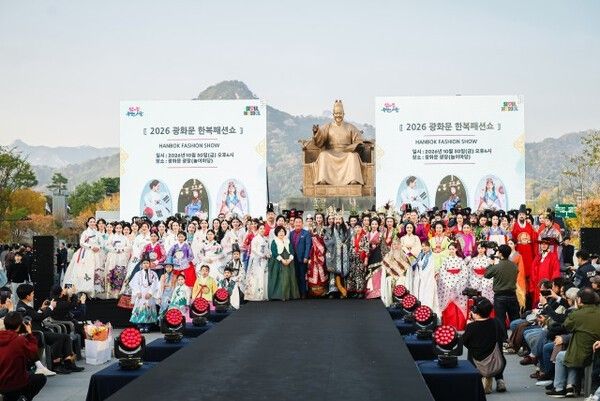
That approach was central to the 2026 Gwanghwamun Hanbok Fashion Show, held October 30 at Gwanghwamun Square in central Seoul. Featuring 160 models and collections by designers Lee Sun-young, Lee Sun-hwa and Baek Seong-sun, the event combined a large-scale runway presentation with orchestral music, dance, taekwondo and breaking. Thousands of residents and international visitors gathered in the square, where Korean dress traditions were presented alongside contemporary performing arts.
A historic setting for a living tradition
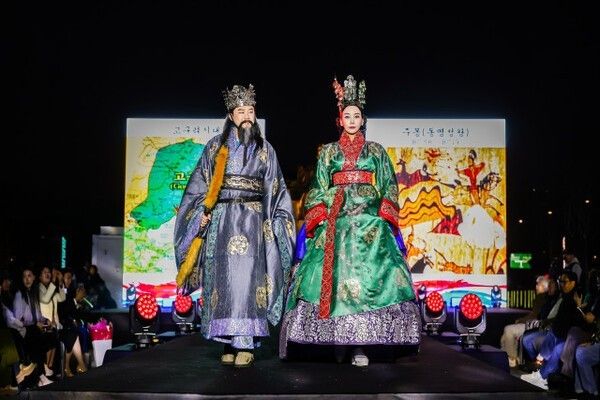
The setting carried particular significance. Gwanghwamun, long associated with the royal palace and government institutions of the Joseon Dynasty, remains one of Seoul's most recognizable historic districts. Against that backdrop, the runway offered a different way of encountering traditional clothing, placing garments associated with earlier periods of Korean history within a contemporary public event.
Hanbok itself has never been a single, unchanging form of dress. Its silhouettes, colors, materials and decorative conventions evolved across centuries, reflecting distinctions in social status, ceremonial practices and everyday life. Royal garments, formal clothing worn by aristocratic families and the practical dress of ordinary people all reveal something about the societies in which they were made and worn.
The three designers approached this history through markedly different visual languages.
Lee Sun-young incorporated imagery drawn from Korean national and cultural symbols, including the national flag, Hunminjeongeum, the historical script underlying the Korean alphabet, the national anthem, Dokdo and traditional folk paintings. Rather than reproducing historical garments alone, the collection used familiar cultural references as elements of contemporary fashion design.
Baek Seong-sun turned to the ceremonial clothing of the Joseon royal court. The collection featured elaborate formal robes and dangui, a traditional upper garment associated with court dress. Rich colors, decorative detailing and carefully constructed silhouettes emphasized the visual codes of royal attire, whose forms and ornamentation were historically governed by rank and occasion.
Lee Sun-hwa presented a more explicitly theatrical interpretation in a special collection titled "Gwanghwamun, Clothed in a Thousand Years of History." Drawing on the Dangun foundation myth and successive periods of Korean history, the presentation moved through Goguryeo, Baekje, Silla, Goryeo and Joseon before arriving at modern Korea.
Each period was represented through costumes intended to evoke its cultural character, including the martial spirit associated with Goguryeo, the refined aesthetics of Baekje, the elaborate ornamentation of Silla and the ceremonial traditions of later dynasties. The collection also drew on the concept of Hongik Ingan, commonly understood as a commitment to benefiting humanity.
The historical narrative extended beyond the garments. A 13-member ensemble from the Youngchang Classic Orchestra accompanied performances inspired by the Hwarang warriors of Silla, traditional sword dance and soprano singing. Together, the elements transformed the runway into a staged interpretation of Korean history in which clothing served both as a visual reference and a component of live performance.
Such productions offer opportunities to introduce traditional dress to audiences who might not ordinarily seek out exhibitions devoted to textile or costume history. Music, choreography and theatrical staging can make historical material more accessible, creating an experience that goes beyond observing the construction and decoration of individual garments.
They also raise questions about historical accuracy. Costumes designed for dramatic effect are not necessarily faithful reconstructions of clothing worn in a particular century. Maintaining a clear distinction between documented dress traditions and creative interpretation is therefore essential, particularly when fashion performances are also presented as cultural education.
Where traditional dress meets popular culture
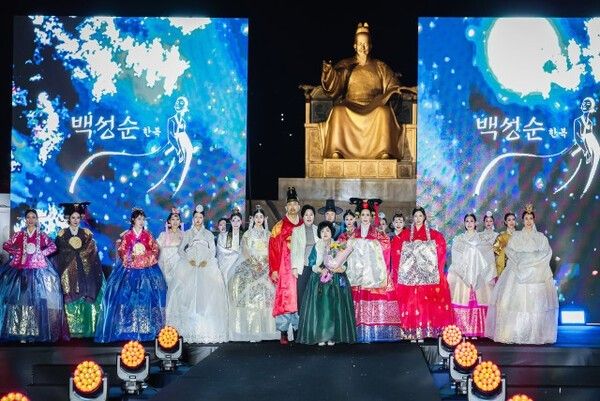
The inclusion of taekwondo, breaking and idol performances further broadened the show's cultural scope.
The T-Soldiers taekwondo demonstration team presented martial arts routines featuring board-breaking sequences, while breaking crew MB CREW and K-pop group EASTSHINE brought contemporary movement and popular music to the program.
These performances were not directly concerned with historical costume. Their presence instead reflected an effort to place traditional dress within a wider spectrum of Korean cultural expression.
The combination challenged the assumption that heritage and contemporary entertainment must occupy separate spaces. Just as hanbok designers can work with historical silhouettes while introducing new fabrics, motifs and modes of presentation, traditional culture can participate in contemporary artistic production without losing its historical reference points.
The central consideration is how these different elements relate to one another. A performance gains cultural depth when modern staging helps audiences understand the traditions being presented, rather than merely using them as decorative material.
Hanbok's global appeal depends on cultural understanding
The international appeal of hanbok is often discussed in terms of its distinctive silhouette, vibrant colors and visual elegance. Yet lasting cultural engagement requires more than recognition of its appearance.
The history of Korean dress encompasses the techniques used to make garments, the social customs governing how they were worn and the symbolic meanings attached to particular designs. Introducing these dimensions allows international audiences to understand hanbok as part of a living cultural tradition rather than simply an attractive form of national costume.
Fashion shows that incorporate performance can help communicate that wider context. At Gwanghwamun, visitors encountered traditional clothing alongside orchestral music, dance, martial arts and popular entertainment. The historic surroundings provided an additional connection to the cultural periods represented on the runway.
Nevertheless, the visibility generated by a major public event does not necessarily translate into sustained interest or long-term cultural participation.
For hanbok to establish a broader presence internationally, theatrical presentations must be supported by accurate historical interpretation, opportunities for contemporary designers and accessible ways for people to engage with traditional clothing beyond special occasions.
Exhibitions, educational programs, cultural tourism and everyday opportunities to wear hanbok can extend the impact of public showcases. Supporting designers and craftspeople is equally important, particularly when the goal is to sustain both traditional production skills and contemporary creative practice.
The challenge is to connect the attention generated by cultural events with the institutions, businesses and communities that support hanbok throughout the year.
The 2026 Gwanghwamun Hanbok Fashion Show illustrated one possible direction. By bringing together historical references, designer collections and contemporary performance in a prominent public space, it presented Korean dress as a form of cultural expression capable of reaching different generations and international audiences.
Its significance lies less in the scale of the runway than in the questions it raises about how traditional clothing can remain relevant.
Hanbok's future will not be secured through historical preservation alone, nor through reinvention detached from its origins. Its continuing relevance depends on the relationship between the two: preserving the knowledge embodied in traditional dress while allowing designers and performers to develop new interpretations for the present.
Reported by News Culture M.J._mj94070777@nc.press
Copyright ⓒ 뉴스컬처 무단 전재 및 재배포 금지


