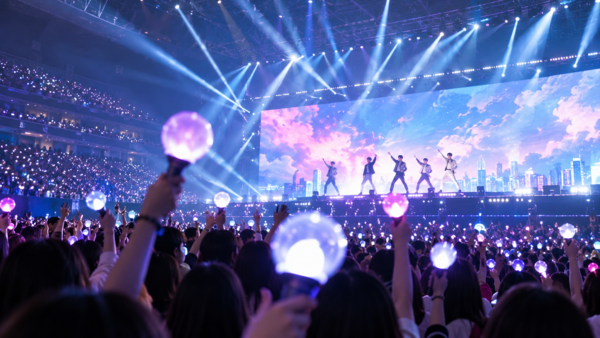
[News Culture] K-pop's global rise has brought more than international listeners. It has also transformed how songs are written, produced and performed, reshaping the creative environment around the genre to meet the expectations of a worldwide market. What began as music planned and produced in Korea for overseas export has evolved into a system in which global songwriting teams develop tracks together, labels consider multiple markets from the outset, and artists are expected to communicate across cultures.
One of the clearest signs of this shift can be found in song lyrics. What was once a practice of mixing occasional English phrases into Korean lyrics has expanded into a broader use of English hooks, English titles and, in some cases, entirely English-language songs. The change reflects a desire to make songs easier for global audiences to understand, remember and sing along with.
This expanded use of English also reflects the realities of the contemporary music industry. In an environment shaped by streaming platforms and short-form video, concise hooks and repetitive phrases can help songs travel quickly and remain memorable. Language choice has therefore become part of a broader production strategy, balancing musical impact with accessibility and market reach.
Global production models are changing K-pop songwriting

As K-pop's reach has expanded, international collaboration has become an increasingly important part of the songwriting and production process. Overseas composers and producers now work regularly with Korean entertainment companies, while songwriting camps have become a major method of developing new material.
At these camps, composers, lyricists and producers create melodies, lyrics and arrangements together, each contributing their own expertise. A melody written by an overseas producer may later be matched with Korean lyrics, while English phrases can be incorporated into a chorus to sharpen its rhythm and immediacy.
Such collaborations have broadened K-pop's musical vocabulary. By drawing on pop, hip-hop, R&B and electronic production techniques from different markets, Korean labels have been able to diversify the genre's sound while gaining a more direct understanding of how audiences consume music abroad.
As international co-production becomes more common, decisions about language and lyrical style are also shaped by a wider range of creative perspectives. An artist's musical identity, a company's long-term direction and expected reactions from international audiences are all taken into account, resulting in songs that combine Korean and English in different ways depending on the project.
English hooks have become part of K-pop's mainstream language
In recent K-pop releases, English is no longer limited to brief supporting phrases. It is now often used to define a song's first impression, whether through a repeated chorus, a key slogan-like phrase or an English title designed to stay in the listener's mind.
This is closely tied to how songs circulate globally. English remains the most widely shared language in mainstream pop, giving listeners who do not speak Korean a direct point of entry. It allows audiences to grasp part of a song immediately and participate in its performance online or in concert without waiting for translations.
At the same time, English and Korean contribute different musical qualities. Korean offers delicate shifts in tone through sentence endings, consonant patterns and vowel combinations, while English can emphasize rhythm and directness through stress and phrasing. The lyricist's task is not simply to combine two languages, but to do so in a way that matches the song's rhythm, emotional tone and the artist's voice.
Korean still carries the emotional and cultural core
The value of Korean lyrics becomes most evident in the expressions that are difficult to translate fully. Distinctions between formal and informal speech, the use of particular terms of address and subtle shifts in sentence endings can all reveal emotional distance, intimacy and social relationships. The same statement can convey very different feelings depending on how it is phrased.
Korean popular music has long explored universal themes such as love, separation, friendship, family and youth through expressions shaped by Korean language and daily life. Familiar turns of phrase, generational slang and references rooted in Korean society help create strong connections with domestic audiences.
For international listeners, Korean lyrics can also become an entry point into a new cultural experience. Some listeners first encounter a song through its melody or performance, then go on to look up the meaning of the lyrics and develop an interest in Korean language and culture. In that sense, songs can become links between music consumption and broader cultural curiosity.
What K-pop has built through Korean is therefore more than a linguistic habit. The sounds, structures and expressive possibilities of Korean are creative resources that help distinguish K-pop from other forms of global pop music. Stories and emotions shaped by Korean social experience give the genre a specificity that broadens, rather than limits, its international appeal.
Globalization can expand, not erase, K-pop's identity

English lyrics and multinational co-production have undoubtedly supported K-pop's global growth. Overseas composers and producers open the door to new sonic experiments, while collaboration across borders helps Korean labels respond more quickly to international listening habits and market trends.
Just as important, however, is the creative diversity that comes from allowing songs to adopt different linguistic structures. Some tracks may lean heavily on English, others may foreground Korean, and many may combine the two in ways that feel organic. That range expands K-pop's artistic possibilities while allowing commercial strategy and creative identity to coexist.
To sustain that balance, lyricists and artists need room to make thoughtful decisions about language and content. Working with international collaborators should not simply increase the amount of English in a song; it should also build experience in using Korean pronunciation, rhythm and cultural expression as deliberate musical tools. Translations, subtitles and lyric-explanation content can help global listeners access the meanings behind the songs, but the distinctiveness of the music itself begins with how those songs are written.
K-pop's globalization is, ultimately, a process of expanding its creative field through encounters with other musical cultures. English lyrics and multinational collaboration serve as important channels into the global market, while Korean lyrics continue to carry the emotional memory, cultural texture and expressive specificity that give the genre its identity.
When the rhythm of English and the subtle emotional phrasing of Korean work together, K-pop gains a broader range of expression. Combined with the experience of artists and the instincts of domestic and international creators, that linguistic interplay helps the genre speak to listeners across cultures without losing the qualities that make it recognizably its own.
K-pop's cultural value will grow even further when songs embraced around the world continue to carry the sounds of Korean language and the stories shaped within Korean society. The coexistence of global ambition and Korean expression may prove to be one of the genre's most important creative strengths in the years ahead.
Reported by News Culture M.J._mj94070777@nc.press
Copyright ⓒ 뉴스컬처 무단 전재 및 재배포 금지


