[News Culture] Sixty emerging actors have spent the past year training in speech, movement, traditional performance, Viewpoints and action theater. Now comes the harder part: deciding what to do with all of it once an audience is in the room.
The National Theater Company of Korea will bring its 2026 Young Actors Training Program to a close with Some Kind of Theater, a four-production festival running Nov. 21-Dec. 11 at Wooran Foundation’s Wooran 2 Gyeong in Seoul.
The lineup moves from Bertolt Brecht and Anton Chekhov to Wajdi Mouawad and Shakespeare, but the repertoire is only part of the point. Each production asks the young company to work differently — maintaining distance from character in Brecht, generating material collectively through Chekhov, navigating Mouawad’s dense architecture of ideas, and building Shakespeare through clowning and physical play.
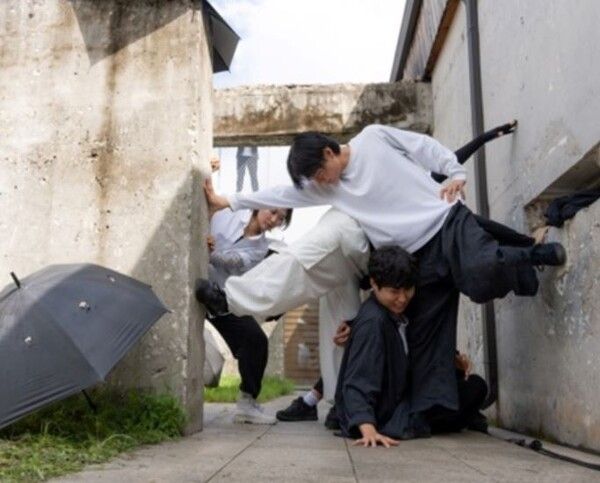
The 60 performers were selected through an application process that drew roughly 14 candidates for every available place. Over the following year, their training ranged from fundamental work on voice and the body to ensemble practices and contemporary performance methods.
That breadth becomes visible first in Brecht’s Drums in the Night, directed by Seong-ho Yun.
Set in Berlin in 1918, the play begins when Kragler returns four years after disappearing during World War I. His former fiancée Anna has begun building another life, while outside the domestic story the Spartacist uprising is gathering force. Private desire and political upheaval keep intruding on one another, leaving the characters to decide what they are willing to fight for and what they would rather leave behind.
Yun approaches the piece through Brecht’s insistence that an actor need not disappear completely into a role. The production exposes the space between performer and character, breaks the fourth wall and keeps the act of performance visible. For young actors trained to seek emotional credibility, that distance presents a different challenge: they have to play a character while also allowing the audience to see how the character is being constructed.
A Chekhov-based production directed by Mi-ran Kim works from almost the opposite direction.
Rather than placing the actors inside a fixed interpretation, Ridiculous and Pitiful People turns 15 performers into a company developing its own response to Chekhov. Misunderstandings, proposals, quarrels and awkward attempts at affection become raw material for a process shaped by improvisation and suggestions from the cast.
Chekhov’s characters repeatedly fail to say what they mean or understand what another person wants. Kim uses that instability as room for the actors to make discoveries rather than reproduce an established performance style. The production becomes as much about a group of young performers finding their way through Chekhov as it is about the characters themselves.
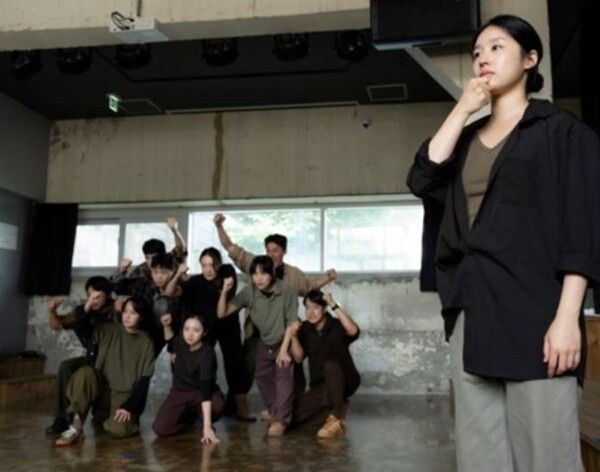
Wajdi Mouawad’s Ciels asks for another kind of concentration.
The play takes place inside an isolated intelligence unit attempting to prevent a terrorist attack. When codebreaker Valéry dies by suicide, the remaining agents begin examining the poems, paintings and coded material he has left behind, gradually uncovering connections between the threatened violence and the world they are preparing to leave to the next generation.
Directed by Su-min Ha, Ciels moves through mythology, religion, poetry and mathematics while keeping the relationship between parents and children at its center. For the young ensemble, the work places personal relationships inside a much larger intellectual structure, requiring the performers to hold emotional detail and abstract material in the same frame.
The festival ends with the most physically playful of the four productions.
In A Midsummer Night’s Dream: The Clown, director Seong-yeon Hong and 16 performers turn Shakespeare’s comedy over to a company of clowns. Mistakes, failed attempts and disruptions are not treated as problems to conceal; they become reasons for the performance to change direction.
Movement, props, music, spatial relationships and rhythm are developed through the actors’ own proposals. The point is not to reproduce a familiar Shakespearean comedy with clown costumes added on top, but to let the logic of clowning reshape how the story moves.
That gives the four productions noticeably different relationships to actor training. Brecht asks performers to step outside a character even while playing one. The Chekhov project relies on improvisation and ensemble authorship. Mouawad requires them to negotiate an intricate text and its competing layers of meaning. Shakespeare turns error, physical instinct and collective play into the method itself.
The festival is therefore less a graduation showcase than a series of practical questions about what kind of actors these 60 performers might become.
The National Theater Company of Korea’s training program is designed to give aspiring professional actors both sustained instruction and production experience before they enter the field. A year of classes can build technique, but performance exposes something classes cannot: how an actor responds when technique meets a director, a text, other performers and a live audience.

The title Some Kind of Theater leaves its own definition deliberately open. The four productions do not propose a single model for what theater — or acting — should look like. Instead, they place the same generation of performers inside four contrasting systems and allow the differences to become visible onstage.
For an actor at the beginning of a career, that may be the more useful measure of training: not whether every technique has been mastered, but whether there are enough tools to enter an unfamiliar rehearsal room and begin making choices.
Some Kind of Theater runs Nov. 21-Dec. 11 at Wooran Foundation’s Wooran 2 Gyeong in Seoul.
Reported by News Culture M.J._mj94070777@nc.press
Copyright ⓒ 뉴스컬처 무단 전재 및 재배포 금지


