[News Culture] Safeguarding intangible cultural heritage requires more than documenting traditional knowledge and practices. As communities change and the conditions supporting cultural transmission evolve, regular assessments are needed to identify emerging challenges and ensure that preservation policies reflect the realities faced by practitioners.
These questions will take center stage at the 2026 World Forum for Intangible Cultural Heritage, scheduled for November 6 at the National Intangible Heritage Center in Jeonju, South Korea. Hosted by the Korea Heritage Service (KHS) and organized by the UNESCO-affiliated International Information and Networking Centre for Intangible Cultural Heritage in the Asia-Pacific Region (ICHCAP), the forum will examine international approaches to heritage monitoring and consider how Korea can improve its periodic surveys of nationally designated intangible heritage.
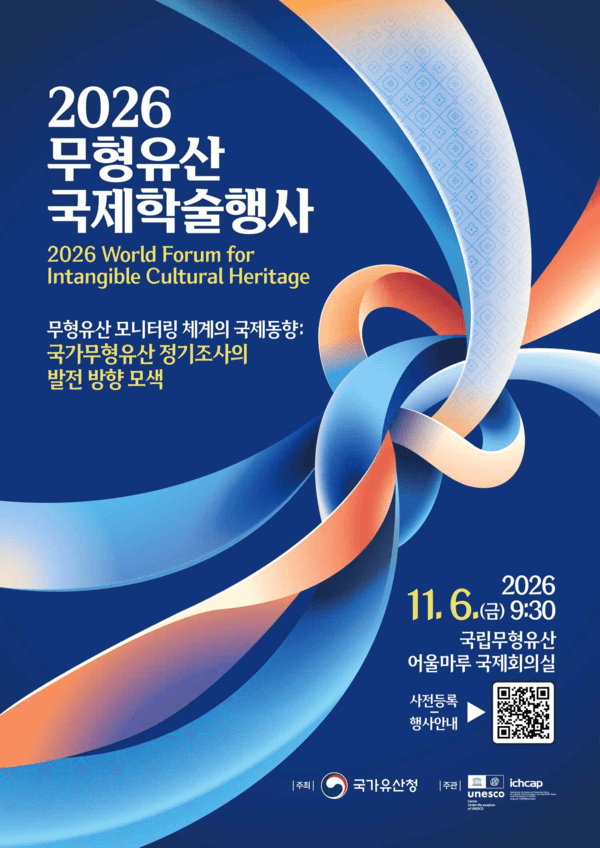
Held under the theme Global Trends in Intangible Cultural Heritage Monitoring Systems: Exploring Future Directions for the Korean Periodic Survey of National Intangible Cultural Heritage, the conference will feature a keynote address, six presentations across two sessions and a concluding panel discussion.
Janet Blake, a scholar associated with Shahid Beheshti University in Iran and an expert on UNESCO's 2003 Convention for the Safeguarding of the Intangible Cultural Heritage, will deliver the keynote address. Her presentation will examine global developments in monitoring living heritage and the implications of the UNESCO convention for assessing the effectiveness of safeguarding measures.
The first session will focus on international monitoring systems and UNESCO reporting practices. Presentations will examine approaches adopted in China, Japan and Mongolia, including the use of digital technologies, community participation and institutional support. Experts will also discuss monitoring practices in South Asia, identifying challenges in assessing whether safeguarding initiatives adequately address the needs of heritage communities.
Case studies will include Xoan singing in Vietnam and the Carnival of Aalst in Belgium. Both will be examined in the context of heritage monitoring following international recognition, with attention to the relationship between safeguarding policies, cultural practices and the communities involved. The discussions will consider how monitoring can extend beyond administrative reporting to assess changes in the conditions under which traditions are practiced and transmitted.
The second session will turn to Korea's periodic survey system. Drawing on the country's experience preparing its 2024 UNESCO periodic report, speakers will review existing assessment practices and identify areas requiring improvement. Particular attention will be given to food-related intangible heritage, including Munbaeju, a traditional Korean distilled liquor, and kimjang, the communal practice of making and sharing kimchi.
These examples will provide an opportunity to compare different forms of cultural transmission. While Munbaeju involves specialized production knowledge and techniques, kimjang is closely connected to communal participation and seasonal customs. Examining their transmission structures and survey records will help illustrate the need for assessment methods that account for the distinctive characteristics of individual heritage practices.
The session will also address how changes in Korea's national heritage policies may require adjustments to survey procedures, evaluation criteria and the ways collected information is used. The central concern is whether periodic assessments can move beyond recording the current status of heritage practices to identifying practical measures that support their continued transmission.
Following the presentations, Yoo Chul-in, professor emeritus at Jeju National University, will chair a panel discussion involving Korean and international specialists. Participants will consider lessons from different monitoring systems and discuss how survey findings can be translated into safeguarding policies and practical support for heritage bearers and communities.
Regular surveys play an important role in identifying risks to cultural transmission, documenting changes among practitioners and determining where additional support may be needed. Their effectiveness depends not only on the quality of information collected but also on whether the findings lead to improvements in preservation measures and the environments in which cultural practices continue.
The forum will bring international experience and Korea's existing survey practices into a common discussion, with the aim of developing a more responsive and effective monitoring framework. KHS plans to consider the findings as it works to strengthen the country's periodic survey system through continued research and international cooperation.
The conference will begin at 10 a.m. on November 6 at the International Conference Hall of the National Intangible Heritage Center in Jeonju.
Reported by News Culture M.J._mj94070777@nc.press
Copyright ⓒ 뉴스컬처 무단 전재 및 재배포 금지


