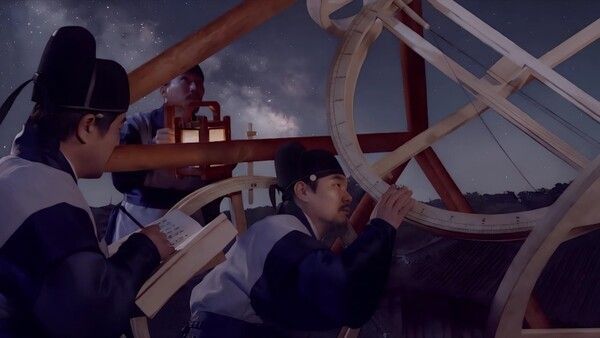
[News Culture] In the autumn of 1604, a new star appeared in the night sky. Astronomers across Eurasia watched it, including Johannes Kepler, whose name would eventually become attached to the supernova.
Joseon kept watching long after the first sighting.
Over roughly seven months, court astronomers produced about 130 observations describing the object’s position, brightness and color. The surviving records are unusually detailed for an era when the sky was still being studied with the naked eye and today remain useful to researchers reconstructing the behavior of what is now known as Kepler’s Supernova.
The Nov. 1 episode of KBS1’s “History Special – Time Traveler,” titled “Reading the Sky,” uses that observation campaign as a window into a much larger scientific system.
Host Ji Seung-hyun moves from the astronomical institutions of King Sejong’s reign and the restored instruments of Gyeongbokgung Palace to the Naro Space Center in 2026, asking why measuring the sky, keeping time and making an accurate calendar became matters of state in Joseon.
For an agricultural kingdom, astronomy was not an abstract pursuit.
Knowing the seasons mattered to farming, and calculating the calendar determined when the state and its people marked the passage of the year. Joseon described the ruler’s responsibility through the idea of gwansang susi: observing celestial phenomena and using that knowledge to establish and communicate time.
That posed a practical problem in the 15th century.
Joseon received its official calendars from Ming China, but the calculations were based on observations centered on Beijing. The sky over Hanyang was not identical, and neither were local measurements of time.
King Sejong wanted calculations suited to Joseon itself.
He brought together scholars and engineers including Jeong In-ji, Yi Cheon and Yi Sun-ji to study existing astronomical texts, examine mathematical formulas and make direct observations from Joseon.
The work was technically demanding and politically significant. Calendar making had long been associated with imperial authority in China. Under Sejong, however, the immediate problem was practical: producing measurements that worked where Joseon’s people actually lived.
The result was not simply a calendar project. It was part of a broader investment in instruments, observatories and timekeeping.
That infrastructure helped establish a culture in which unusual events in the sky were not merely noticed but repeatedly measured and written down.
The 1604 supernova is one of the clearest examples.
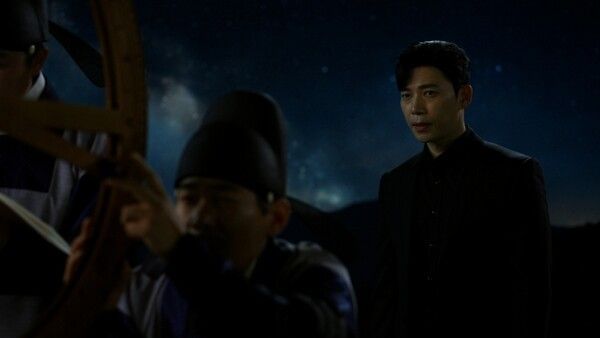
The program notes that Joseon observers detected the phenomenon before Kepler’s own observation and then continued to document it for months. The records tracked changes in apparent position, brightness and color rather than reducing the event to a single sighting.
The practice had deeper roots.
Astronomical events appear throughout Korean historical sources including the “Samguk Sagi” and the “History of Goryeo,” with records of comets, unusual stars and other celestial phenomena extending centuries before Joseon.
Under Joseon, the process became increasingly systematic. When an unusual object appeared, observers were assigned to follow it and produce written and visual records.
The episode examines materials associated with the Seongbyeon Deungnok, records devoted to extraordinary celestial phenomena, alongside the observations of the 1604 supernova.
Modern astronomical scholarship has identified more than 130 references to the supernova in Joseon court records, including detailed descriptions that can be used to reconstruct changes in its brightness over time.
For KBS, those documents open another question: what kind of instruments made sustained observation possible?
During Sejong’s reign, an astronomical platform was constructed at Gyeongbokgung Palace, while Jang Yeong-sil and other technicians worked on devices for measuring celestial positions.
The program uses a reconstructed large ganui, an astronomical instrument designed to measure the coordinates of celestial bodies, to recreate elements of the observation process.
Timekeeping presented a related challenge.
Joseon needed not only to observe the heavens but also to translate celestial movement into usable hours.
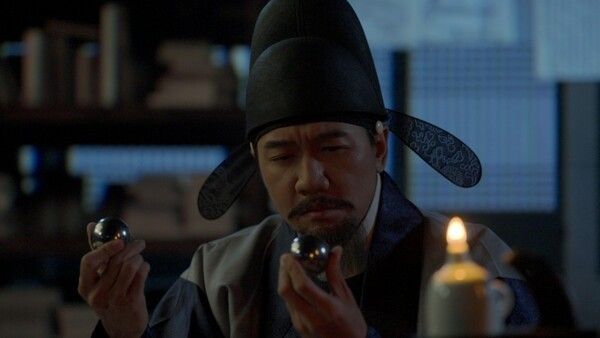
One of Sejong-era Korea’s most sophisticated answers was the Jagyeongnu, an automated water clock designed to announce the time through a mechanical sequence driven by flowing water and falling balls.
For centuries, reconstructing the device was difficult because written descriptions survived more fully than the mechanism itself.
An archaeological discovery in Seoul’s Insa-dong in 2021 changed that. Excavations uncovered components associated with the clock’s power-transmission and ball-release systems, providing new physical evidence for researchers attempting to understand how the machine operated.
Rather than presenting astronomy and clockmaking as separate achievements, “History Special – Time Traveler” places them within the same problem: how to measure the movement of the sky accurately enough to organize time on the ground.
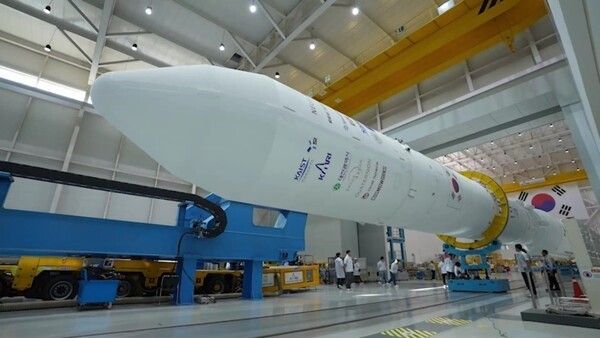
The episode’s final stop is not another palace or historical observatory, but the Naro Space Center.
Korea’s first lunar orbiter, Danuri, remains in operation around the moon and has continued to collect scientific observations. In August 2026, it photographed the lunar surface before and after the impact of a spent Falcon 9 upper stage near Einstein crater, producing data for subsequent research.
Closer to Earth, the fifth flight of Korea’s Nuri launch vehicle lifted off from Naro on Oct. 7, 2026, carrying a group of small satellites into orbit.
The documentary does not treat a 15th-century astronomical instrument and a modern launch vehicle as versions of the same technology. The distance between them is too great for that.
Instead, the comparison returns to a question that runs through the episode: what happens when observing the sky becomes an organized scientific project rather than the work of isolated individuals?
For Joseon, that meant calculations adapted to Hanyang, instruments installed inside a royal palace and teams assigned to record an unfamiliar star night after night.
Four centuries later, the tools have changed beyond recognition. The impulse to measure, record and test what is happening above the Earth has not.
“Reading the Sky,” the final installment in “History Special – Time Traveler”’s three-part series on science and technology that changed history, airs Sunday, Nov. 1 at 9:30 p.m. KST on KBS1.
Reported by News Culture M.J._mj94070777@nc.press
Copyright ⓒ 뉴스컬처 무단 전재 및 재배포 금지


