[News Culture] At MMCA Cheongju, the route into the museum is becoming part of the exhibition.
Beginning Oct. 31, the National Museum of Modern and Contemporary Art, Korea will present “Museum Passage Project: Rho Jae-jung,” placing new work along the approach to the museum and across its exterior media facade. Rather than waiting for visitors to enter a gallery, the project introduces art into spaces they would normally pass through without much attention.
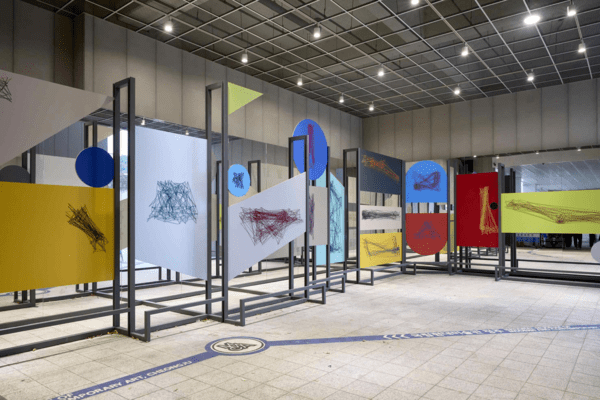
Running through June 30, 2027, the project features two works by artist duo Rho Jae-jung: the installation “Passage” along the museum entrance and the video work “Still Life” on the outdoor media canvas.
The project is part of an effort to extend the physical boundaries of the museum beyond its exhibition rooms. Paths, walls and surrounding views become part of the viewing environment, allowing the encounter with art to begin before visitors reach the building itself.
Rho Jae-jung approaches that idea through two different media. Both works rearrange familiar objects, language and scenery so that what appears depends on where the viewer stands and how they move.
A Sentence That Appears Only in Reflection
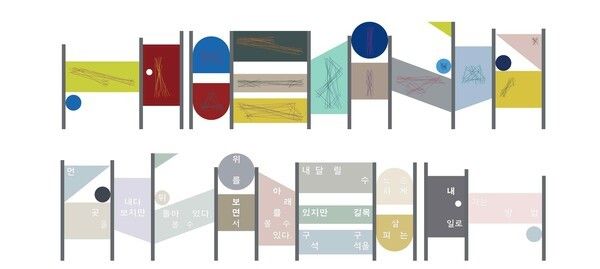
“Passage,” installed along the entrance route, consists of panels embroidered with abstract images in multicolored thread. The panels are arranged at different angles and heights in a folding-screen-like structure that partially covers a mirrored wall.
As visitors walk past, a phrase written on the reverse of the panels — “How to Get to Tomorrow” — appears in the mirror. Letters that cannot be read directly come together only through reflection.
The work shifts between image and language as visitors move. Abstract embroidery appears on one side, while the mirrored sentence emerges from another position, making the act of walking part of how the work is understood.
Its title, “Passage,” carries a double meaning: a physical route and a section of written text. The installation links the experience of moving through space with the act of reading, suggesting that a familiar object or phrase can change when seen from another angle.
Cheongju Seen Through a Mosquito Net
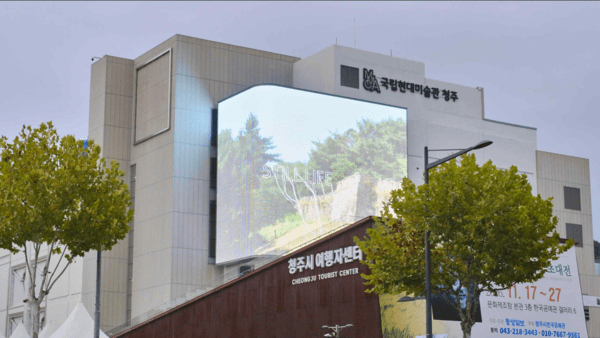
On the museum’s exterior media canvas, “Still Life” brings together four locations in Cheongju: Sangdangsanseong Fortress, the historic Western-style houses in Tap-dong, Solbat Park and Chungbuk National University.
For the series, Rho Jae-jung installs mosquito netting at different sites, embroiders the words “still life” onto it in white thread and films the landscape through the mesh. The net, the text and the surrounding scenery occupy the same frame.
The landscape continues to shift almost imperceptibly with wind, light and movement, while the embroidered words remain fixed.
The title plays on two meanings of “still life.” It refers to the traditional artistic genre of still life, but it can also be read literally as life that continues.
In the Cheongju works, that tension brings together the relative stillness of the text and the ongoing movement of the places behind it. Local landscapes become more than recognizable views; they also carry traces of history, daily life and change.
Looking Again at Familiar Things
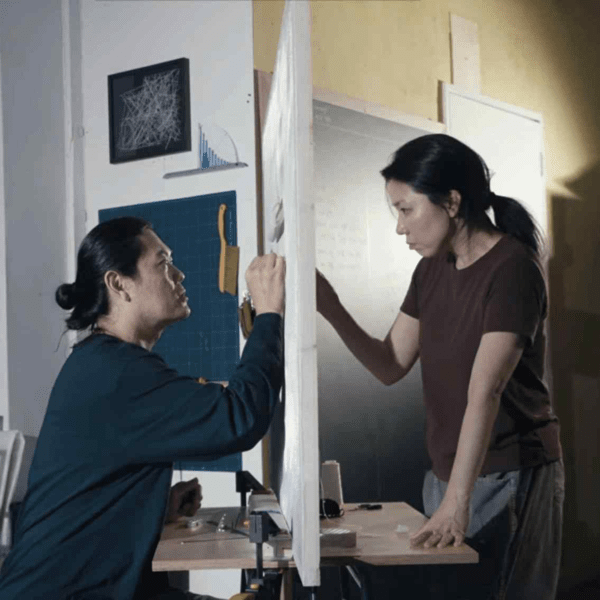
Rho Jae-jung is composed of artists Rho Yoon-hee and Jung Hyun-seok. Their collaborative practice develops through conversation and negotiation while allowing different perspectives to remain present.
Their work often begins with ordinary objects, language and familiar environments, then shifts their position or relationship until something previously taken for granted becomes less stable.
Mirrors, screens, written phrases and everyday materials are not used simply as visual devices. They become ways of testing how perception changes according to position, context and expectation.
Humor and a sense of the absurd frequently enter that process, particularly when the artists place ordinary things in arrangements that expose contradictions in everyday habits or social conventions.
The Walk to the Museum Becomes Part of the Visit
The project ultimately turns attention toward spaces that usually sit outside the main exhibition experience.
The approach to the museum is no longer just a route from the street to the entrance, and the exterior wall is no longer simply part of the architecture. Both become places where visitors encounter images, text and changing views before stepping into a gallery.
That shift is central to the “Museum Passage Project.” Rather than separating art from the act of arriving, it allows movement through the site to become part of how the museum is experienced.
“Museum Passage Project: Rho Jae-jung” runs from Oct. 31, 2026, through June 30, 2027, at MMCA Cheongju.
Reported by News Culture M.J._mj94070777@nc.press
Copyright ⓒ 뉴스컬처 무단 전재 및 재배포 금지


