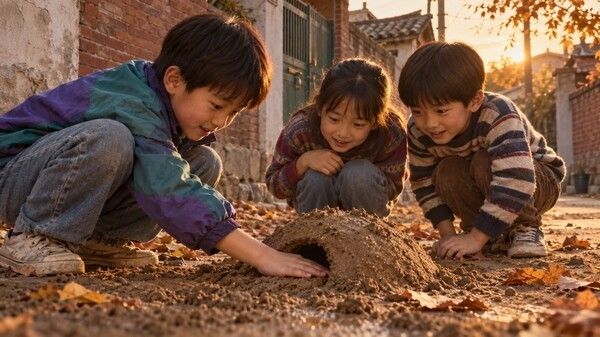
[News Culture] A child places one hand on damp sand and begins piling soil over it, patting the mound until it holds its shape. The most difficult part comes at the end: slowly withdrawing the buried hand without bringing the structure down. This simple exercise in patience and precision is known in Korea as dukkeobijip jitgi, or the toad house game. Once a familiar pastime in playgrounds and village yards, it required nothing more than sand, water and a pair of hands. Yet the game also developed its own songs, local rules and folklore, including a tale that interprets the exchange of an old house for a new one as an act of maternal sacrifice.
The game begins by covering the back of one hand with moist soil or sand, then repeatedly pressing the mound with the other hand until it becomes firm. Keeping the buried hand still demands patience, while removing it without cracking the structure requires careful control of both pressure and movement. Once the small hollow house is complete, children may place beetles or other insects inside to observe their movements, build neighboring houses connected by tunnels, or decorate the surface with flower petals, twigs and seashells. In some communities, children also made wishes immediately before withdrawing their hands, believing that a house left standing would bring good fortune.
A House Built by Hand and Strengthened by Song
The construction process was traditionally accompanied by short folk verses, the best known of which begins, "Dukkeoba, dukkeoba, heon jip julge sae jip dao" — "Toad, toad, I'll give you my old house, so give me a new one." Sung in rhythm with the repeated patting of the sand, the rhyme became one of the game's defining features. Its wording varied across regions, with local versions introducing animals such as magpies, storks and cattle. In Mungyeong, North Gyeongsang Province, children sang a verse calling on a stork to bring water and a toad to build a house. In South Chungcheong Province, another version expressed the wish that the structure would remain firm even if stepped on by a cow or a magpie.
The appearance of the magpie in these verses also recalls its association with good fortune in Korean folk belief. The wish for a sturdy house has been compared with the traditional custom of throwing a child's fallen baby tooth onto a roof, often accompanied by a rhyme addressed to a magpie. Although the two practices differ, both connect childhood activities with spoken wishes and familiar animals. The toad house game was therefore more than a test of manual skill: through its songs and local variations, it formed part of an oral tradition passed between generations of children.
From Sand Construction to a Game of Deduction
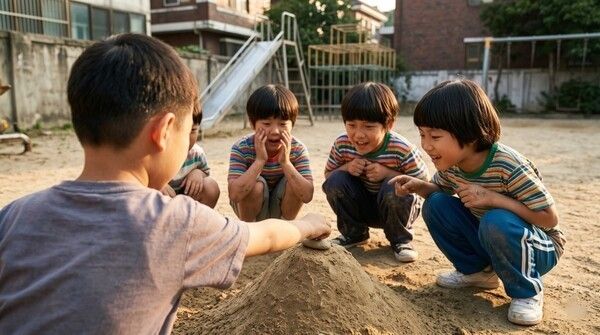
The game could be played alone, but group participation introduced competition and additional challenges. Children sometimes tested the strength of their completed houses by carefully placing heavy stones on top, seeing whose structure could withstand the greatest weight without collapsing. Such contests required participants to judge the moisture and firmness of the sand while developing their own techniques for shaping the mound. With no fixed number of players or elaborate equipment, the game could be adapted to almost any outdoor setting where suitable soil was available.
A more elaborate variation was recorded in the Seosan area of South Chungcheong Province, where the construction game developed into a contest involving memory and deduction. After choosing a seeker through rock-paper-scissors, the other children built several sand houses while the seeker waited with covered eyes. Each builder secretly marked one house as their own by hiding a leaf or pebble inside. The builders then moved away while the seeker erased their footprints, removing the most obvious clues to ownership. Upon returning, each player had to identify their original house without damaging it. Success meant victory, while failure resulted in a change of seeker.
This regional version added a different kind of challenge to the familiar sand-building activity. Rather than concentrating solely on making a structure strong enough to stand, children had to remember its location and appearance after the surrounding evidence had been deliberately removed. The shift from construction to deduction illustrates how traditional games could evolve through local experimentation, with children introducing new rules while retaining the central activity of building small houses from earth.
The Toad and the Legend of a Mother's Sacrifice
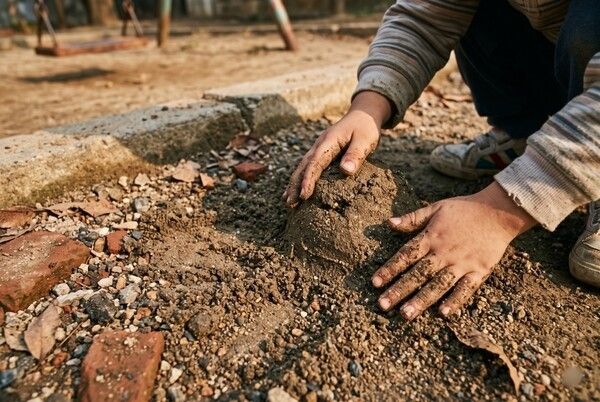
The game's name is commonly explained by the appearance of the finished structure. Its rounded surface resembles a toad's back, making the animal a natural point of reference for the small earthen house. Another explanation is found in folklore associated with the omdukkeobi, a toad linked to a story of maternal sacrifice. According to the tale, a mother toad carrying eggs allows herself to be swallowed by a venomous snake, then releases poison inside its body, causing both animals to die. The surviving eggs eventually hatch, drawing nourishment from the remains of the mother and the snake.
In one interpretation of the familiar rhyme, the "old house" represents the mother who gives up her life, while the "new house" symbolizes the offspring that survive and grow through her sacrifice. This is a symbolic reading of an orally transmitted story, not a verified account of animal behavior or an established historical explanation for the game's origins. Nevertheless, the tale introduces themes of parental devotion and the continuation of life into a childhood activity otherwise centered on building and competition.
The toad house game survives in accounts of regional customs, children's rhymes and the recollections of generations who played with little more than damp earth. Its variations reveal how a shared activity could take different forms from one community to another, incorporating wishes, contests of strength and even games of deduction. The stories attached to the game likewise show how familiar verses could acquire meanings beyond their immediate use in play. Whether those meanings arose alongside the game or were added through later interpretation remains uncertain, but together they form part of the oral traditions surrounding one of Korea's simplest childhood pastimes.
Reported by News Culture M.J._mj94070777@nc.press
Copyright ⓒ 뉴스컬처 무단 전재 및 재배포 금지


