[News Culture] In Korean folklore, the Ishimi is a mysterious creature said to inhabit ponds, reservoirs and deep mountain valleys. It is often associated with the imugi, the great serpent that has yet to become a dragon, and in parts of Gangwon Province the word itself has been used as a regional term for an imugi. Yet the stories surrounding Ishimi vary enough from place to place that the two cannot simply be treated as identical beings.
Dragons in Korean tradition were regarded as powerful creatures of the heavens, closely associated with rain and water. The imugi, by contrast, was often imagined as a being on the threshold of transformation, either waiting to become a dragon or having failed to ascend. Ishimi belongs to a similar imaginative world, but its role is far less stable. In some stories it rescues people and repays kindness; in others it threatens human life. That moral ambiguity allowed the creature to take on markedly different roles as tales moved from one community to another.
Betrayal and Repayment in the Wild-Ginseng Tale
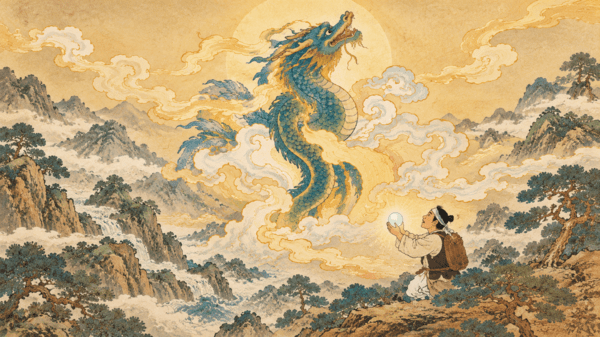
One of the best-known stories illustrating Ishimi’s dual nature centers on wild ginseng. In the middle of winter, a woodcutter climbing a mountain spots a valuable ginseng root near the edge of a cliff and asks a neighbor for help. The two recover it together, but the neighbor, overcome by greed, takes the ginseng for himself and abandons the woodcutter on the cliff.
The creature that comes to the stranded man’s rescue is Ishimi.
It carries the woodcutter to safety on its back, then tracks down and devours the neighbor who betrayed him. In gratitude, the woodcutter later obtains a yeouiju, the magical jewel traditionally associated with dragons, for Ishimi. The creature finally transforms into a dragon and ascends to the heavens.
Here, Ishimi overturns the assumptions attached to its monstrous appearance. A familiar human neighbor abandons a vulnerable man for material gain, while the feared creature saves him. The betrayer is punished, and Ishimi, having shown gratitude, achieves the transformation it had long been denied.
The tale brings together two familiar moral principles: justice for wrongdoing and repayment of kindness.
Wild ginseng also serves as more than a valuable object. Its rarity turns it into a test of human desire. What was gained through cooperation becomes the source of betrayal when one person attempts to claim it all. The woodcutter and Ishimi, by contrast, survive and prosper through mutual aid. The story thus creates a form of moral justice that everyday life cannot always guarantee.
A Monster Shaped by Fear of the Natural World
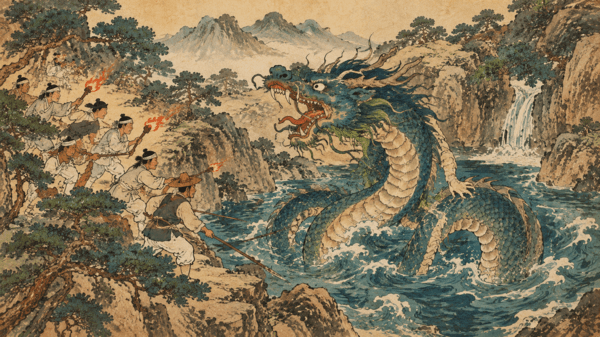
Ishimi is not always a benevolent creature.
A legend associated with Dubongsan Mountain in Gwangam-ri, Naechon-myeon, Hongcheon County in Gangwon Province tells of a woman who falls ill and dies after seeing an Ishimi. In another tradition from the Gyeongsang region, a man-eating Ishimi inhabiting a deep pool is eventually killed by local people.
Such stories can be read as attempts to give physical form to the dangers associated with deep water, isolated valleys and difficult terrain. Pools of unknown depth and inaccessible mountain landscapes posed genuine risks, and a monster such as Ishimi could give those dangers a recognizable shape while warning people to keep their distance.
It would, however, require additional folkloric evidence to conclude that every Ishimi tradition arose directly from a specific local hazard. What can be seen more clearly is that the creature changed as the stories traveled.
That variation is itself characteristic of oral culture. Stories transmitted from one person to another rarely preserve a single fixed text. They are reshaped through the memories of storytellers and the concerns of individual communities. The same Ishimi can therefore appear as a grateful helper in one place and a deadly threat that must be destroyed in another.
From Fearsome Creature to Comic Disorder in Kkokdugaksi Noreum
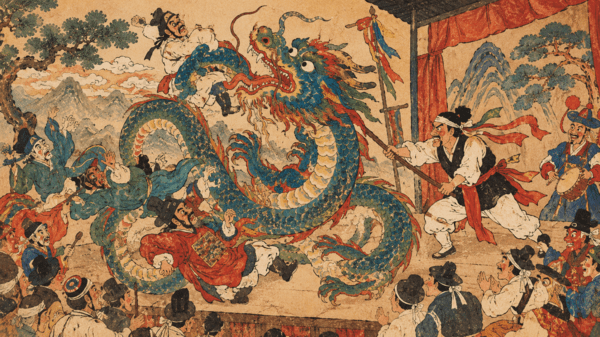
Ishimi also appears in Kkokdugaksi Noreum, the traditional puppet theater associated with itinerant Namsadang troupes.
In the performance, Ishimi devours a succession of characters, including Dongbangsak, a legendary figure renowned for longevity, before eventually being killed by Hong Dong-ji. A creature associated with fear in oral legend becomes, on the puppet stage, a source of chaos, exaggeration and comic spectacle.
Kkokdugaksi Noreum developed as a form of popular entertainment built around puppetry, verbal humor and exaggerated action, often using comedy to satirize society and authority. Ishimi brings danger and disruption into the performance, but its seemingly overwhelming power is ultimately broken when Hong Dong-ji defeats it. For audiences, the result is a reversal in which something once feared can be mocked and conquered.
The wild-ginseng tale and the puppet tradition deploy the creature in very different ways. In one, Ishimi punishes betrayal and rewards kindness. In the other, it is itself the destructive force that must be brought down.
There is no basis for assuming that the two traditions share a single direct origin. What they do show is that Ishimi was not confined to stories told orally around a household or village. The creature also entered communal performance, where its meaning could be reshaped through humor and spectacle.
From Traditional Monster to a Resource for Modern Storytelling
Connecting Ishimi with the imugi tradition also reveals how fluid supernatural creatures could be within Korean folk imagination.
In the wild-ginseng story, Ishimi does not remain permanently trapped in its monstrous state. After saving a human and receiving a yeouiju in return, it becomes a dragon and rises to the sky. Its fate changes through its relationship with a person, creating a narrative in which conduct, gratitude and reward lead to transformation.
Some interpretations have also connected Ishimi with the resilience of ordinary people. Its armored scales, long life and ability to survive repeated struggles have been read as qualities that evoke people who endure hardship without easily submitting to oppression. Such readings can offer one way of approaching the creature, though they should not be generalized across every regional tradition or taken as direct evidence of how ordinary people in the past universally understood Ishimi.
The name has continued to find new life in contemporary popular culture. Characters drawing on Ishimi have appeared in the Naver webtoon “Please Get Me Accepted” and the game “Destiny Child,” among other works. The traditional monster is no longer bound to the roles it occupied in folktales, but can instead be given an entirely new personality, visual identity and narrative function.
That adaptability is central to Ishimi’s cultural significance.
Its stories carry memories of fear toward the natural world, anxieties about human greed, and ideas of gratitude, punishment and justice. In Kkokdugaksi Noreum, the same creature became material for popular laughter and theatrical satire. In contemporary storytelling, it offers a recognizable piece of traditional imagination that can be dismantled and rebuilt for new audiences.
The historical value of Ishimi, then, does not lie in identifying a single “correct” version of the monster. It lies in the opposite: the creature survived because its meaning was never completely fixed.
Savior in one story, predator in another and comic antagonist on the puppet stage, Ishimi changed as it moved across regions, generations and forms of storytelling. Those contradictions preserve something larger than the monster itself—the flexibility of Korea’s oral tradition and the many ways communities turned their encounters with nature, danger and human behavior into stories.
Reported by News Culture M.J._mj94070777@nc.press
Copyright ⓒ 뉴스컬처 무단 전재 및 재배포 금지


