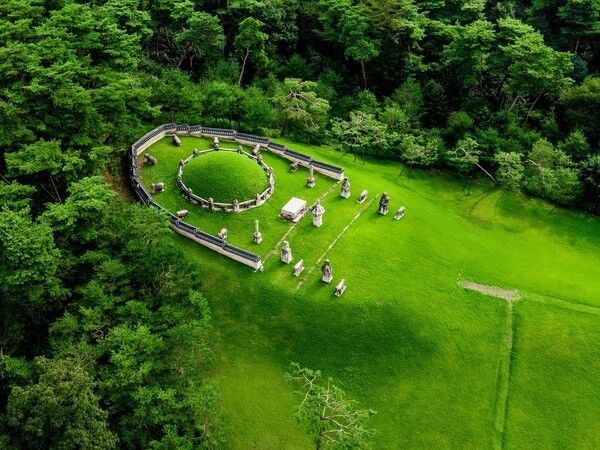
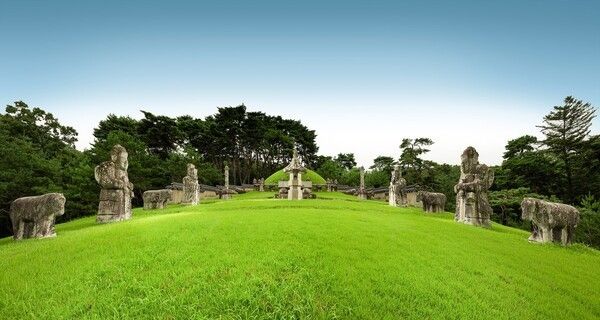
[News Culture] At Yeongneung (寧陵) in Yeoju, Gyeonggi Province, King Hyojong and Queen Inseon lie on the same hillside, but not beside each other. The queen's burial mound occupies the lower slope, while the king's stands farther uphill. Their graves form the first known example of dongwon sanghareung (同原上下陵) in the Joseon Dynasty, an arrangement in which a king and queen are buried at different elevations within a single royal tomb complex.
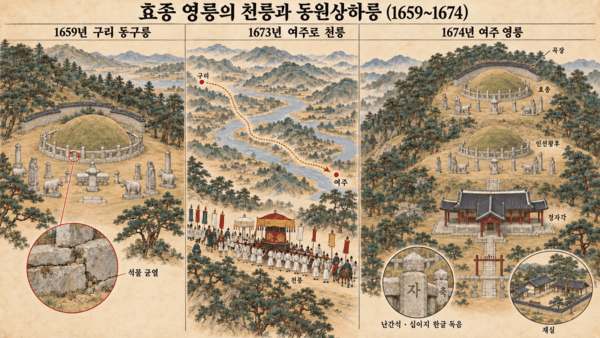
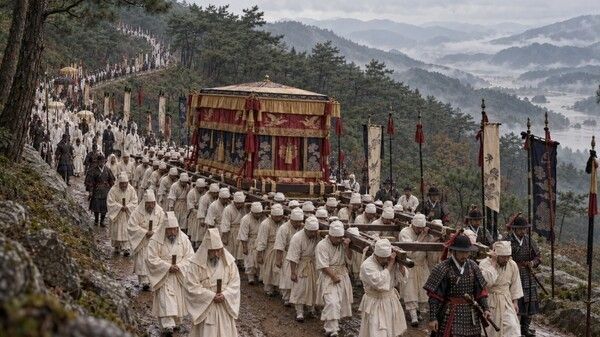
The unusual layout was the outcome of a lengthy dispute over the king's burial site. Hyojong, who died in 1659, was originally interred at Donggureung in present-day Guri. Within a year, cracks had appeared in the stone structures surrounding his grave. Repeated repairs failed to resolve the problem, raising concerns that rainwater might eventually enter the underground burial chamber. In 1673, his son and successor, King Hyeonjong, ordered the tomb moved to Yeoju, 14 years after the original funeral. Yet when the old chamber was opened, inspectors found no evidence of the water damage they had feared.
The decision to relocate the tomb had consequences beyond the choice of a new burial site. It led to changes in the design of the burial mound, the placement of protective stonework and the arrangement of royal graves. The resulting complex provides a record of how political deliberation, geomantic beliefs and funerary architecture intersected in 17th-century Joseon.
From Qing Hostage to King of Joseon
King Hyojong (1619–1659), whose personal name was Ho (淏), was born in Hanyang, present-day Seoul, as the second son of King Injo and Queen Inyeol of the Han clan. After Injo seized the throne in 1623, the young prince received the title Grand Prince Bongnim in 1626. In 1631, he married a daughter of the scholar-official Jang Yu, who would later become Queen Inseon (1619–1674).
His life changed dramatically during the Qing invasion of Joseon in 1636. As Qing forces advanced, King Injo took refuge in Namhansanseong Fortress but surrendered the following year. Crown Prince Sohyeon and his younger brother, Grand Prince Bongnim, were taken to Qing territory as hostages, placing both the heir to the throne and the prince next in line under the authority of the foreign power that had defeated Joseon.
Bongnim spent approximately eight years in Qing territory, from 1637 to 1645. During his captivity, he witnessed the expansion of Qing military power and the decline of the Ming Dynasty. While Sohyeon became interested in Western knowledge and changes taking place under Qing rule, Bongnim's experiences reinforced his determination to avenge Joseon's defeat. The years of captivity would later shape the central political ambition of his reign.
The succession took an unexpected turn after Sohyeon returned to Joseon and died suddenly in 1645. Although the crown prince had sons of his own, Injo designated Bongnim as his successor, arguing that an adult prince was better prepared to govern. The decision provoked controversy over hereditary succession, but Bongnim retained his position as crown prince. Following Injo's death in 1649, he ascended the throne at Injeongmun Gate of Changdeokgung Palace as Joseon's 17th king.
Hyojong's reign became closely associated with bukbeol, the proposed military campaign against the Qing. He appointed influential Western Faction scholars, including Kim Sang-heon, Kim Jip, Song Si-yeol and Song Jun-gil, to government positions while recruiting commanders such as Yi Wan and Yu Hyeok-yeon to strengthen the armed forces. He reorganized the Royal Guards Command, expanded military training and reinforced defensive positions around the capital and other strategic locations.
The proposed campaign, however, faced severe practical constraints. Joseon had yet to recover fully from two devastating Manchu invasions, while the Qing had consolidated control over much of China. A large-scale offensive would have required resources and military strength that Joseon could scarcely assemble. The contradictions of Hyojong's position became apparent in 1654 and 1658, when Joseon sent troops at Qing request to fight Russian forces along the northeastern frontier. Soldiers serving a king who contemplated war against the Qing were instead deployed in support of Qing military operations.
Economic recovery remained another major priority. Acting on proposals from officials including Kim Yuk, Hyojong extended the Daedong tax system into Chungcheong Province and parts of Jeolla Province, seeking to improve the collection of taxes and tribute. He also supported the publication of Nongga Jipseong, a compilation of agricultural knowledge intended to improve farming practices and production.
Although he pursued military reforms and economic reconstruction throughout his reign, Hyojong never launched the northern campaign he envisioned. He died at Daejojeon Hall in Changdeokgung Palace on the fourth day of the fifth lunar month of 1659, roughly a decade after ascending the throne. His sudden death ended his preparations for a confrontation with the Qing and initiated a new series of disputes over where the king should be buried.
A Royal Tomb Troubled by Cracks and Repeated Repairs
The selection of Hyojong's original burial site was contentious from the outset. After Hyeonjong succeeded his father, the court considered locations around Geonwolleung in Guri, as well as sites in Yeoju, Suwon and Gwacheon. Suwon initially emerged as a strong candidate, but officials questioned its geomantic suitability and the disruption that construction would cause to surrounding communities. Some warned that the project could affect more than 500 houses and approximately 700 gyeol of farmland, using the historical unit of agricultural land measurement.
Song Si-yeol and Song Jun-gil were among those who challenged the Suwon site's geographical characteristics. Although Hyeonjong initially favored proceeding with construction there, sustained opposition eventually forced him to abandon the plan. The court instead selected a hillside west of Geonwolleung, the tomb of Joseon's founder, King Taejo, within the Donggureung royal tomb complex. The location was near the site where King Yeongjo's Wonreung would later be established.
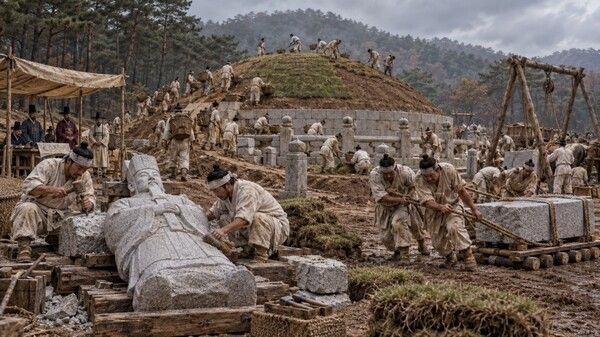
Construction began in earnest in the seventh lunar month of 1659 under the supervision of the Sanneung Dogam, the government office responsible for building royal tombs. The work involved preparing the burial mound, transporting large quantities of stone and commissioning specialized craftsmen to produce the required monuments. Labor shortages and difficulties moving stone from Suwon complicated the project, forcing officials to obtain materials from other quarries. Hyojong was eventually interred on the 29th day of the tenth lunar month of 1659, in a tomb furnished with protective stone panels, railings, statues of civil and military officials, a stone lantern and other ceremonial structures.
The first signs of deterioration appeared soon afterward. Reports from 1660 described gaps opening between sections of stonework and mortar falling away from joints. Cracks developed around the connections between the protective panels and railings, while the alignment of foundation stones and other structural components became unstable. Officials examined the damage and ordered repairs, but further defects were discovered in 1661. Records describe additional work in 1662, 1663, 1667 and 1668, suggesting that the problems persisted despite repeated intervention.
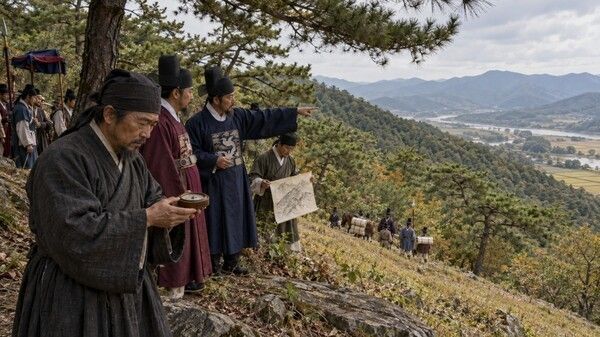
The deterioration was compounded by a fire in 1670 at the subokbang, a building used by attendants responsible for maintaining the royal tomb. By 1673, concern over the condition of the burial complex had become a matter of court debate. Yi Ik-su, an official holding the title Yeongnimburyeong, submitted a memorial noting that repairs had been necessary almost every year since the tomb's construction. Cracks, displaced stones and damaged joints, he argued, could no longer be treated as isolated maintenance problems.
Hyeonjong ordered a detailed investigation. Officials were instructed to reproduce the damaged sections on thin oiled paper, marking the location and extent of individual cracks so the court could assess the condition of the stonework. The discussion increasingly turned to whether the tomb should be repaired once more or moved to a different location.
Of particular concern was the hyeongung (玄宮), the underground chamber containing the royal coffin. Continued deterioration of the surrounding structures raised fears that rainwater might eventually penetrate the chamber. For the court, the issue extended beyond the physical condition of the grave. A royal tomb was both the resting place of a deceased sovereign and a sacred site maintained through state ritual, making any threat to its integrity a matter of considerable political and ceremonial importance.
Hyeonjong ultimately approved the relocation. Rebuilding the tomb elsewhere would require extensive labor and financial resources, but maintaining the existing site had become increasingly difficult to justify. The possibility of water entering the burial chamber weighed heavily in the decision.
The subsequent examination produced an unexpected result. When officials opened the original tomb, they found no evidence that rainwater had entered the chamber. Although the cracks and structural defects were well documented, the feared damage to the king's burial space had not occurred. The relocation nevertheless proceeded, demonstrating the weight the Joseon court placed on preserving the condition and dignity of a royal grave.
Fourteen years after Hyojong's original funeral, the king's remains were transferred to Yeoju. A prolonged problem of stonework and maintenance had become the catalyst for a major change in royal burial architecture.
One Hillside, Two Royal Tombs
In 1673, the court selected a new burial site in the Hongje-dong area of Yeoju, close to the tomb of King Sejong and Queen Soheon. Both burial sites are called Yeongneung in Korean, although their Chinese characters differ: 英陵 for Sejong and 寧陵 for Hyojong. The new location offered an opportunity to reconsider not only the construction of Hyojong's tomb but also the eventual burial arrangement for Queen Inseon.
Hyeonjong initially considered the conventional form of a paired royal tomb, with the king and queen placed side by side. During discussions in the sixth lunar month of 1673, however, Min Yu-jung questioned whether such an arrangement would make the best use of the hillside's geomantic features. He argued that placing two mounds horizontally could leave neither grave on the jeonghyeol (正穴), the point regarded in traditional geomancy as the most favorable location within the surrounding landscape.
Royal burial sites were selected through a detailed assessment of the main mountain, the direction of ridgelines, surrounding terrain and the flow of water. In this system, the jeonghyeol was understood as the point where favorable geographical forces converged. Min maintained that a side-by-side arrangement might place this point between the two mounds, rather than beneath either of them. He therefore proposed positioning the graves at different elevations along the same ridge, allowing the two burial mounds to follow the natural contours of the hillside.
The court accepted the proposal, establishing the form known as dongwon sanghareung. Hyojong's remains were reinterred in Yeoju in 1673, while the lower section of the burial ground was reserved for his queen.
Queen Inseon died in the second lunar month of 1674. A member of the Deoksu Jang clan, she had shared Hyojong's years of captivity in Qing territory before becoming queen upon his accession in 1649 and queen dowager when Hyeonjong inherited the throne. Her death triggered another major dispute over royal mourning rites, known as the Second Yesong Dispute. The central question was how long Queen Jangnyeol, King Injo's second wife, should mourn for Inseon. What began as a debate over Confucian ritual prescriptions escalated into a political confrontation between rival factions.
Inseon was buried on the fourth day of the sixth lunar month of 1674, on the slope below her husband's tomb. The arrangement completed Joseon's first dongwon sanghareung. Although the mounds occupy different elevations, each has its own burial setting, including stone railings, statues of civil and military officials, stone horses, a lantern, memorial pillars and sculptures of sheep and tigers.
One notable distinction lies in the curved stone wall known as a gokjang (曲墻), which encloses the rear and sides of the king's burial mound. No corresponding wall surrounds the queen's lower tomb, reflecting the treatment of the two graves as parts of a unified burial complex. The layout subsequently provided a precedent for later royal burials, including Uireung, where King Gyeongjong and Queen Seonui were interred in a similar arrangement.
The change arose from a specific disagreement over the geomantic qualities of the Yeoju hillside, but its influence extended beyond Hyojong's tomb. The new design demonstrated how established royal burial conventions could be adapted when officials believed the terrain demanded a different solution.
The Stone Screen Disappears, Zodiac Characters Take Its Place
The relocation also brought significant changes to the structures surrounding the burial mound. Hyojong's original tomb at Donggureung had featured byeongpungseok, protective stone panels encircling the lower part of the grave. Such panels were often decorated with zodiac guardians, clouds and other carved motifs. Even during the construction of the first tomb, however, their decoration had provoked disagreement.
Song Jun-gil questioned whether some of the figures carved into the panels resembled Buddhist images, raising concerns over their appropriateness at a Confucian royal burial site. The officials responsible for construction maintained that the figures represented directional guardians rather than Buddhist deities. When the court planned the new tomb in 1673, it chose to eliminate the stone screen altogether, drawing on precedents from the tombs of King Sejo and King Sejong.
Instead, the burial mound was surrounded by stone railings, and the directional markings formerly associated with the panels were incorporated into the railing supports. Craftsmen inscribed characters representing the twelve Earthly Branches, the traditional zodiac system, on the small stone pillars known as dongjaseokju. Characters such as ja (子), chuk (丑), in (寅) and myo (卯) marked directions according to the traditional system.
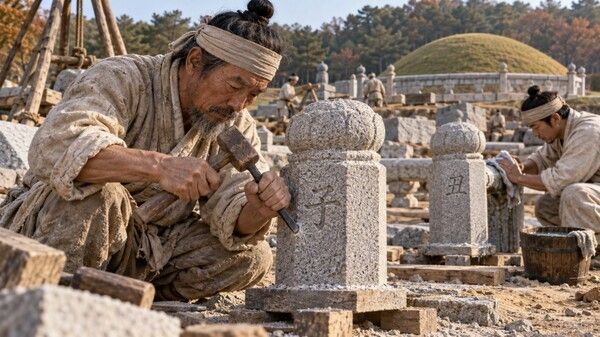
The redesign extended to the dimensions and assembly of the stonework. Horizontal railing stones were lengthened to reduce the number of individual components, while other dimensions were determined through comparisons with earlier royal tombs. For the statues of civil and military officials, craftsmen studied examples at Hyoreung, the tomb of King Injong. Court painters and stonemasons examined the forms before adapting them for Yeongneung, producing sculptures that retained characteristics of 16th-century royal tomb art while reflecting 17th-century carving techniques.
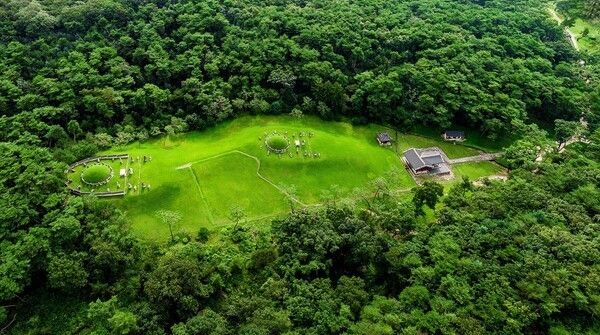
Hyojong's burial mound measures approximately 12 meters in diameter and 4.2 meters in height. Four stone sheep and four stone tigers stand around the grave as symbolic guardians. A stone offering table and memorial pillars occupy the area immediately before the mound, while the middle terrace contains a stone lantern, civil-official statues and stone horses. Military-official statues and their horses stand on the lower terrace. Queen Inseon's tomb has a comparable arrangement of stone monuments.
The tomb's commemorative stele represents another development in Joseon royal burial practice. Earlier royal tombs had sometimes featured sindobi, large monuments recording the achievements of the deceased, but the use of such inscriptions changed after the reign of King Munjong. Following Hyojong's relocation, the court debated whether to erect a pyoseok, a memorial stone identifying the king by his temple name and the tomb by its official designation.
Those discussions continued into the reign of King Sukjong, and the stele was eventually erected in 1682. It is regarded as the first example of this form of memorial stele at a Joseon royal tomb and became a precedent for later royal burial monuments.
The relocation also introduced a notable change in the production of jiseok (誌石), inscribed burial records identifying the deceased and documenting their life. Stone had traditionally been used for such records in Joseon state funerals, but accounts of the 1673 relocation describe the production of a white porcelain jiseok instead. This departure from earlier practice offers another example of the technical and material changes associated with Hyojong's reburial.
Taken together, the modified railings, sculptures, memorial stele and porcelain burial record illustrate how the reconstruction of a single royal tomb became an occasion for revising established funerary practices. The changes were not merely decorative: they reflected decisions about construction methods, ritual conventions and the preservation of royal memory.
A 300-Year-Old Boxwood and the Buildings That Sustained Royal Rituals
Among Yeongneung's surviving structures, the jaesil (齋室), or royal tomb ritual and administrative complex, is especially significant. Its buildings accommodated officials responsible for maintaining the site, preparing ancestral offerings and overseeing the equipment required for ceremonies. The complex is considered one of the best-preserved examples of Joseon royal tomb administrative architecture and was designated a nationally protected Treasure in 2007.
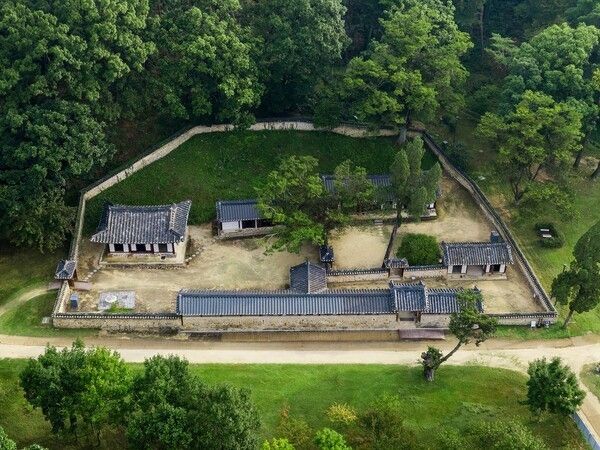
The jaesil's history is closely connected with the tomb's relocation. The original buildings were constructed at Donggureung in 1659 and subsequently dismantled and moved to Yeoju when Hyojong's remains were transferred in 1673. Their position appears to have been adjusted again following Queen Inseon's burial in 1674.
The surviving complex includes the anhyangcheong, jegigo, principal administrative and residential buildings, and adjoining quarters. The anhyangcheong served functions associated with ceremonial preparations, while the jegigo housed ritual vessels and other supplies. Officials including the chambong, who supervised tomb management, worked and resided within the complex. Attendants known as subok carried out maintenance duties and supported the observance of royal ancestral rites.
These buildings offer evidence of the daily operations behind Joseon's royal burial system. A royal tomb was not simply a monument to a deceased ruler. It remained an active state institution requiring personnel, resources and regular ceremonial observance. The jaesil provided the infrastructure necessary to sustain those functions over successive generations.
Nearby stands one of Yeongneung's most distinctive natural features: a boxwood tree estimated to be approximately 300 years old. Boxwood is generally a low-growing evergreen shrub, but the specimen at the royal tomb has reached an exceptional size through centuries of growth. It was designated a Natural Monument in 2005.
According to a local tradition, the tree was transplanted from Guri when Hyojong's tomb was moved to Yeoju in 1673. Its precise planting history cannot be established with certainty, but the tree's long association with the jaesil grounds makes it an important part of the site's cultural landscape.
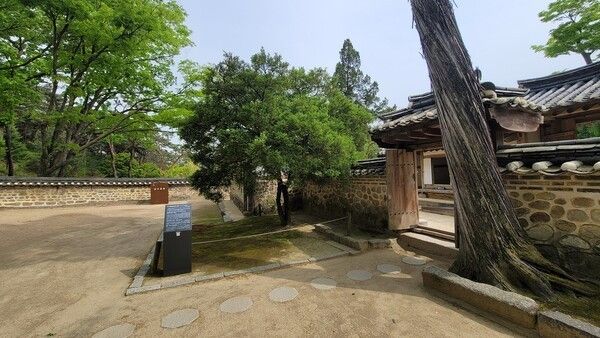
Beyond the jaesil, Yeongneung preserves the spatial organization of royal ancestral ceremonies. The hongsalmun, a red wooden gate, marks the entrance to the sacred precinct. From the gate, two parallel paths lead toward the ceremonial shrine. The hyangno was used to carry incense and ritual prayers, while the eoro was reserved for the king or designated ritual officials. The different elevations of the paths expressed the hierarchy embedded in royal ceremonial practice.
Yeongneung also has an unusual arrangement of its geumcheongyo, a bridge crossing the watercourse within the burial grounds. At most Joseon royal tombs, the bridge stands before the hongsalmun. Here, it is situated between the gate and the ceremonial shrine, a relatively uncommon placement shaped by the natural course of water through the site.
The jeongjagak, or T-shaped ceremonial shrine, served as the principal setting for ancestral offerings to the deceased king and queen. Its name derives from its floor plan, which resembles the Chinese character 丁. The surrounding precinct also contained the suragan, where ceremonial food was prepared, and the subokbang, used by tomb attendants. A separate bigak, or stele pavilion, houses the stone monument commemorating the royal burial.
The arrangement shows how the burial mounds, ceremonial buildings and surrounding terrain formed a single managed landscape. The elevated graves marked the resting places of the king and queen, while the structures below provided the setting for the rites through which successive generations honored them. Architecture, administration and Confucian ritual were inseparable parts of the royal tomb's continuing function.
Hyojong's life remains closely associated with his years as a Qing hostage and his unsuccessful ambition to launch a northern military campaign. Yet the history of his burial reveals another dimension of his reign's legacy. The cracks that appeared in his original tomb prompted years of repairs, an extensive court investigation and, ultimately, the decision to move his remains. The discovery that the burial chamber had remained dry did not reverse that decision, and the new tomb introduced architectural forms that would influence later royal burials.
The hillside at Yeoju preserves the successive stages of that history: Hyojong's first burial in 1659, his relocation in 1673 and Queen Inseon's burial in 1674. The resulting arrangement, with the king above and the queen below, remains a distinctive example of how Joseon officials reconciled funerary convention with geomantic considerations and changing construction practices.
At Yeongneung, the two burial mounds are only part of the historical record. The stone monuments, ceremonial buildings, memorial inscriptions and centuries-old boxwood preserve evidence of the decisions and labor involved in maintaining a royal tomb long after the monarch's death. Together, they document not only how a Joseon king was buried twice, but how that second burial left a lasting mark on the dynasty's royal tomb architecture.
Reported by News Culture M.J._mj94070777@nc.press
Copyright ⓒ 뉴스컬처 무단 전재 및 재배포 금지


