
[News Culture] In 44 BCE, Cicero was watching the political world that had defined his life come apart. Julius Caesar had been assassinated, the Roman Republic was entering another period of upheaval, and one of Rome’s most celebrated orators found himself increasingly removed from the arena where he had built his reputation.
He turned instead to philosophy. Addressed to his son Marcus, “On Duties” became a sustained argument about how a person should act when principle and self-interest appear to point in different directions. Nearly two millennia later, EBS1’s “AI Classics: 100 Books That Changed History” returns to that question in a 10-part series beginning Oct. 19.


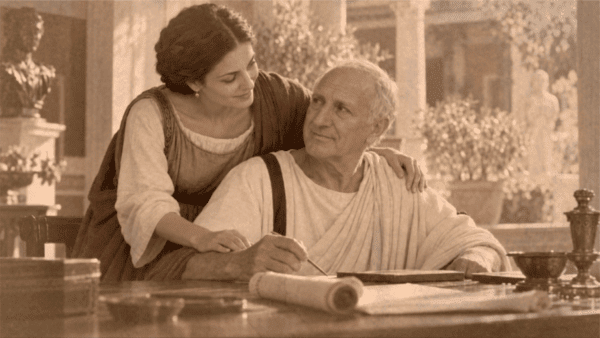
Written in three books, “On Duties” moves from the morally honorable to what appears useful, before bringing the two into direct confrontation. Cicero drew in part on the Stoic philosopher Panaetius, but pushed the unfinished discussion further by asking what should happen when advantage seems to demand a compromise in principle.
His answer leaves little room for that compromise. What is genuinely beneficial, Cicero argues, cannot ultimately be separated from what is morally right. A choice may produce an immediate gain, but if it depends on injustice, deception or the abandonment of duty, the apparent advantage is already compromised.
That argument gives the work much of its continuing force. The political institutions, social hierarchy and moral vocabulary of late Republican Rome belong to another age, but the tension Cicero identifies remains familiar: what happens when doing what seems profitable conflicts with doing what one believes is right?
The series approaches that tension through the examples Cicero himself used. The Ring of Gyges raises the question of how a person behaves when wrongdoing can be committed without fear of discovery, while the story of Regulus tests whether obligation should survive even when honoring it brings devastating personal consequences. Other episodes examine justice and competing claims of duty, using extreme cases to expose the assumptions behind ordinary moral choices.
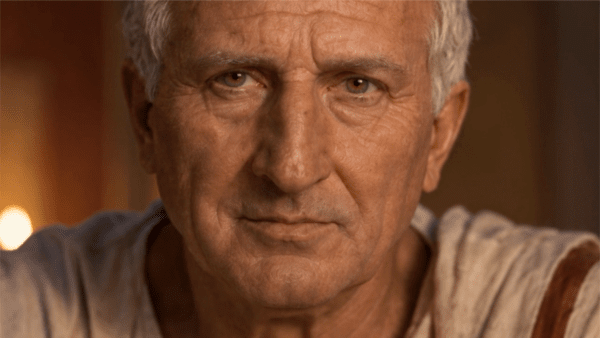

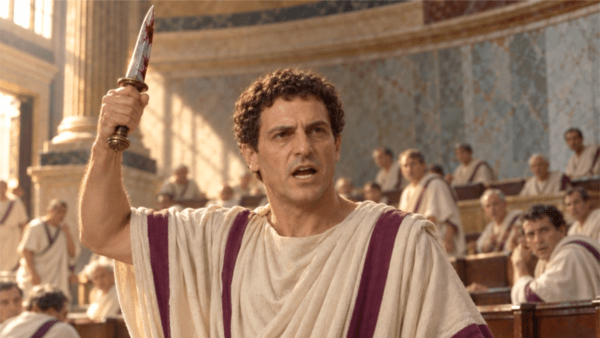
The first installment introduces Cicero’s life and the political world in which “On Duties” was written, while episodes two through 10 work through the major arguments of the three books. Seong-jin Lim, a researcher at the Jeongam Academy, served as an academic adviser.
The program uses AI to recreate Cicero’s face and voice, presenting the lectures in the first person as though the Roman statesman were explaining the work himself. That format draws on the original structure of the book: Cicero wrote “On Duties” for his son, and the television version turns that private act of instruction outward toward a contemporary audience.
The text itself has already survived several major transformations in the history of reading. A printed edition appeared in 1465, placing “On Duties” among the works that entered circulation during the early decades of European movable-type printing. A book that had survived for centuries through manuscript transmission could now reach readers on a very different scale.

That long afterlife helps explain why the work continues to be revisited. Cicero was writing at a moment when political authority, personal standing and the future of the republic were all uncertain, yet his response was not a manual for recovering power. He chose instead to ask what obligations remain when circumstances make expediency tempting.
“On Duties” therefore reaches beyond individual morality. Its arguments also touch public responsibility, leadership and the standards by which a community judges actions carried out in the name of advantage.

The historical setting has changed completely, but the pressure behind the question has not. When something profitable appears to require abandoning a principle, Cicero asks whether it was ever truly in one’s interest to begin with.
EBS1’s “AI Classics: 100 Books That Changed History” series on Cicero’s “On Duties” airs weekdays from Oct. 19 through 30 at 12:05 a.m. KST.
Reported by News Culture M.J._mj94070777@nc.press
.
Copyright ⓒ 뉴스컬처 무단 전재 및 재배포 금지


