[News Culture] Moral principles are supposed to tell us what is right and wrong, yet they rarely operate with the consistency people imagine. We condemn another person’s dishonesty while finding an exception for our own, oppose violence while defending it when used by a group we support, and treat beliefs shaped by our circumstances as if they were universal truths.
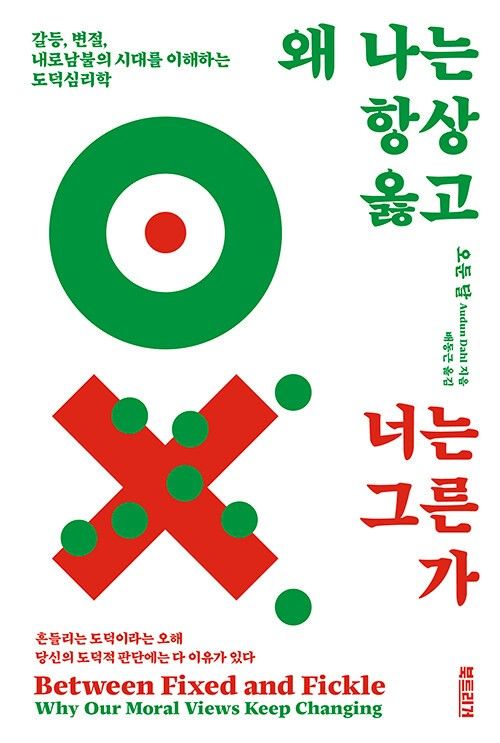
In “Between Fixed and Fickle: Why Our Moral Views Keep Changing,” Cornell University psychologist Audun Dahl examines why moral judgments vary across individuals, situations and historical periods. The book has been published in Korean by Book Trigger under the title “Why Am I Always Right and You Are Wrong,” in a translation by Dong-geun Bae.
History offers some of the clearest evidence of moral change. Slavery, now recognized as a profound injustice, was sustained for centuries by societies that considered themselves civilized. Thomas Jefferson proclaimed human liberty as the principal author of the Declaration of Independence while enslaving hundreds of people. Those convictions, irreconcilable from a contemporary perspective, coexisted within the same person and political order.
Slavery was abolished in the United States through the 13th Amendment in 1865, but its long acceptance raises a difficult question. Were people in the past simply less moral, or did they direct moral concern toward different people, facts and values? Dahl is less interested in excusing historical wrongdoing than in understanding how practices once treated as ordinary become morally indefensible.
The book moves from slavery and women’s rights to corporal punishment and the trolley problem, tracing moral judgment across personal development, everyday choices and social history. The issues differ, but each shows that people do not apply a single principle mechanically. They decide what matters, whose welfare counts and which value should take precedence when freedom, equality, safety, tradition and responsibility collide.
Moral change is therefore neither completely fixed nor arbitrarily fickle. A judgment may shift when someone learns new facts, encounters a previously excluded perspective or reconsiders the balance between competing values. What appears to be inconsistency can reflect a genuine revision of what a person understands the situation to involve.
That does not mean every judgment is equally valid. Understanding the experiences or assumptions behind another person’s decision is different from declaring the resulting action right. Context may explain why someone acted as they did, but it does not erase the harm caused or remove the need for moral evaluation.
Dahl’s approach instead asks readers to inspect the architecture of a judgment. Which value was given priority? Who was included in the circle of concern, and who was left outside it? Was the same rule applied to allies and opponents? Did self-interest create an exception that would be denied to someone else?
These questions also change the terms of moral disagreement. Treating an opponent as malicious or irrational may make condemnation easier, but it reveals little about how the disagreement arose. Understanding another person’s reasoning can expose the assumptions behind it while also forcing us to examine the origins and consistency of our own convictions.
The book’s warning extends beyond the errors of the past. Practices widely accepted today may appear indefensible to future generations, just as slavery does now. Dahl considers abortion, climate change, war and economic inequality among the issues on which later societies may judge the present far more harshly than it judges itself.
This is not an argument that morality is merely relative or that certainty should be abandoned. It is a case for treating moral confidence as something that must remain open to evidence, consequences and scrutiny. The danger lies not in holding principles, but in assuming that our current application of them cannot be mistaken.
“Between Fixed and Fickle” ultimately redirects moral inquiry away from exposing the failures of others and toward examining our own. The most responsible way to defend today’s values may be to ask repeatedly whom they protect, whom they burden and whether we live by them when doing so becomes inconvenient.
Reported by News Culture M.J._mj94070777@nc.press
Copyright ⓒ 뉴스컬처 무단 전재 및 재배포 금지


