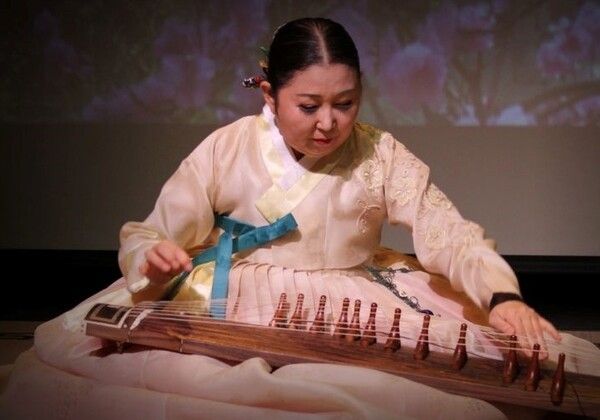
[News Culture] On Sept. 24, 1996, gayageum and ajaeng master In-young Baek took the stage at the National Gugak Center. After performing the gayageum sanjo he had inherited from Dae-bong Yoo, Baek entrusted one of his own works, “Sinawi Nadeuri,” to a group of younger gayageum players. Among them was Ok-seon Chae.
Three decades later, Chae is returning to that music in her own recital.
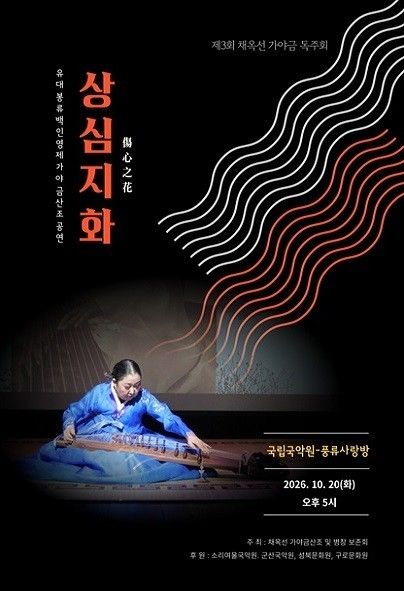
Her third gayageum solo concert, “Sangsimjihwa” (傷心之花), brings together three works connected to Baek’s musical legacy: the Yoo Dae-bong-lineage gayageum sanjo in Baek In-young’s version, “Sinawi Nadeuri,” and the gayageum byeongchang piece “Saetaryeong.” The program moves from solo sanjo to ensemble improvisation and finally to singing with the instrument, allowing different aspects of the same musical inheritance to emerge in succession.
The title “Sangsimjihwa” evokes the image of a flower growing from a wounded heart. Yet the musical focus is less metaphorical than genealogical. Yoo’s repertory passed to Baek, who expanded and transmitted it to another generation; Chae, once one of the young musicians on Baek’s stage, now carries that material into a recital under her own name.
The opening sanjo begins with daseureum before moving through jinyangjo, jungmori, jungjungmori, jajinmori and hwimori. Baek added the daseureum to the music he had learned from Yoo, shaping an opening that moves from ujo toward gyemyeonjo before the main rhythmic progression begins.
As the music enters jinyangjo, the longer phrases give Chae room to work with the deep nonghyeon and pitch inflections central to the repertory. The melodic character shifts from the weight of ujo through the lighter color of gyeongdeureum and into the more intense sound of jin-gyemyeon.
Those contrasts are fundamental to the sanjo. Gyeongdeureum draws on the brighter, more agile color associated with Gyeonggi vocal style, while jin-gyemyeon carries the stronger inflections of southern Korean music. The tension between them gives the repertory much of its tonal range.
Changes continue through jungmori and jungjungmori, where the music shifts between gyemyeonjo and gyeongdeureum and occasionally relocates its tonal center through byeoncheong. The result is not a simple progression from slow to fast, but a continual rebalancing of pitch, mode and emotional weight.
By jajinmori, the playing becomes more assertive. Elements associated with geomungo-style melodic writing and strongly articulated plucking come to the fore, while hwimori drives the work toward its close. One distinctive technique is the so-called “seureureong,” which recalls the scraping resonance of the geomungo and gives the gayageum a tougher, more percussive edge.
The second work, “Sinawi Nadeuri,” carries a particularly direct history for Chae. Baek included the piece in his 1996 National Gugak Center recital as a gayageum duet, performed by Yeong-ae Jo, Ok-seon Chae and Seong-yeon Kim across two parts, with Woo-chil Choi on janggu. Chae also appeared in Baek’s arrangement of “Paldo Minyo-gok” on the same program.
Her connection to the music continued after Baek’s death in 2012. In 2014, she performed at a memorial concert marking the second anniversary of his passing, joining senior musicians including Gyeong-man Choi, Cheol-ju Lee and Cheong-man Kim in repertory associated with Baek.
“Sinawi Nadeuri” draws on the musical logic of sinawi, the improvisatory instrumental tradition rooted in the shamanic music of Korea’s southern regions. Its ensemble texture does not depend on every player reproducing the same melody. Musicians share a tonal language, jangdan and vocabulary of sigimsae, but move independently within that framework, answering one another or allowing separate lines to coexist.
Improvisation here is not unrestricted freedom. The players must understand the same modal and rhythmic grammar and make constant decisions in response to what they hear around them. Baek adapted that principle to the gayageum ensemble, extending some of the tonal flexibility and spontaneous interaction of sanjo into a multi-player setting.
For Chae, the return to “Sinawi Nadeuri” is therefore more than a revival of a piece she once performed. It places the sound of her younger years beside the musician she has become over the intervening 30 years.
The recital closes with “Saetaryeong,” one of the best-known songs in the southern folk repertory, performed here as gayageum byeongchang. The text brings together an array of birds — swallows, phoenixes, parrots, cranes, wild geese, cuckoos and orioles — using their movements and calls as material for vocal play.
Gayageum byeongchang demands a different coordination from either sanjo or ensemble playing. The performer must sing while simultaneously controlling right-hand articulation, left-hand nonghyeon and the instrumental responses between vocal phrases. In “Saetaryeong,” imitation of birdsong adds another layer of vocal character, with differences in register, rhythm and articulation helping distinguish one bird from another.
The sequence of the program is therefore deliberate. In the sanjo, a single gayageum carries the musical argument. In “Sinawi Nadeuri,” several instrumental lines interact. In “Saetaryeong,” the performer’s own voice enters the texture. Solo playing, ensemble exchange and song become three different ways of hearing the musical language Chae inherited.
Baek himself had received the Yoo Dae-bong repertory and developed it into a distinctive body of music. At a time when the Yoo lineage was becoming less widely heard, he preserved and expanded it through performance, notation, recording and teaching. Chae was among the musicians who absorbed that work directly from him.
Transmission in sanjo, however, involves more than memorizing melodic sequences. A player must understand how the music handles tonal centers, how nonghyeon changes from one mode to another, where a phrase is allowed to stretch, and how the southern weight of gyemyeon can sit beside the lighter movement of gyeongdeureum.
“Sangsimjihwa” places those questions across three forms rather than answering them in a single work. Yoo Dae-bong died in 1974; In-young Baek died in 2012. The musicians who first shaped and transmitted this repertory are gone, but their musical choices remain audible in the hands of the players who followed.
In 1996, Chae performed “Sinawi Nadeuri” on her teacher’s stage. Thirty years later, she brings it back under her own name, alongside the sanjo Baek inherited and reshaped. What has been passed down is not simply a sequence of notes, but a way of hearing and responding — one that now sounds through another performer’s hands.
Reported by News Culture M.J._mj94070777@nc.press
Copyright ⓒ 뉴스컬처 무단 전재 및 재배포 금지


