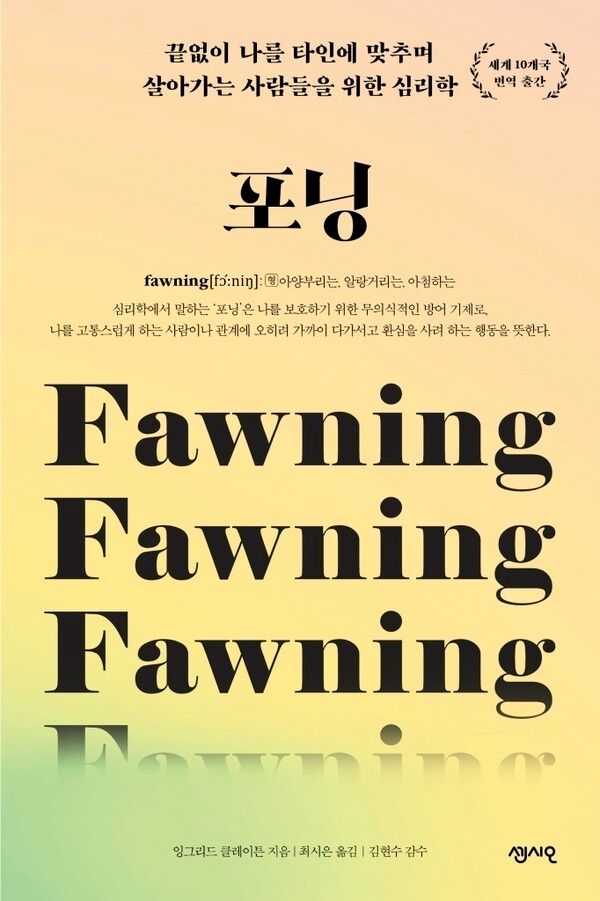
[News Culture] Some apologies are less about regret than survival. When a person has learned that disagreement may bring punishment, rejection or abuse, saying “I’m sorry” can become a way to anticipate danger and keep the peace. In “Fawning,” clinical psychologist Ingrid Clayton argues that such behavior is not simply evidence of low self-esteem or a weak personality, but a protective response shaped by threat.
The book’s full English title is “Fawning: Why the Need to Please Makes Us Lose Ourselves—and How to Find Our Way Back.” Published in Korean by Sensio in a translation by Si-eun Choi, it examines what Clayton describes as an often-overlooked fourth trauma response alongside fight, flight and freeze.
Fawning occurs when someone moves closer to a person or relationship causing harm rather than resisting or withdrawing. The response may take the form of excessive apologizing, conflict avoidance, constant vigilance or caring for others at one’s own expense. In an unsafe environment, winning over a threatening person can reduce immediate danger. The difficulty begins when that once-useful strategy becomes an automatic pattern long after the original threat has passed.
Clayton’s reframing shifts the question from “Why did you allow this to happen?” to “What did you have to do to survive?” That change matters because shame often compounds the original harm. People may blame themselves for remaining in abusive relationships, tolerating mistreatment at work or repeatedly surrendering their own needs, without recognizing that their nervous systems had learned accommodation as a route to safety.
Rather than build the book around clinical theory alone, Clayton draws on her experience as a survivor of sexual abuse, two decades of work in trauma recovery and seven client case studies. They include a Harvard Law School graduate whose perfectionism concealed persistent fear and a woman whose addiction and compulsive lying had become entangled with her attempts to survive. Their stories show how fawning can assume different forms while producing similar losses of agency.
Recovery, Clayton argues, does not begin by condemning the response or demanding immediate confidence. It starts with acknowledging that fawning once served a purpose. Treating the behavior with compassion allows survivors to separate an adaptive strategy from an identity they had come to regard as defective.
That understanding does not require remaining in damaging relationships. Clayton presents boundary-setting as an act of self-protection rather than a campaign to reform another person. Leaving an exploitative relationship, refusing an unreasonable demand or tolerating someone else’s disappointment becomes a way to restore choice.
The process is neither clean nor final. A person may establish a boundary and later retreat from it, or recognize a pattern only after repeating it. Clayton resists turning healing into another standard of perfection, asking readers to treat such reversals as part of recovery rather than proof of failure.
The book also makes room for anger, an emotion chronic fawners often suppress because conflict feels dangerous. Healthy anger can identify a violation, protect a boundary and return attention to needs that have long been subordinated to those of others. Learning to disagree therefore becomes less about provoking confrontation than about accepting that genuine relationships cannot be built on one person’s disappearance.
“Fawning” offers a compassionate account of why people remain agreeable, invisible or endlessly accommodating in situations that hurt them. Its central argument is that survival strategies deserve gratitude for the protection they once provided—but they do not have to govern the rest of a person’s life.
Reported by News Culture M.J._mj94070777@nc.press
Copyright ⓒ 뉴스컬처 무단 전재 및 재배포 금지


