[News Culture] In Intra Muros, a theater workshop inside a prison becomes less a lesson in acting than a way of approaching lives that have been reduced to what happened before incarceration.
Written by French playwright Alexis Michalik, the play begins when theater director Richard agrees to lead a workshop at a prison at the suggestion of Alice, a social-work intern. His former wife and actor Jeanne joins him. What appears to be a small class gradually opens onto the histories of Kevin, a young inmate, and Ange, a longtime prisoner, whose seemingly separate stories begin to intersect.
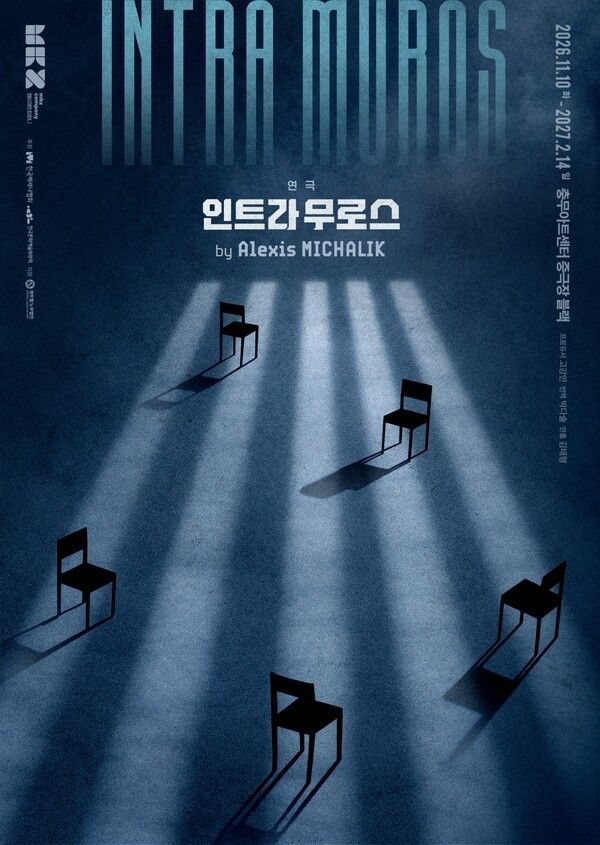
First staged in France in 2017, Intra Muros will receive its Korean premiere in November.
The workshop provides the production with its central theatrical device.
Exercises involving role reversal and reenactment ask the participants to perform experiences rather than simply recount them. Kevin begins to reveal what lies behind his abrasive manner, while Ange, initially reluctant to speak, is drawn into revisiting events he has kept to himself.
The distinction between testimony and performance matters. A remembered event does not return to the stage as an objective record. It is reconstructed through another body, another point of view and the distance created by performance.
That allows Intra Muros to move between present action and remembered experience without treating memory as fixed.
Reenacting the past can expose details that were not apparent when an event first occurred. Taking another person’s role can also change how a character understands a relationship or conflict. Michalik uses those theatrical exercises to make interpretation itself part of the drama.
The play does not suggest that disclosure erases what happened.
The consequences of past actions remain, as does responsibility for them. What changes is the amount of information available to the people listening. Characters initially encountered through a limited set of facts become more difficult to reduce to those facts alone.
That is particularly significant in the prison setting.
The inmates are accountable for the actions that brought them there, but Intra Muros separates accountability from the assumption that a conviction can explain an entire life. As Kevin and Ange’s histories emerge, the production adds context without turning that context into exoneration.
Richard, Jeanne and Alice are also drawn into that process.
They begin as the people facilitating or observing the workshop, but listening to the inmates’ stories changes the position from which they judge what they hear. The class therefore does not operate as a one-way exercise in rehabilitation. It becomes an exchange in which the people watching and directing the performances are also required to reconsider their assumptions.
Reality and Performance Begin to Overlap

Michalik builds the play through a metatheatrical structure in which actors move between present-day characters and figures from remembered events.
As those reenactments accumulate, details introduced earlier can acquire different meanings. What first appears to be one person’s account may look different once another perspective enters the story.
The resulting reversals give Intra Muros the mechanics of a mystery, but the dramatic function goes beyond revealing withheld information. The play repeatedly asks how much confidence can be placed in a story when memory, perspective and performance are all shaping what the audience sees.
Acting operates in two directions.
It can conceal, because a person can assume another identity. It can also disclose, because playing a role may allow something difficult to say directly to emerge through performance.
The title, meaning “within the walls,” refers most immediately to the prison. The stage, however, allows the characters to move beyond that physical boundary by reconstructing people, places and relationships that exist outside the room.
Five principal roles support that shifting structure, with performers moving through additional characters as the past is reconstructed.
Seok-jun Lee, Dae-seok Oh and Do-bin Kim alternate as Ange. Seok-jin Choi, Jae-hwan Jung and Doo-ho Park play Kevin.
Na-hyun Hong, Nak-won Yoo and Jung-hwa Lee share the role of Alice, while Jae-beom Kim, Jung-taek Oh and Chang-yong Ahn alternate as Richard. Soo-rim Han, Yu-min Oh and Seo-hyun Lee play Jeanne.
The multiple-role structure allows the production to change time, place and identity without leaving the confined setting that frames the workshop. Rather than building separate realistic environments for each memory, the actors themselves become the mechanism through which the story expands.
That is where the prison workshop and the play’s metatheatrical form meet.
Intra Muros is not concerned with theater as a method that automatically heals trauma or resolves damaged relationships. Its interest lies in what performance can make possible: giving an experience another form, allowing another person to inhabit part of it, and creating enough distance for a memory to be examined from a different position.
For the audience, the same mechanism complicates first impressions.
Information arrives in stages, and characters who appeared easy to classify become harder to read as their histories overlap. Understanding more about someone does not erase responsibility, but it can change the terms on which that responsibility is considered.
Intra Muros runs from Nov. 10 through Feb. 14, 2027, at the Black Theater at Chungmu Arts Center in Seoul.
Reported by News Culture M.J._mj94070777@nc.press
Copyright ⓒ 뉴스컬처 무단 전재 및 재배포 금지


