[News Culture] Korean traditional dance often finds its expressive force not in dramatic gesture but in the relationship between movement, breath and rhythm. A pause can hold as much weight as a turn; a carefully placed step can redirect the mood of an entire phrase. Those qualities run through the two works Daejeon Yeonjeong Korean Traditional Music Group will present at the 2026 Korea Traditional Dance Festival on October 24, with choreographer Yeong-ae Park approaching tradition from two different directions: inward reflection in Sanjo Dance for Flowers and the recombination of established repertory in Daepungnyu Seungmu·Geommu Hapseol.
Sanjo Dance for Flowers takes solitude as its emotional starting point. Rather than building around an external conflict or dramatic event, the work follows the quieter process of confronting loneliness, allowing it to settle and finding the resolve to move beyond it. Its idea of consolation is therefore not presented as a sudden transformation but as a gradual shift in emotional weight, carried by the body rather than explained through narrative.
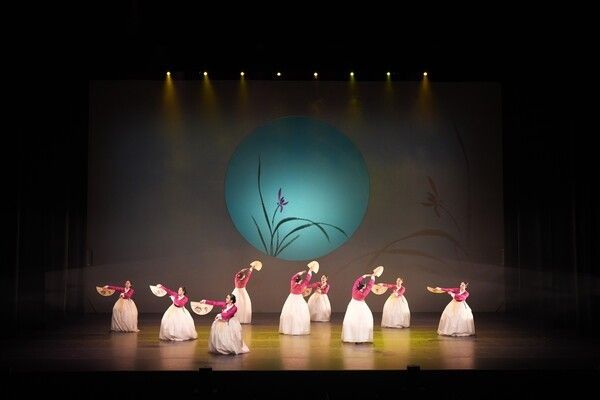
Sanjo provides a natural framework for that progression. Traditionally performed as an instrumental solo with janggu accompaniment, sanjo moves through changing rhythmic cycles, often beginning with the expansive pace of jinyangjo before developing through jungmori, jungjungmori and jajinmori. As the pulse changes, tension gathers and releases, and the music continually alters its sense of direction. Sanjo dance translates that elasticity into movement, allowing breath, posture, footwork and timing to respond directly to changes in rhythm and melodic phrasing.
In Sanjo Dance for Flowers, that relationship between music and body gives the work its emotional shape. A gesture can linger within a slower passage before tightening as the rhythm accelerates; stillness can interrupt motion without stopping the larger flow. Rather than displaying emotion overtly, the choreography relies on restraint and controlled release, using the inherited vocabulary of Korean dance to address a distinctly contemporary state of mind. The work belongs to the realm of newly created traditional dance precisely because it does not reproduce an established repertory piece intact. Instead, it uses traditional movement principles as a language through which present-day feelings of solitude, endurance and recovery can be expressed.
The program then shifts from introspection to construction with Daepungnyu Seungmu·Geommu Hapseol. Here, Park brings together two traditions with markedly different visual identities and reorganizes them within the rhythmic framework of daepungnyu. Seungmu draws much of its character from regulated breath, restrained phrasing and the expansive motion of the jangsam, whose long sleeves allow relatively contained movements of the body to travel outward through space. Geommu works differently. The swords sharpen the direction of the dancer’s gestures, emphasizing turns, footwork and changes of orientation with a more defined geometric quality.
Rather than presenting those forms one after another as repertory excerpts, the work asks what happens when their contrasting movement languages share the same compositional space. Daepungnyu provides the musical foundation for that encounter. With wind and percussion instruments historically used in dance accompaniment, its rhythmic flow allows the two forms to remain distinct while participating in a larger structure. Seungmu retains its breadth, breath and suspended motion; geommu retains the clarity created by the swords and its more sharply articulated changes of direction. Their differences are not erased but used to generate the work’s internal tension.
That is also where the idea of hapseol becomes important. The aim is not simply to combine two familiar dances into a medley. The interest lies in creating a new relationship between them — one in which movement, rhythm and musical phrasing determine how the traditions meet. The result turns inherited repertory into compositional material without stripping it of the formal characteristics that make each dance recognizable.
Seen together, the two works reveal complementary approaches to tradition. Sanjo Dance for Flowers expands traditional dance through subject matter, using inherited movement to address the emotional experience of the present. Daepungnyu Seungmu·Geommu Hapseol expands it through structure, reconsidering how established dance forms can interact within a new choreographic frame. One begins with the inner state of the individual; the other begins with the relationship among existing forms.
Yet both depend on the same principle: tradition remains active only when it continues to be embodied and reinterpreted. A rhythmic cycle survives because dancers continue to respond to it. A gesture remains meaningful because it can be learned, altered in context and placed in relation to another movement. Repertory endures not simply because its outward form is preserved, but because performers continue to test what that form can express.
Daejeon Yeonjeong Korean Traditional Music Group’s festival program places those two possibilities on the same stage. Sanjo Dance for Flowers turns sanjo’s changing pulse toward solitude and consolation, while Daepungnyu Seungmu·Geommu Hapseol uses the contrasting vocabularies of seungmu and geommu to explore how inherited forms can be reorganized without losing their identities.
In both works, tradition functions less as a fixed object than as a working language. It can turn inward to articulate private emotion, or outward to create new relationships among established forms. Park’s choreography moves between those two poles, showing how Korean traditional dance can carry what has been inherited while continuing to generate new structures for the present.
Reported by News Culture M.J._mj94070777@nc.press
Copyright ⓒ 뉴스컬처 무단 전재 및 재배포 금지


