
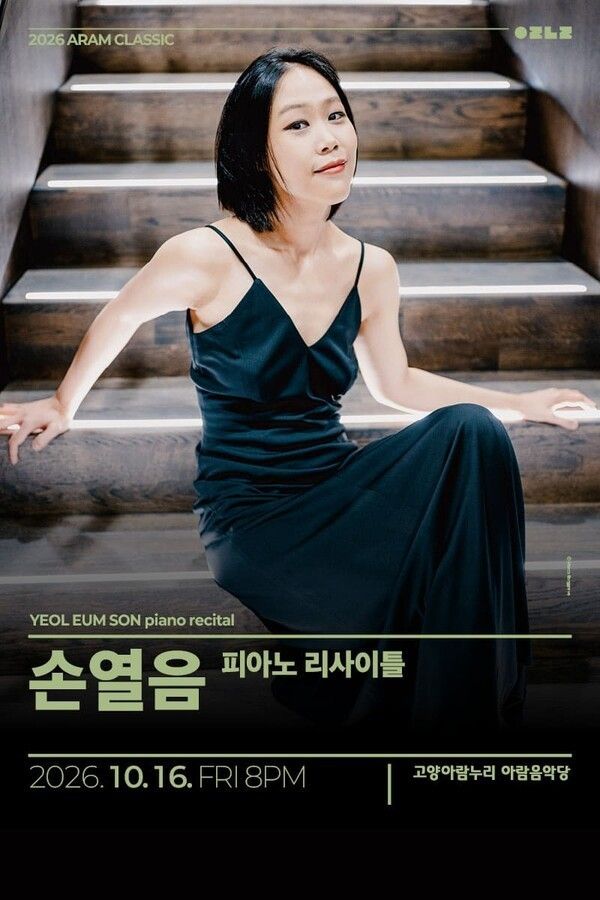
[News Culture] Pianist Yeol Eum Son will turn attention from the interpretive achievements of some of the 20th century’s most celebrated pianists to their own compositions in an Oct. 16 recital at Aram Music Hall in Goyang, South Korea.
The program brings together works by 11 pianist-composers, including Ignacy Jan Paderewski, Wilhelm Kempff, Walter Gieseking and Artur Schnabel. Best remembered for their performances and recordings of established repertoire, these musicians also pursued composition, often drawing on styles and musical interests less apparent in their careers as interpreters.
The recital extends a line of inquiry Son explored in her 2024 project The Pianists at Seoul Arts Center. Rather than surveying the performance traditions associated with these figures, she examines their original scores, from late-Romantic character pieces to compositions incorporating jazz and popular dance rhythms.
The first half begins with selections from Paderewski’s Six Humoresques de concert, Op. 14, composed in 1887–88. The opening book, titled À l'antique, draws on earlier keyboard idioms, including the style of Domenico Scarlatti, while retaining the harmonic language and pianistic virtuosity of the late 19th century.
Son then turns to Ignaz Friedman’s piano miniatures, including his Mazourka from Three Pieces, Op. 33, followed by Shura Cherkassky’s Prélude pathétique, written in 1923. The latter’s concentrated harmonic writing contrasts with the dance-derived character of Friedman’s music.
Robert Casadesus’ Toccata, Op. 40, composed in 1946, introduces a more tightly organized approach to keyboard figuration, while Josef Hofmann’s Prelude in B Minor, Op. 30 No. 6 adds another example of original music by a pianist whose reputation rests primarily on his performing career.
The selections establish the first half as a study of different compositional identities within the great pianist tradition. The works range from Paderewski’s engagement with historical keyboard styles to the condensed virtuosity and harmonic language of 20th-century concert pieces.
After intermission, Son begins with the Notturno from Kempff’s Suite Ischia, a lyrical work that offers a different perspective on a musician closely associated with the German Classical and Romantic repertoire.
A more explicit encounter with popular musical culture follows through works by Gieseking and Schnabel. Son will alternate selections from Gieseking’s Three Tanz-Improvisationen with movements from Schnabel’s Eine Tanzsuite, placing their approaches to dance rhythm in direct comparison.
Both composers incorporated musical gestures associated with the foxtrot and Charleston, dances that circulated widely in Europe during the 1920s. Their presence in works by pianists now chiefly associated with Beethoven and other canonical composers complicates the familiar distinction between classical interpretation and contemporary popular music.
The final group of works moves further toward jazz and popular idioms.
Friedrich Gulda’s Sonatine provides the transition, followed by the third movement, Reflets d’un blues, from Alexis Weissenberg’s Sonate en état de jazz. Both pianists explored musical territory beyond the conventional Classical repertory, incorporating jazz-derived rhythm and harmony into their own keyboard writing.
The recital concludes with the Toccata: À la Ricky Martin, the finale of Earl Wild’s Sonata 2000. Written in 2000, the movement invokes the Puerto Rican pop singer through its title and brings virtuosic concert writing into contact with contemporary popular dance rhythms.
The progression from Paderewski to Wild gives the program a broader historical dimension. Early selections reflect the late-Romantic virtuoso tradition and its engagement with older keyboard forms, while the later works demonstrate how pianist-composers absorbed jazz, dance music and popular culture into the concert repertoire.
At the center of the recital is a distinction between the pianist as interpreter and the pianist as creator. Gieseking, Schnabel and Kempff remain closely associated with their readings of canonical works, but their compositions reveal musical interests that extend beyond those established reputations.
Son's decision to perform these pieces together places the compositional output of celebrated performers within a shared historical framework, offering a perspective on 20th-century piano culture through music written by the pianists themselves.
Son received second prize at the 2011 International Tchaikovsky Competition, along with special prizes for her performances of a Mozart concerto and the competition's commissioned work. Her discography includes Mozart concertos and sonatas as well as music by Nikolai Kapustin. She previously served as artistic director of the PyeongChang Music Festival and School.
Reported by News Culture M.J._mj94070777@nc.press
Copyright ⓒ 뉴스컬처 무단 전재 및 재배포 금지


