[News Culture] Water flows, fire transforms, air moves and earth sustains life. Those elemental processes provide the structural language for “Circulator,” a new performance by contemporary Korean music ensemble Hey string that considers change not as rupture, but as part of a continuing cycle.
The work will be presented Oct. 15 at Crown Haitai Hall at Seoul Namsan Gugakdang. Built around the four classical elements — water, fire, air and earth — “Circulator” brings the gayageum into dialogue with movement, installation and spatial design.
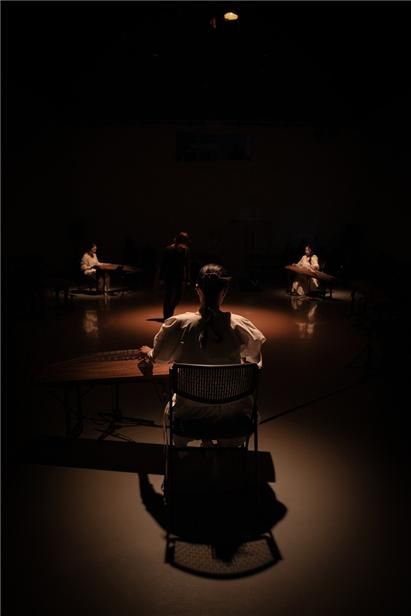
Rather than treating the elements as fixed symbols, the production focuses on their physical qualities: the weightlessness of air, the volatility of fire, the fluidity of water and the texture of earth. Those properties are translated into sound and bodily movement, allowing the audience to encounter nature less as narrative subject matter than as a changing sensory condition.
The approach also places the gayageum within a broader contemporary performance vocabulary. Long associated with Korean traditional music, the instrument becomes here not simply a vehicle for inherited repertoire but a source of timbre, resonance and gesture that can be reorganized to address present-day ideas about nature, the body and space.
“Circulator” consists of seven sections: “Air,” “Dream,” “Fire,” “Water,” “Earth,” “Walking, Running” and “Rhythm of Thought.” The sequence does not follow a conventional dramatic arc. Instead, works centered on natural elements are interspersed with sections concerned with dreaming, physical motion and reflection.
That arrangement creates a recurring movement between the natural world and human experience. The production’s central idea of circulation emerges through this alternation: nature leads to the body, the body to thought, and thought back toward nature.
Movement is integral to that construction. The performers do not function as visual accompaniment to the music; their bodies operate as another compositional layer. Rapid shifts can evoke the instability of fire, while sustained, continuous motion can parallel the behavior of water. In combination with the gayageum, those gestures make rhythm and texture simultaneously audible and visible.
Spatial design plays a comparable role. Installations alter the stage environment and shape the relationship among sound, performers and the surrounding architecture. The audience is therefore asked to register not only what occurs onstage, but how the performance space itself changes over the course of the work.
This expanded use of the gayageum reflects a larger question running through “Circulator”: how can a traditional instrument remain connected to its history while operating within contemporary artistic forms?
Hey string’s answer is not to discard the instrument’s existing identity, but to treat it as a point of departure. Its plucked strings and resonant body remain central, while choreography, installation and spatial composition open the music outward.
Nature, likewise, functions as more than scenery. Water, fire, air and earth become models for transformation — forces that continually change form while remaining part of a larger system. The same logic is applied to music and tradition, suggesting that continuity does not require immobility.
The final section, “Rhythm of Thought,” turns that process back toward the audience. Rather than resolving the work with a fixed conclusion, it leaves space for the sounds, movements and images of the preceding sections to be reorganized through individual memory.
What begins with four elements ultimately returns to human experience. The gayageum moves into the body, the body into space, and the performance into the memory of the listener. In “Circulator,” that passage is not ancillary to the work. It is the cycle itself.
Reported by News Culture M.J._mj94070777@nc.press
Copyright ⓒ 뉴스컬처 무단 전재 및 재배포 금지


