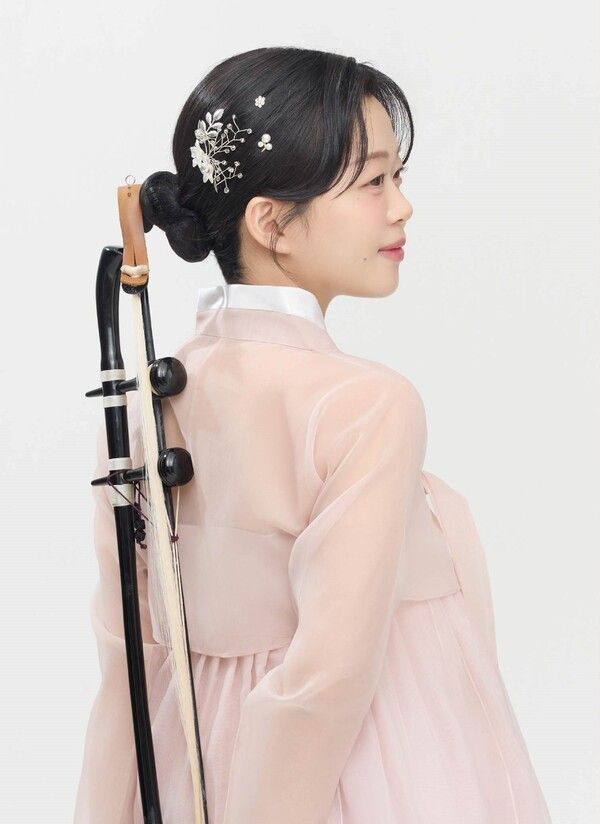
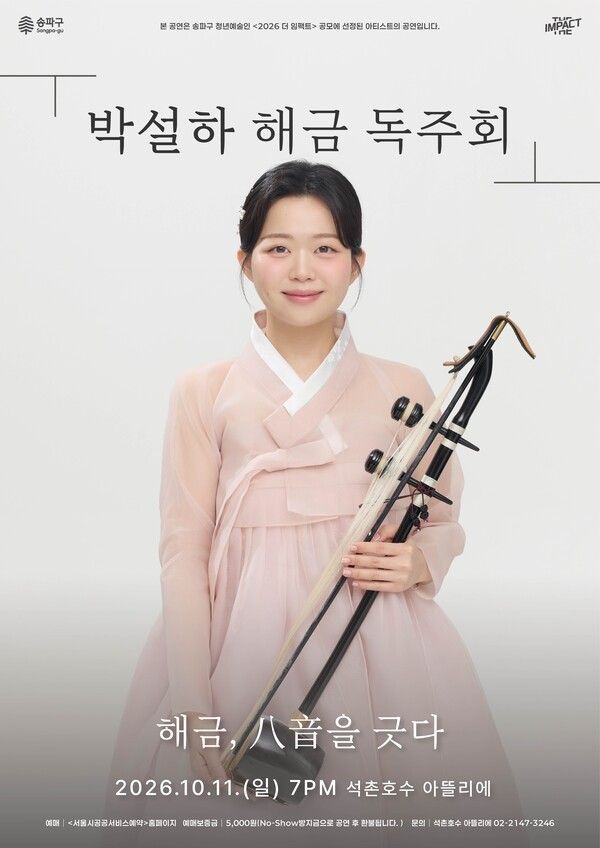
[News Culture] Seol-ha Park’s new recital does not treat the haegeum as a single, fixed voice. Across three works, the two-string fiddle moves from the disciplined give-and-take of traditional ensemble music to the individual freedom of sanjo and finally into a contemporary duet with gayageum. Haegeum, Drawing the Eight Sounds brings together Hamnyeongjigok, Ji Young-hee-style Haegeum Sanjo and Jun-il Kang’s Eotsori, using three very different repertories to show how radically the instrument’s role can change with its musical setting.
The concert title refers to paleum (八音), the old East Asian classification of instruments by their principal materials. Park uses the concept loosely rather than historically, as a way of opening out the haegeum’s range of color and technique. That idea is built into the program itself. Hamnyeongjigok comes from the world of Samhyeon Yeongsanhoesang, where the haegeum works inside a larger texture alongside winds and percussion. Park has chosen the four-part sequence of Samhyeon Dodri, Yeombul Dodri, Taryeong and Gunak, joined by Jun-hyeon Ji on piri and Jeong-min Park on percussion. The music gathers momentum as it moves forward, but the real interest lies in how the haegeum fits into the ensemble: matching and shading the melodic line rather than claiming the foreground.
That balance disappears in the second work. Ji Young-hee-style Haegeum Sanjo places the instrument at the center, with janggu providing the rhythmic framework beneath it. The lineage is closely associated with the folk and sinawi traditions of Gyeonggi Province, reflecting Young-hee Ji’s background in regional shamanic and instrumental music. Its sequence of jinyangjo, jungmori, jungjungmori, gutgeori and jajinmori gradually tightens the pace, but the music is defined as much by changes of mode and melodic character as by acceleration. Gyeonggi sinawi inflections, shifts among ujo, pyeongjo and gyemyeonjo, and the unusually prominent gutgeori section give the repertory its particular profile.
For Park, that means a different kind of playing. In Hamnyeongjigok, phrasing is shaped by the musicians around her. In sanjo, the bow, left hand and timing of each phrase become much more exposed. Pitch bends, vibrato, attack and the give-and-take with Jeong-min Park’s janggu determine the character of the performance. Heard back to back, the two works make clear that “traditional music” is not a single performance system: one asks the haegeum to function as part of a collective sound, while the other depends on the soloist’s ability to inhabit and reshape an inherited melodic line.
Jun-il Kang’s Eotsori takes the recital somewhere else entirely. Written for haegeum and gayageum, the work draws on everyday sounds rather than an established court or folk repertory. Its five sections evoke people humming at work, the rhythm of conversation and argument, a street vendor calling on a winter night, and the loose energy of drinking and parting. So-min Kim joins Park on gayageum. Instead of following the ensemble conventions of Samhyeon Yeongsanhoesang or the inherited rhythmic sequence of sanjo, the two instruments work as equal partners, turning fragments of speech, gesture and daily life into composed musical material.
That progression gives the recital its shape. Hamnyeongjigok places the haegeum inside tradition as an ensemble voice; sanjo brings it forward as a solo instrument; Eotsori asks what it can do when the rules are newly written. The contrast is more revealing than a simple survey of styles, because the instrument itself remains unchanged while its musical responsibilities are repeatedly reset.
Park graduated from the National Middle and High School of Traditional Korean Arts and is currently a senior in Korean music at Ewha Womans University. Her performance experience ranges from traditional ensembles and orchestral collaborations to more recent crossover work. At the 2026 Hangang University Song Festival, she performed with the gugak band Hwangsaeng on Bakta, a funk-based reworking of the gourd-splitting passage from Heungboga, which earned the group a bronze prize.
That wider activity sits outside the more concentrated frame of this recital, but it helps explain the program’s central question. Park is less interested in presenting the haegeum as an instrument with one inherited identity than in showing how its sound changes when the musical grammar around it changes. Across Hamnyeongjigok, Ji Young-hee sanjo and Eotsori, the recital follows that shift from ensemble restraint to solo expression and finally to contemporary dialogue.
News Culture M.J._mj94070777@nc.press
Copyright ⓒ 뉴스컬처 무단 전재 및 재배포 금지


