[News Culture] The afterlife is usually imagined as a place of judgment, separation and silence. In Jeoseung Nanjang, however, the first thing to break that silence is not mourning but music.
The new musical-theater production from Jejakso Salary overturns the familiar image of the Korean underworld, filling it instead with dokkaebi, grim reapers, gumiho and kings of the dead. At the center is a disappearing tradition of yeonhui, or Korean folk performance, and a dokkaebi determined to bring the old play back to life.
The title’s “nanjang” is central to how the production works. In traditional Korean performance, a pan is not simply a stage to be watched from a distance. Music, rhythm and movement can draw spectators into the event itself, loosening the line between performer and audience. Order and improvisation coexist, and the energy of the gathering becomes as important as the formal sequence of the performance.
Jeoseung Nanjang brings that sensibility into the afterlife.
Its story begins when a dokkaebi official responsible for performance realizes that the dead have lost interest in the old yeonhui. To revive it, he sets out with a grim reaper who works in a bureaucratic complaints office and is far more accustomed to rules, procedures and stamps than spontaneous play.
Their contrast establishes the comic structure of the work: one character is driven by improvisation and the desire to create a pan, while the other is defined by order. Their journey begins to disrupt both.
The situation becomes more complicated when a gumiho enters the story. Initially sent under the orders of King Songje to interfere with the pair, she unexpectedly becomes their guide. What begins as manipulation gradually turns into companionship, reinforcing one of the production’s recurring ideas: relationships are not fixed at the moment people meet, but change through what they experience together.
King Songje introduces another kind of disruption. He wants to become the most fashionable and attention-grabbing performer in the underworld himself, turning the effort to revive yeonhui into a contest over who gets to occupy the center of the stage.
The comedy emerges from those clashing desires, but the structure also reflects the logic of nanjang: authority can be mocked, the person who follows every rule can be swept into the game, and an unexpected figure can suddenly take the spotlight. Rather than representing pure disorder, the nanjang becomes a temporary reversal of the usual hierarchy.
Music is essential to that reversal.
The production layers the rhythms of instruments such as the ggwaenggwari and buk with rap and hip-hop beats, avoiding a straightforward reconstruction of traditional performance. The connection between the two musical languages lies in rhythm: both depend on repetition, pulse and the ability to move the body.
That fusion also gives the characters a contemporary voice. The grim reaper, dokkaebi and gumiho each bring their own frustrations and ambitions to the stage—one clings to rules, another wants freedom, while others pursue status or recognition. Rap and rhythmic speech allow those competing desires to surface directly.
As a result, the underworld gradually becomes less a realm of the dead than a space filled with recognizably human impulses.
That shift is important to the production’s larger perspective. Jeoseung Nanjang is less interested in asking what waits after death than in asking what people are doing while they are still alive.
Daily life is filled with obligations, routines and other people’s expectations. The production places those familiar pressures in an unfamiliar afterlife, where rules can suddenly turn into rhythm and even the sound of stamping official documents can become part of the beat.
The premise that yeonhui itself is disappearing also gives the story a connection to the present. Korean folk performance historically depended on people gathering, watching, responding, singing and moving together. Jeoseung Nanjang treats the decline of that shared experience not merely as a fictional crisis in the underworld, but as a question about what happens when communal forms of play become harder to sustain.
Its use of tradition therefore does not depend only on placing familiar figures such as dokkaebi or gumiho onstage. The production is more interested in recovering the participatory energy of traditional performance—its ability to turn a group of spectators into a temporary community.
That is where the combination of Korean rhythm and hip-hop becomes more than stylistic decoration. The production uses contemporary sound to carry forward the social function of the older form rather than reproducing its surface unchanged.
Jejakso Salary, founded in 2022, has built its work around ensemble performance and the idea that theater is fundamentally an actor’s art. Jeoseung Nanjang follows that approach. Rather than concentrating the action around one protagonist, it builds momentum through collisions among the grim reaper, dokkaebi, gumiho, King Yeomra, King Songje and the other figures who populate its underworld.
Writer-director Jung Da-woon has described the production in terms of people “laughing and making noise together,” an idea that captures both its comic tone and its theatrical structure. The goal is not to provide a grand answer to questions about life and death, but to create a space in which performers and audiences can briefly enter the same pan.
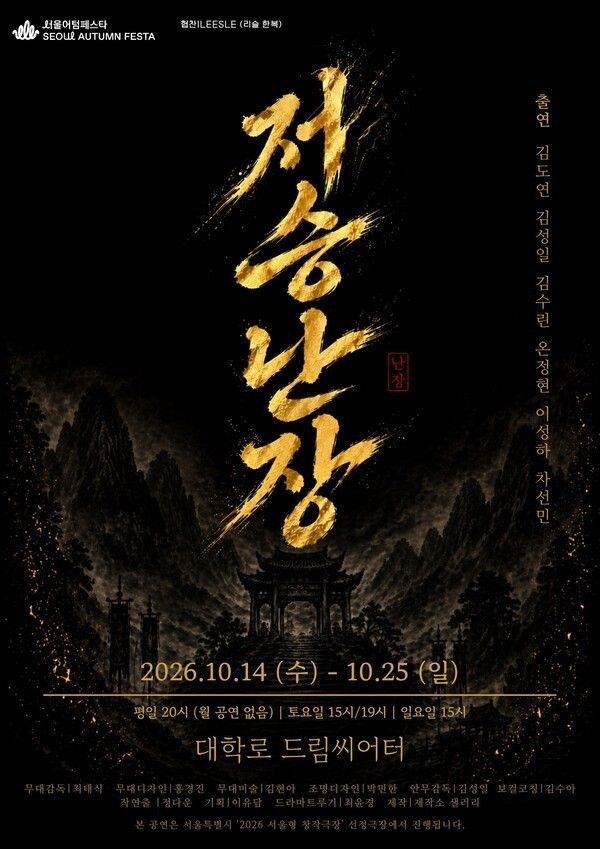
The cast includes Lee Seong-ha as the grim reaper, Kim Seong-il as the dokkaebi, Kim Do-yeon as King Yeomra, Kim Su-rin as the gumiho, On Jeong-hyeon as King Songje and Cha Seon-min as Choi Myeong-seong.
Their afterlife is designed less as a dark supernatural realm than as an unstable playground where gods, spirits and the dead collide, rules meet impulse and each character’s desires push the performance toward an increasingly unruly communal celebration.
Jeoseung Nanjang runs from Oct. 14 through 25 at Dream Theater in Daehangno, Seoul.
Its story begins with an attempt to save performance in the afterlife, but its questions eventually turn toward the living: why people stop playing, why laughter becomes harder to find in everyday life, and what remains worth doing when time is finite.
When the sound of the ggwaenggwari and drum meets rap and hip-hop—and even bureaucratic noise begins to fall into rhythm—the solemnity of the afterlife gives way to something much more physical.
What remains is the pulse of a nanjang: people moving, speaking, laughing and occupying the same space together.
Reported by News Culture M.J._mj94070777@nc.press
Copyright ⓒ 뉴스컬처 무단 전재 및 재배포 금지


