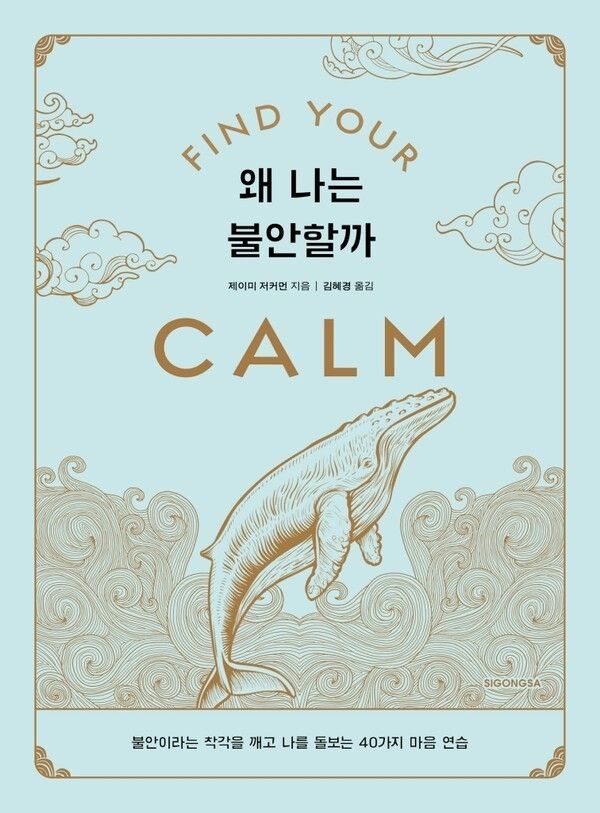
[News Culture] Anxiety rarely waits for a convenient moment. It can surface after a brief message, keep someone awake long after the day has ended or turn a new opportunity into a list of everything that might go wrong. The usual response is to push the feeling away. Clinical psychologist Jaime Zuckerman’s “Find Your Calm” begins with a different premise: anxiety is a protective signal, and fighting it can make the alarm even louder.
Newly published in Korean in a translation by Kim Hye-kyung, the book does not promise a life without worry. Its focus is more practical—helping readers recognize when anxiety has taken over, step back from the thoughts it produces and continue with what matters to them.
“Find Your Calm” is structured as a guided journal rather than a conventional self-help book. Forty exercises based on cognitive behavioral therapy and acceptance and commitment therapy move the reader from explanation to practice. Writing prompts, meditation exercises and tracking pages require active participation; progress comes from answering the questions and testing the techniques, not simply reading about them.
The approach treats an anxious thought as a mental event, not a command or a prediction. A fear of failure does not prove that failure is imminent, just as the thought that others are judging someone does not make that judgment real. Learning to create distance between the self and the thought interrupts the cycle in which one worry produces another until the imagined threat feels unavoidable.
Zuckerman also brings attention back to the body. Balloon breathing, five-senses grounding, body scans and progressive muscle relaxation offer ways to respond when anxiety becomes physical. Most take about 10 minutes and can be used without special equipment, making them easier to incorporate into an ordinary day.
These exercises are not presented as quick cures. Their purpose is to help the nervous system return to the present when the mind has raced ahead into an uncertain future. Naming what can be seen, heard and felt may not remove the source of worry, but it can keep that worry from consuming every part of the moment.
The written exercises address a different layer of anxiety: the habits that keep it in place. Readers are asked to separate what they can influence from what lies beyond their control, examine the standards created by perfectionism and notice how often self-criticism is mistaken for motivation. The workbook gradually replaces that punishing inner voice with a more measured form of self-observation.
That shift matters because many people postpone living until they feel completely secure. They wait for the worry to stop before applying for a job, beginning a relationship, speaking up or attempting something unfamiliar. “Find Your Calm” challenges the assumption that confidence must arrive first. A meaningful choice can still be made while uncertainty remains.
The journal format makes that idea tangible. Putting a fear into words gives it boundaries; recording a physical reaction makes it easier to recognize the next time it appears. Repeated entries can reveal triggers and patterns that are difficult to see while anxiety is unfolding. Writing becomes a way to observe the feeling without immediately obeying it.
The book is particularly accessible to readers whose worries intensify at night, whose fear of failure keeps them from taking risks or whose sense of worth depends heavily on meeting other people’s expectations. It does not ask them to become fearless. It asks them to notice what fear has been deciding on their behalf.
“Find Your Calm” offers no fantasy of permanent serenity. Anxiety will return because uncertainty is part of being alive. The difference lies in what happens next: whether the feeling dictates the day or is allowed to pass through it.
Ten minutes of breathing or journaling will not eliminate every worry. It can, however, create enough space to make a choice before anxiety makes it instead. Across its 40 exercises, the workbook returns to that modest but useful goal—acknowledge the alarm, understand what set it off and keep moving without handing it control of the entire life.
Reported by News Culture M.J._mj94070777@nc.press
Copyright ⓒ 뉴스컬처 무단 전재 및 재배포 금지


