[News Culture] What does it take for traditional arts to remain a living culture rather than something preserved at a distance?
Conservation matters. So does passing techniques from one generation to the next and maintaining performance practices with historical integrity. But tradition also depends on repeated contact with everyday life. When music, dance and folk customs are encountered only in museums, classrooms or formal theaters, they can gradually become something audiences are expected to observe rather than something they actively share.
That is where a public square can change the relationship. Unlike a theater, which generally draws audiences who have already decided to attend, a square remains open to people moving through the city for entirely different reasons. Some arrive for a performance; others stop while walking with family or friends. Children may join a game, while older visitors recognize customs they have not practiced in years.
Once traditional arts enter that environment, the distance between performer, practice and public begins to narrow.
Tradition as Experience, Not Just Instruction
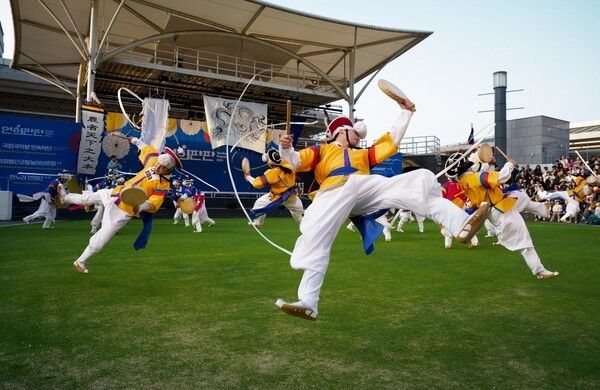
Hands-on programming is often discussed as a way of making traditional culture more accessible, but its value extends beyond simply adding another activity to an event.
Touching a gayageum or haegeum and producing a sound changes how the instrument is understood. Trying a beona spinning plate or handling a sangmo ribbon hat makes folk performance physical rather than abstract. Blowing a nagak conch or nabal brass horn, kicking a jegi or taking a turn at tuho creates a kind of memory that reading about those practices rarely can.
That distinction is particularly important for younger visitors. Traditional culture encountered in a textbook and traditional culture experienced through sound, movement and play are not equivalent. Even a brief encounter can leave a concrete sensory memory — the vibration of a string, the resistance of an unfamiliar instrument, the rhythm of a game played with other people.
Cultural transmission does not always begin with formal training. Sometimes it begins with having tried something once, becoming curious and choosing to return.
Rebuilding the Communal Side of Chuseok in the City
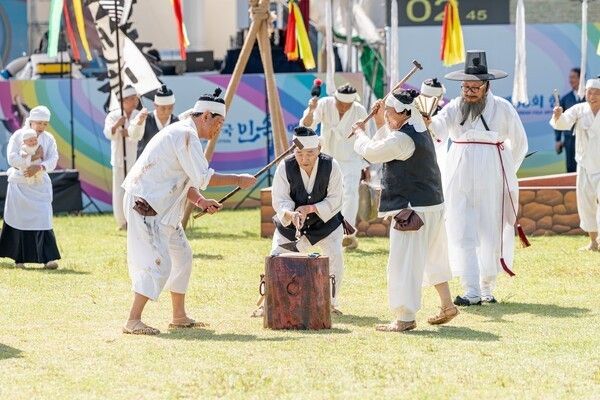
Chuseok can be viewed through the same lens.
The holiday was historically rooted in family and village communities, but contemporary urban life has made the ways people spend it far more varied. Family gatherings remain central for many, yet there is no longer a single shared model of the holiday.
An open civic space offers one way to reintroduce a communal dimension without recreating the social structure of the past. Strangers can listen to the same music, watch the same dances and participate in the same games. Families, friends, neighbors and passersby can occupy the same cultural space without needing prior knowledge of the art forms being presented.
Traditional yeonhui, or Korean folk performance, is especially suited to that setting. Its boundary between performer and spectator has historically been more permeable than that of many formal stage genres. Audiences respond, clap, move and at times join the action, contributing directly to the atmosphere of the performance.
That is also why daedongnori, a large communal folk celebration, so often functions as a finale. Rather than concluding with performers alone onstage, the event resolves by bringing participants together through collective play. The communal character of the form becomes most visible when the audience is no longer simply watching.
Young Artists and the Next Life of Tradition
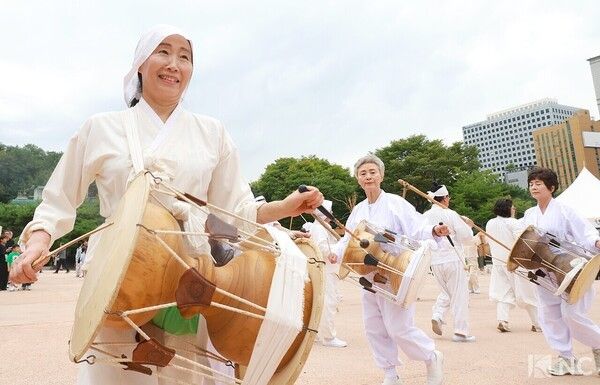
Any discussion of continuity in traditional arts eventually comes back to the people who will carry them forward.
Preserving established repertory is only one part of that process. Traditional arts also require performers who interpret inherited forms and composers who create new work from within them. This makes public appearances by younger artists studying Korean traditional music and dance more than student showcases; they are part of the mechanism through which the tradition continues to change.
The Sept. 27 “Hangawi Haneumhoe” at Gwanghwamun Square brings together students and artists from institutions including Seoul Institute of the Arts, Chugye University for the Arts and Chung-Ang University. Alongside established repertory, the program will premiere the new work “Haneumga.”
That pairing places two timelines on the same stage: music and dance transmitted across generations, and work being created by artists active now.
Familiar repertory including “Arirang,” “Namdo Arirang,” pansori and nongak will therefore appear alongside new composition. The juxtaposition makes a broader point: preservation and change are not necessarily opposing forces. In a living tradition, they operate at the same time.
Why “Hangawi Haneumhoe” Is Taking Over Gwanghwamun Square
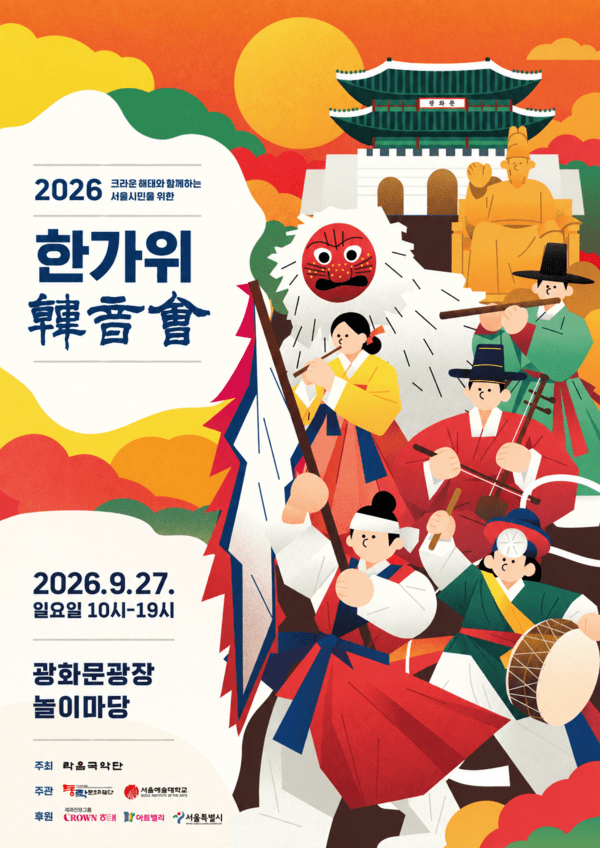
That context helps explain why “Hangawi Haneumhoe” has chosen Gwanghwamun Square as its setting.
Launched in 2024, the annual pre-Chuseok event has focused on bringing Korean traditional arts into direct contact with the public. This year’s edition, scheduled for Sept. 27 at the square’s Nori Madang from 10 a.m. to 7 p.m., expands that approach through a full day of performance and participation.
The program is divided across vocal music, dance, orchestral performance and yeonhui. Seoul Institute of the Arts’ Haneum Soridan will open the vocal section with repertory including the gayageum byeongchang piece “Dongbaek Taryeong,” the gourd-breaking passage from the pansori Heungboga, and selections from Gyeonggi and Namdo folk songs.
The dance program will be presented by the Korea National University of Arts’ School of Korean Traditional Arts dance company, with Taepyeongmu, Chunaengjeon, Song Beom-style Ganggangsullae, Hallyangmu and Kim Baek-bong’s fan dance.
The university concert will feature Seoul Institute of the Arts, Chugye University for the Arts and Chung-Ang University under conductors Yong-gu Lee, Sang-gu Kang and Young-jeol Kim. The repertory includes “Namdo Arirang,” “Arirang,” the newly created “Haneumga,” “Gaja Gaja Eoseo Gaja” from Sugungga, “Sinmodeum” and “Song of Cheonma.”
Dongnak Yeonhui Troupe and the Seoul Institute of the Arts Percussion and Yeonhui Ensemble will take over the folk-performance segment with mungut, binari, Samdo nongak rhythms, Jindo drum dance and central-region nongak.
Around the square, six themed activity stations will invite visitors to try traditional clothing, blow nagak and nabal instruments, play gayageum and haegeum, and experiment with beona and sangmo. Folk games including tuho, ttakji, spinning tops and jegichagi will also be available throughout the day.
The event will close with a daedongnori bringing performers and visitors together.
Closing the Distance Between Tradition and the Public
“Hangawi Haneumhoe” is not significant because it presents one particular branch of Korean traditional art. Its larger value lies in the way it tests how those arts can meet contemporary audiences.
A visitor does not need to know the conventions of pansori, distinguish one nongak lineage from another or understand the structure of court dance before entering the square. Someone can simply hear a voice, watch a dance, pick up an instrument or join a game.
What happens after that first encounter may matter more than the encounter itself. A short passage of pansori heard in the square can lead someone to seek out a full performance. Touching a traditional instrument for the first time may make its sound more recognizable later. A folk game shared by a family can become part of how a child remembers Chuseok.
The continuity of traditional culture does not depend only on preservation policy or formal education. It also depends on repeated acts of contact — people encountering a practice, enjoying it, remembering it and eventually passing that memory on.
At Gwanghwamun Square, “Hangawi Haneumhoe” places that process in one of Seoul’s most public spaces. Its premise is straightforward: if tradition is to remain part of the present, people need places where they can still meet it.
Reported by News Culture M.J._mj94070777@nc.press
Copyright ⓒ 뉴스컬처 무단 전재 및 재배포 금지


