[News Culture] A moon jar and a pair of shoes begin from almost opposite visual ideas. One is still, rounded and defined as much by the space around it as by its form. The other immediately suggests movement and direction. At The Armory Show in New York, works by Youngwook Choi and Jaeseon Kim bring those contrasting images together through two different approaches to time and lived experience.
Gallery Dasun will present Choi’s “Karma” series and Kim’s “Dreaming Wanderer” at The Armory Show, running Sept. 24-27 at the Javits Center. Rather than treating the moon jar and traditional paper simply as familiar markers of Korean culture, both artists use them as working material for contemporary painting.
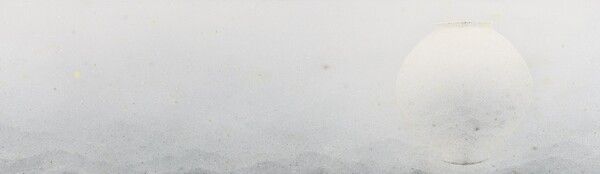
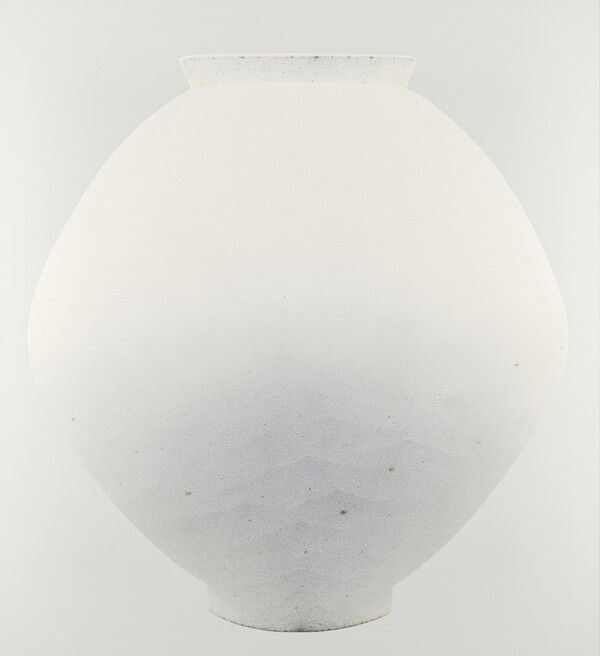
Choi’s “Karma” appears restrained from a distance. A single moon jar sits within an open field, its pale surface and rounded silhouette recalling the understated character of traditional Korean white porcelain. Up close, however, the image is built from dense layers of fine lines and repeated brushwork.
The lines recall the crackle patterns that appear on ceramic glaze, but their role is not purely descriptive. Choi returns to the surface again and again, allowing repeated gestures to accumulate over time. What first reads as a quiet, almost weightless vessel gradually reveals a far more worked surface.
That process is central to “Karma.” The moon jar becomes less a straightforward representation of porcelain than a structure through which Choi addresses memory, relationships and the passage of time. The image remains still, but the making of it is based on repetition and accumulation.
Empty space is equally important. Choi resists filling the entire canvas, allowing the surrounding field to sharpen the presence of the vessel. The balance between the worked surface and the open ground draws on qualities long associated with Korean white porcelain while translating them into a contemporary pictorial language.

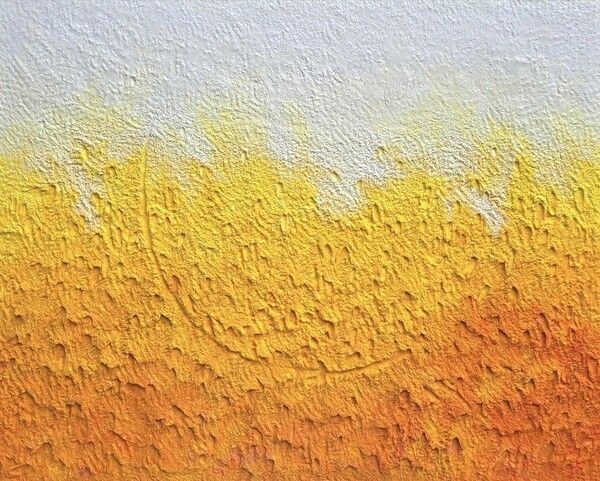
Kim approaches the surface differently in “Dreaming Wanderer.” She layers and presses hanji and mulberry paper by hand, building an uneven, tactile ground before adding color and imagery.
The material retains evidence of that process. Fibers, creases and variations in depth remain visible rather than being smoothed away, giving the finished work a physical presence that differs markedly from a conventional painted canvas.
Shoes recur throughout the series. Familiar and functional, they also carry an immediate association with walking, departure and movement. Kim uses that everyday object to consider the experience of continuing forward without necessarily knowing where a journey will end.
The title “Dreaming Wanderer” reinforces that sense of movement. The figure implied by the shoes is not fixed in one place, yet the work is not simply about restlessness. It also carries the possibility of searching, imagining and moving toward something still out of reach.
Set against the handmade surface of the paper, the image remains grounded in the physical. The material records touch, while the shoes introduce direction.
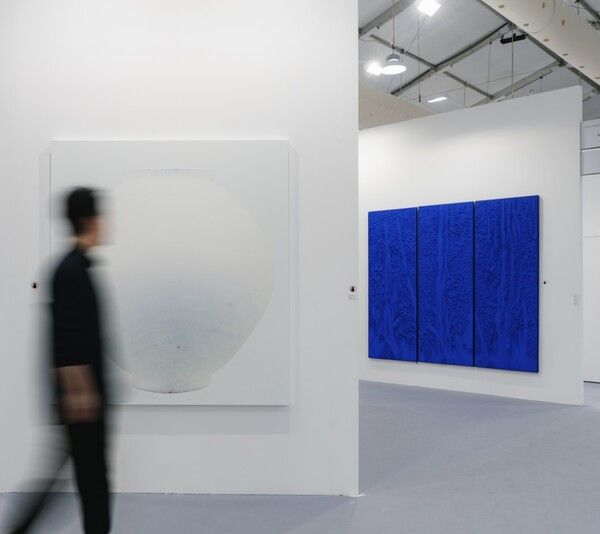
The contrast between the two artists becomes clearer when their works are shown together. Choi concentrates time within the stillness of the moon jar. Kim begins with an object associated with movement and builds around it a more tactile, physical surface.
Both, however, make process visible. Choi leaves time in the accumulation of brushstrokes; Kim leaves it in the layering and handling of paper. In each case, the way the work is made is closely tied to what it communicates.
That connection also changes the role of tradition in the two practices.
For Choi, the moon jar is not reproduced as a historical object. Its shape becomes a framework for thinking about memory and human relationships. For Kim, hanji and mulberry paper are not used simply for their cultural associations; their texture and responsiveness become part of the image itself.
The result is less a shared “Korean style” than two individual uses of inherited forms and materials. Choi works through restraint, repetition and open space, while Kim emphasizes touch, surface and movement.
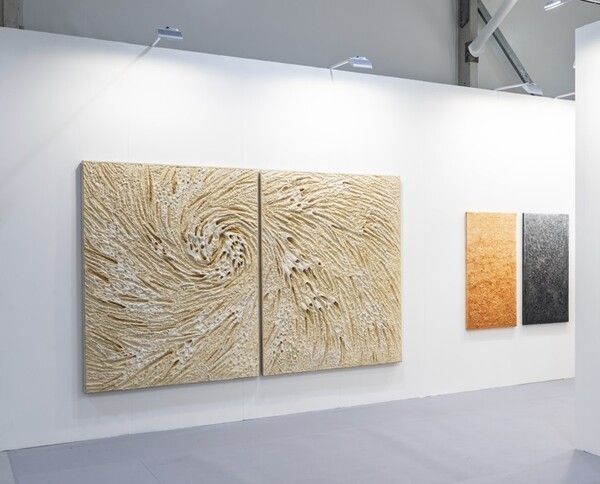
That distinction is particularly relevant at an international fair such as The Armory Show, where works from different cultural contexts appear side by side. The Korean references in both artists’ practices are immediately legible, but they function as starting points rather than conclusions.
Choi’s moon jar carries the visual memory of Korean ceramics while moving toward questions of personal time and connection. Kim’s paper retains the material history of Korean craft while the image of shoes opens onto a broader experience of movement and uncertainty.
Seen together, “Karma” and “Dreaming Wanderer” show how traditional forms and materials can remain active without being treated as fixed symbols of the past. One begins with stillness, the other with movement; both arrive at works shaped by the accumulation of time and the trace of the hand.
Gallery Dasun will present Youngwook Choi’s “Karma” and Jaeseon Kim’s “Dreaming Wanderer” at The Armory Show in New York from Sept. 24 to 27.
Reported by News Culture M.J._mj94070777@nc.press
Copyright ⓒ 뉴스컬처 무단 전재 및 재배포 금지


