[News Culture]The Korea National Contemporary Dance Company’s Triple Bill brings together three works that treat choreography not as movement generated in isolation, but as a system shaped by surrounding conditions.
Set for Oct. 23 at Busan Citizens’ Hall, the program pairs William Forsythe’s One Flat Thing, reproduced with Lee Jaeyoung’s Mechanism and Jung Cheol-in’s Unprotected.
The works differ substantially in choreographic method. Forsythe organizes movement through a dense field of tables and a complex network of cues between dancers. Lee examines how individual bodies operate within collective systems and what happens when those bodies depart from an established order. Jung begins with the everyday circulation of pedestrians, vehicles and objects, translating patterns of urban movement into stage choreography.
What connects the three is an interest in how movement is produced through external conditions. Space is not a neutral container, and the body is not treated as an autonomous unit. In each work, choreography develops through contact with structures, objects or other moving bodies.
William Forsythe: Choreography as a Spatial Network
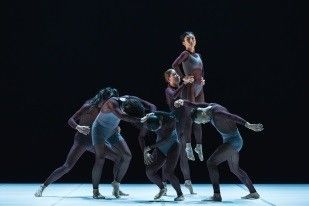
William Forsythe’s One Flat Thing, reproduced makes spatial organization one of the primary engines of the choreography.
Premiered by Ballet Frankfurt in 2000, the work places a large number of metal tables across the stage. The dancers move between, around and over them, negotiating a field that continuously restricts and redirects their trajectories.
The tables function as more than stage objects. They determine available pathways, alter the dancers’ spatial orientation and produce a constantly changing set of physical constraints.
At the same time, Forsythe builds the work through an elaborate cueing structure. Dancers respond to specific movements, positions and events generated by others, creating overlapping chains of action across the ensemble.
Individual phrases can appear independent, but they are embedded in a larger choreographic network. Timing, direction and spatial placement are therefore determined not only by the movement material itself, but by relationships among multiple dancers operating simultaneously.
This organization is central to the work. Rather than presenting movement as a fixed sequence, One Flat Thing, reproduced exposes choreography as a system of interdependent decisions.
The dancers continually produce space through their movement while also being constrained by the spatial conditions already in place. The result is a choreography in which environment and movement cannot be separated.
The work reflects Forsythe’s broader practice of examining the internal structures of dance. Across a career spanning more than five decades, he has expanded ballet beyond inherited vocabulary by investigating coordination, spatial geometry and the procedures through which movement can be generated and reorganized.
Forsythe has received honors including the Golden Lion for Lifetime Achievement at the Venice Biennale, the Faust Theatre Prize for lifetime achievement in Germany and the 2024 Kyoto Prize.
The Busan performance features Go Donghun, Kwon Jaehun, Kim Geon, Kim Suin, Kim Eunseo, Kim Heejun, Park Sejin, Seo Jeongbin, Song Seunguk, Lee Junseok, Lee Haeseul, Jung Geon, Jung Chaerin, Cho Seonjae, Ha Yeonju and Ham Seungsu.
Following its Korean premiere last year, the work will be presented in Busan for the first time.
Lee Jaeyoung: Order, Repetition and Deviation
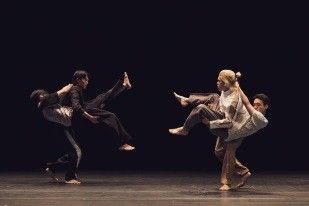
Lee Jaeyoung’s Mechanism shifts the focus from physical architecture to systems that organize collective life.
Premiered in 2022, the work considers human beings as participants in structures larger than themselves — from the natural order of the universe and Earth to civilization and society.
Lee translates that premise into choreographic terms through repetition, alignment and deviation.
Bodies move according to shared patterns, but those patterns do not remain stable. A dancer may shift direction, break from a collective formation or alter an established rhythm, producing friction between individual movement and group structure.
The work’s central tension lies in that instability.
A system depends on repetition and continuity, yet movement introduces the possibility of variation. Small departures by one body can reorganize the surrounding ensemble, making visible the relationship between conformity and resistance without relying on explicit narrative.
For the current production, the cast has expanded from six dancers to nine: Kwon Hyuk, Kim Soyeon, Byun Hyerim, Lee Woobin, Lee Taenyeong, Lee Serim, Jung Jaewoo, Cha Eunju and Han Gyueun.
The larger ensemble gives greater weight to the collective dimension of the work. With more bodies occupying the stage, the choreography can establish denser group structures and make individual deviations more legible in relation to the whole.
Since founding COMPANY SIGA in 2013, Lee has repeatedly examined the body in relation to social organization and collective behavior. His work has been presented at international platforms including Tanz im August, Internationale Tanzmesse NRW, the Grec Festival and The Place in London.
In Mechanism, social systems are not illustrated directly. They are translated into choreographic procedures: repetition, shared direction, synchronization, disruption and reorganization.
Jung Cheol-in: Movement as Negotiation
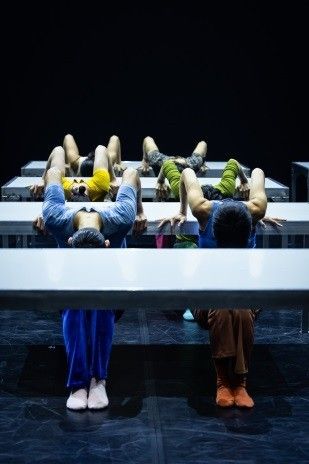
Jung Cheol-in’s Unprotected begins with another kind of system: the street.
Premiered in 2022, the work draws on the movement of pedestrians, vehicles and objects occupying the same urban environment.
Street movement is rarely synchronized. Different bodies travel at different speeds, follow different routes and continuously adjust to the presence of others. Avoidance, passing, stopping and maintaining distance become forms of spatial negotiation.
Jung uses these ordinary patterns as choreographic material.
A change in one dancer’s trajectory prompts another response. Proximity affects speed. A route is redirected by the arrival of another body. Movement develops less as a predetermined sequence than as a chain of spatial adjustments.
The work is particularly concerned with coexistence inside a shared environment. Rather than treating safety and control as fixed conditions, Unprotected examines how multiple bodies maintain, lose and renegotiate distance.
This year’s staging places greater emphasis on those relationships, expanding the work’s attention to the way different movements can occupy the same space without becoming uniform.
The cast includes Kim Yunhyeon, Ryu Jisu, Moon Gyeongjae, Lee Daeho, Lim Hyeonjun, Jeon Junggeun, Joo Youngsang, Kim Hyeonung, Lee Huiseong, Seok Yujin and Lee Eunseok.
Jung, who leads Melancholy Dance Company, has consistently worked with the physical possibilities of the body and the relationships generated through movement. His choreography approaches social questions through spatial behavior and interaction rather than conventional storytelling.
In Unprotected, the street becomes a model for choreography because it is already a site of continuous adjustment: bodies read one another, alter their routes and reorganize shared space in real time.
Three Models of Choreographic Environment
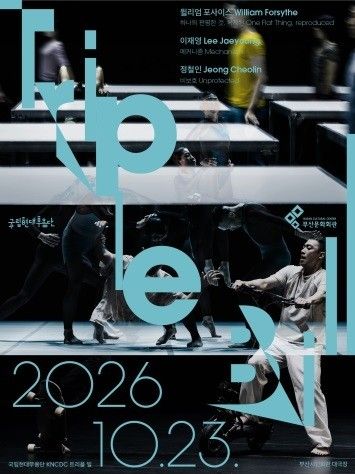
Across Triple Bill, the concept of environment operates at three different levels.
In One Flat Thing, reproduced, the environment is materially present. The tables determine pathways and provide a physical framework within which the dancers’ cueing system operates.
In Mechanism, the environment is structural. Collective patterns establish an order that individual bodies may follow, interrupt or reorganize.
In Unprotected, the environment is relational. Space is continually produced through changing distances, trajectories and reactions among moving bodies.
The distinction is significant because each choreographer locates choreographic agency differently.
Forsythe distributes it across an interdependent network of dancers, objects and cues. Lee places it in the tension between collective organization and individual variation. Jung locates it in continuous negotiation between bodies sharing the same field.
Seen together, the three works present choreography as a process of organization rather than simply a sequence of steps.
Movement acquires meaning through what surrounds it: the obstruction of an object, the pressure of a collective pattern, the approach of another body or the need to alter direction.
That perspective also broadens the role of space in contemporary dance. Space can operate as physical architecture, as an abstract system of rules or as a field of constantly shifting relationships.
Triple Bill brings those approaches into direct comparison.
Forsythe, Lee and Jung do not share a single movement language, nor do they arrive at the same conclusion. What connects their works is the premise that choreography emerges through interaction — between bodies, between bodies and objects, and between individual movement and larger systems.
The body does not simply occupy an environment. It responds to it, reorganizes it and is reorganized in return.
Across the three works, that reciprocal process becomes the central choreographic material.
Reported by News Culture M.J._mj94070777@nc.press
Copyright ⓒ 뉴스컬처 무단 전재 및 재배포 금지


