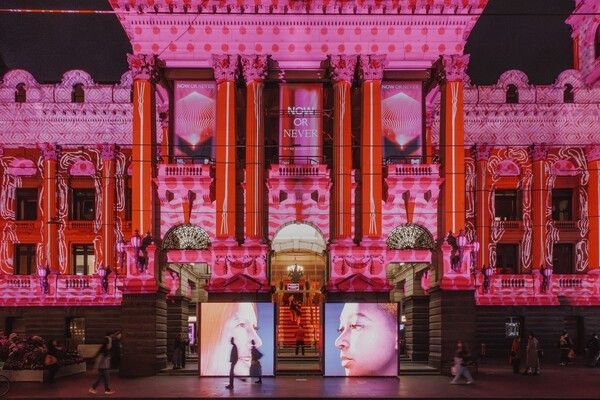
As art and technology become increasingly intertwined, the international path for Korean media and technology-based artists is also changing. Overseas exposure is no longer defined simply by placing a finished work in a foreign festival. Increasingly, it involves adapting projects to local venues, working with technical crews, meeting audiences and entering conversations with artists operating in different cultural and production environments.
Melbourne’s 2026 Now or Never festival offered a recent example of that shift.
Held from Aug. 19 through 30, the City of Melbourne festival drew approximately 220,000 visitors and presented more than 150 programs involving over 250 artists under the theme “A Whole New World.” Staged across multiple sites throughout the city, the festival focuses on work emerging at the intersection of contemporary art, technology, sound and performance.
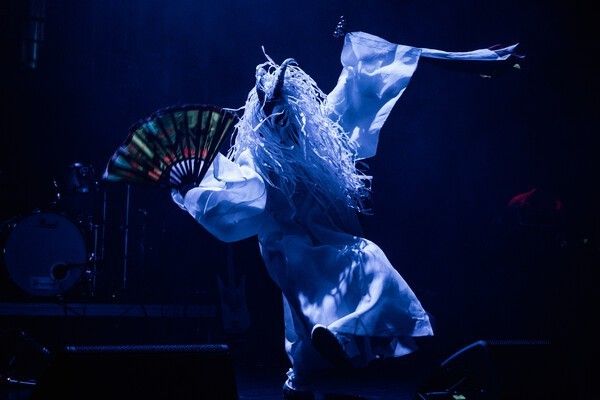
Three Korean artists — Hyejeong Jeong, Hakason, also known as Daehan Son, and Jeho Yun — joined this year’s program through Art Korea Lab. Their projects ranged from video and kinetic installation to audiovisual performance, but each treated technology not as a decorative device but as part of the work’s underlying artistic language.
Jeong’s Row, Row, Row Your Boat began with 3D scans of people she encountered in Korea and Australia. Using a game engine, she transformed those faces into a collective singing presence, constructing a digital chorus from individuals separated by geography.
Hakason’s Knot Protocol: Autopoietic Ritual used motors, sensors and fabric to create a kinetic system in which mechanical movement became part of the composition itself.
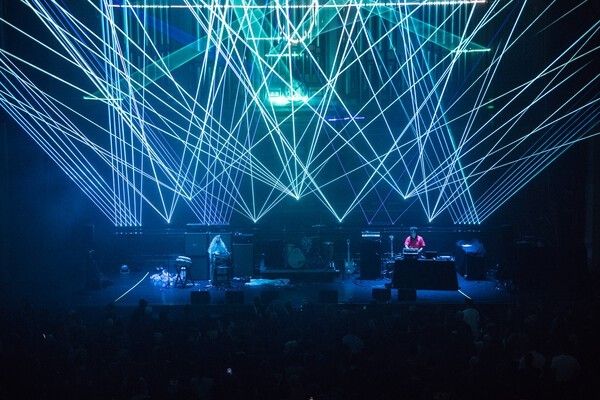
Yun’s KNOCK, performed with Kyungjin So, brought together Korean traditional percussion and physical movement with lasers and electronic sound. Presented as the festival’s closing performance on Aug. 30, it drew roughly 1,400 ticketed attendees.
Their participation also demonstrated the range of formats through which Korean technology-based art can enter an international festival. Installations and live performance were placed within the same program, allowing audiences to encounter technology through markedly different forms of artistic experience.
The more significant development, however, was not simply the number of works presented or the size of their audiences. The Korean artists were involved in the broader process of producing and situating their work abroad.
Selected through an open call in March by South Korea’s Ministry of Culture, Sports and Tourism and the Korea Arts Management Service’s Art Korea Lab, the artists received support extending from production to installation, performance and artist talks in Melbourne.
That process is particularly important for technology-driven work, which often travels less easily than conventional exhibition material. Video systems, sound equipment, sensors, motors, lighting and architectural conditions can all affect whether a project functions as intended. An artwork cannot always be completed in Korea, shipped overseas and installed without modification.
Instead, artists may have to recalibrate a project for a new room, rebuild technical systems with local crews or adapt to equipment and infrastructure that differ from those used during development. The ability to navigate that process becomes part of the artist’s international practice.
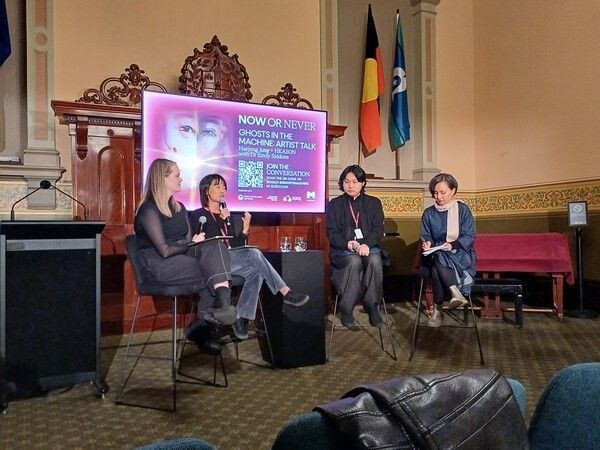
Jeong pointed to that aspect of the Melbourne experience, emphasizing the value of working directly with the festival team while installing and presenting her project. Such experience can become as important as the exhibition itself, providing knowledge that can be applied when preparing for future international presentations.
Long-term circulation also depends on relationships beyond the work on display.
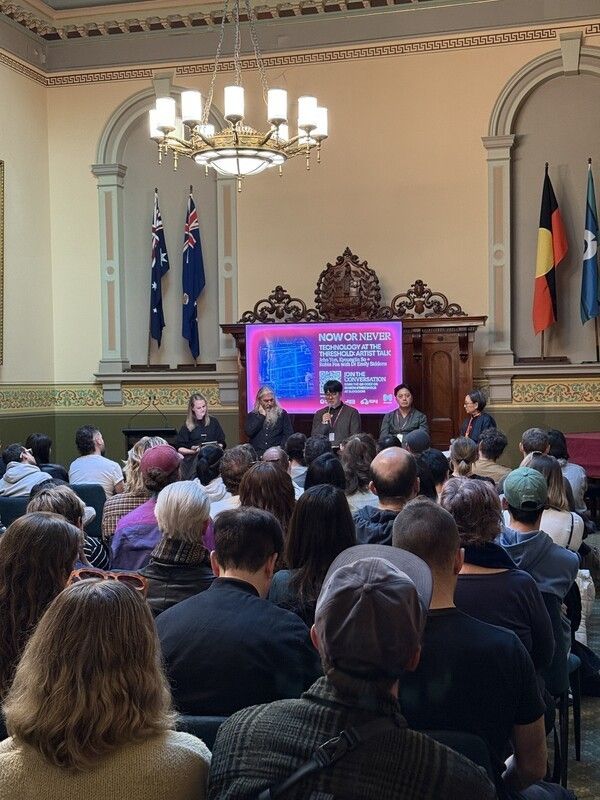
Now or Never incorporated artist talks alongside its exhibitions and performances. On Aug. 20, Jeong and Hakason met artists and audiences at Melbourne Town Hall’s Yarra Room for a discussion on the impact of technology on human creativity and artistic agency.
On Aug. 29, Yun and So joined Australian artist Robin Fox for a conversation about human presence and liveness in technologically mediated performance. The sessions positioned the artists not only as exhibitors but as participants in a broader professional and conceptual exchange.
That distinction matters as international circulation in art and technology becomes more complex. Entering the program of a major festival is one step; learning how to operate within its production environment is another.
Artists must work with local technicians, respond to unfamiliar architectural conditions, test how audiences engage with their projects and communicate the ideas behind their use of technology. Those experiences can establish the practical foundation for subsequent invitations, collaborations or co-productions.
Art Korea Lab has been expanding this type of international partnership throughout 2026. Before Melbourne, it worked with NewImages Festival in Paris in April and Sónar+D in Barcelona in June, giving Korean artists access to different technology-oriented cultural platforms and production environments.
The strategy reflects a broader shift from exporting individual works toward developing channels through which artists can repeatedly enter international networks.
Rapid technological change makes that infrastructure particularly relevant. New tools continually reshape the possibilities of digital and technology-based art, but technical novelty alone offers little guarantee of international resonance.
The larger question is how technology is translated into an experience that audiences can understand, question or feel. The competitive distinction increasingly lies not in the presence of sophisticated equipment, but in how convincingly an artist connects technical systems to an artistic idea.
Now or Never founder and artistic director Elise Peyronnet described the three Korean projects as demonstrating both the originality and technical capacity of Korea’s convergence-art scene. Their presence in Melbourne also created opportunities for relationships formed during the festival to develop into future collaborations.
For Korean artists working across art and technology, that potential is increasingly central to the idea of international expansion.
Sustaining an overseas presence will require support not only for making work but also for circulating it. Choosing appropriate festivals, adapting projects to local venues, establishing relationships with producers and artists abroad, and accumulating experience in international production are all becoming part of the same ecosystem.
Much of that infrastructure remains difficult for an individual artist to build alone.
The Melbourne program suggests that one measure of international success is therefore beginning to change. The question is no longer only how many Korean works are shown overseas, but how effectively those works function once they arrive.
When exhibitions lead to conversations, performances generate professional relationships and local production experience creates the groundwork for another project, an overseas appearance can become something more durable than a single invitation.
Technology may travel easily across borders. Art does not necessarily do the same. For a work to take root in a different cultural environment, it must connect with a new space, a new audience and a new community of makers.
Whether the relationships formed in Melbourne develop into further exhibitions, performances or co-productions will help determine how far this model can extend. What is already clear is that the international future of Korean convergence art will depend as much on the networks built around the work as on the technology inside it.
Reported by News Culture M.J._mj94070777@nc.press
Copyright ⓒ 뉴스컬처 무단 전재 및 재배포 금지


