[News Culture] After sunset, Jejumok-Gwana will take on a second life. The courtyards and traditional buildings of the former Joseon-era government compound will become the backdrop for stories of Jeju’s gods, its people and the island’s cultural heritage.
“Heritage Media Art at Jejumok-Gwana — Pellong Pellong Bit Modeurak 2” will run from Sept. 22 through Oct. 5, turning the historic site in Jeju City into a nighttime media-art venue built around the island’s mythology.
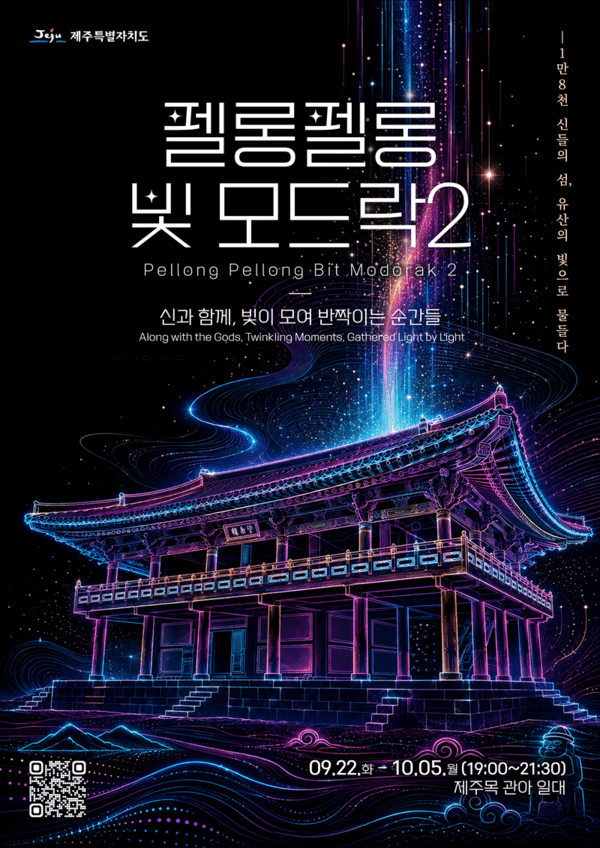
Last year’s edition looked to Tamna Sullyeokdo, an illustrated record of Jeju from the Joseon period, as a starting point for scenes of the island’s landscape and culture. This year, the focus shifts decisively to mythology.
Jeju is often described in local tradition as an island of 18,000 gods, and those stories provide the framework for this year’s program. Rather than treating mythology as a collection of old tales, the projections place it alongside historic sites and the lives of the people who have inhabited the island, showing how the two have long existed together.
The event’s Jeju-language title carries the same sense of collective experience. Pellong pellong means “sparkling” or “twinkling,” while modeurak means “everyone” — a name intended to suggest a gathering of lights shared by all.
The setting gives that idea additional weight. Jejumok-Gwana once served as Jeju’s administrative, military and cultural center during the Joseon period. Historic remains survive alongside reconstructed government buildings at the site, which was designated a Historic Site in 1993.
During the day, visitors encounter that history through architecture and archaeological remains. Once darkness falls, the buildings themselves become part of the visual program, with projections unfolding across the site and recasting the old compound as a stage for Jeju’s mythology.
The format has already found a large audience. Last year’s 24-day run drew 92,792 visitors, with attendance reaching 8,081 on its busiest day — the highest single-day figure recorded at Jejumok-Gwana since the restored site reopened in 2003.
Admission will be free throughout the event. Because the program is staged outdoors, screenings may be suspended temporarily in heavy rain or strong winds.
The project is also set to move beyond Jejumok-Gwana. In 2027, Jeju Special Self-Governing Province’s World Heritage Headquarters plans to extend the media-art program to the Chusa Exile Site, bringing the same nighttime format to another historic setting on the island.
This year’s shift toward mythology gives the program a broader canvas. Jejumok-Gwana remains the historical anchor, but after dark, the emphasis moves from preserving the site as a monument to using it as a place where Jeju’s old stories can be encountered again.
Reported by News Culture M.J._mj94070777@nc.press
Copyright ⓒ 뉴스컬처 무단 전재 및 재배포 금지


