[News Culture] A play is usually considered finished long before an audience sees it. The script has been studied, the role constructed, the movement rehearsed and the emotional architecture tested repeatedly in the room.
White Rabbit Red Rabbit begins by removing that certainty.
The actor walks onstage without having read the play. There has been no rehearsal and no opportunity to prepare an interpretation in advance. Only after the performance begins does the performer receive the script, open it and start reading. What would ordinarily belong to the rehearsal room — discovery, hesitation, interpretation and decision — becomes visible as part of the event itself.
That simple restriction radically changes the relationship between text and performer. The actor is not reproducing a sequence of choices already made elsewhere but making those choices in front of the audience, while the audience encounters the same uncertainty from the opposite side of the room. The performance is therefore less a presentation of a completed role than a public act of reading, responding and negotiating with a text whose demands remain unknown.
The structure also shifts the audience’s position. Spectators are not merely watching a performer execute a rehearsed score; they are watching someone process information in real time. A pause may come from uncertainty rather than design. A change in tone may be instinctive rather than rehearsed. A reaction from the audience can alter the atmosphere of the room before the performer has had time to decide how to absorb it.
That makes the play unusually dependent on presence. The text may remain fixed, but almost everything surrounding it remains variable: the actor’s temperament, theatrical experience, sense of humor, tolerance for ambiguity and willingness to follow an unfamiliar instruction, as well as the mood of the audience on a given night.
In that sense, White Rabbit Red Rabbit does not eliminate preparation so much as relocate it. The preparation happens publicly, inside the performance.
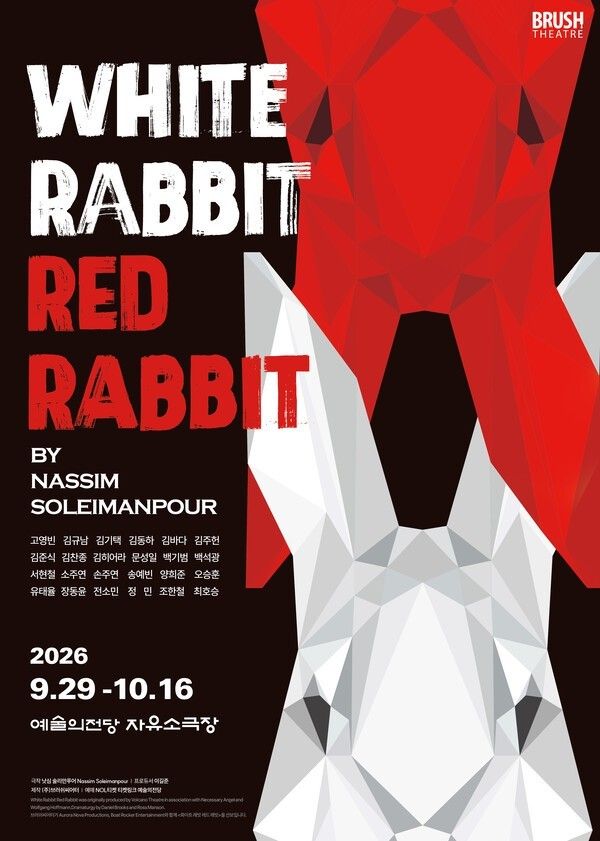
The 2026 Seoul season makes that instability especially visible through a cast of 24 performers: Ko Young-bin, Kim Kyu-nam, Kim Ki-taek, Kim Dong-ha, Kim Bada, Kim Ju-heon, Kim Jun-sik, Kim Chan-jong, Kim Hieora, Moon Sung-il, Baek Ki-beom, Baek Seok-kwang, Seo Hyun-chul, So Ju-yeon, Son Ju-yeon, Song Ye-bin, Yang Hee-jun, Oh Seung-hoon, Yoo Tae-yul, Jang Dong-yoon, Jeon So-min, Jung Min, Cho Han-chul and Choi Ho-seung.
One actor appears at each performance. The cast list, then, is not simply a roster of alternate performers. Each name effectively represents a different version of the production.
A veteran stage actor may respond to the script through years of live-performance instinct, while a performer shaped primarily by film or television may negotiate the same material through a different sense of timing and exposure. Because none of those responses can be rehearsed into uniformity, the differences are not secondary to the production; they are part of its structure.
That also changes the logic of repeat attendance. In a conventional production, audiences may return to observe refinements within a stable performance framework. Here, returning means replacing the central interpreter altogether. The same text is tested against another body, another temperament and another audience.
Written by Iranian playwright Nassim Soleimanpour, White Rabbit Red Rabbit has circulated internationally through a performance model built around that encounter with the unknown. In Korea, it was presented during the 2025 season and continued through spring 2026 before returning this fall.
The work’s durability is tied in part to the fact that it foregrounds a condition common to all live performance but usually hidden beneath rehearsal: a theatrical event can never be reproduced exactly.
In most plays, rehearsal works to contain that instability. Actors may repeat the same lines and movements night after night, but each performance still changes through timing, energy and the audience in the room. White Rabbit Red Rabbit does not attempt to suppress that variation. It makes variation the organizing principle.
Once a performance ends, the actor’s first encounter with the script is gone. The pauses, decisions and moments of uncertainty produced under those conditions cannot be restored. Another actor may read the same words the following night, but it will no longer be the same event.
Its roughly 80-minute running time therefore measures more than duration. It defines the temporary life of a performance that begins with an unopened script and disappears when the actor reaches the end.
The central question is not simply what White Rabbit Red Rabbit is about. It is when, exactly, the play comes into being.
In this production, that moment does not precede the audience. It happens in front of them.
The 2026 fall season of White Rabbit Red Rabbit runs from Sept. 29 through Oct. 16 at the Jayu Theater of the Seoul Arts Center in Seoul.
Reported by News Culture M.J._mj94070777@nc.press
Copyright ⓒ 뉴스컬처 무단 전재 및 재배포 금지


