[News Culture] An old puppet returns to the stage, but not to repeat the familiar story attached to it.
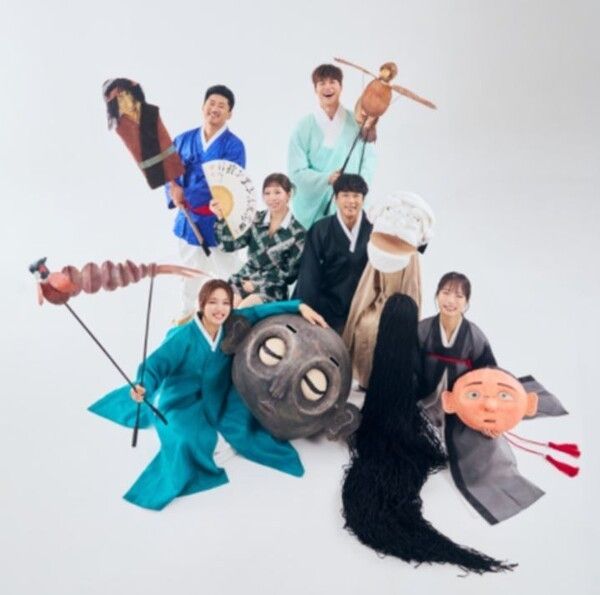
Kkokdu: Between the Times, running Oct. 22-28 at National Jeongdong Theater Cecil, takes the characters and performance vocabulary of kkokdugaksi noreum, Korea’s traditional puppet theater, and rearranges them around figures that once remained at the edges of the form.
Park Cheomji, normally one of its most recognizable characters, is reduced here to speaking only a single syllable. The sanbaji, traditionally positioned outside the puppet booth as the performer who exchanges dialogue with the puppets and helps propel the action, instead becomes the narrator guiding the story.
The production begins with a question of taste.
An aging Park Cheomji adores pretty, appealing puppets while dismissing those that fail to please him. The sanbaji takes him and the young Dongbang on a journey backward through time, where they encounter the story of Kkokdu, a forgotten puppet pushed aside because it fit no one’s idea of beauty.
That premise turns the conventions of traditional puppet theater toward a contemporary question: not simply why people are drawn to certain things, but how they treat what falls outside their preferences.
By placing the widely loved Park Cheomji alongside a puppet that no one chooses, the production shifts attention from the object of affection to the act of exclusion itself. Familiarity and beauty become less important than the behavior they produce toward those deemed unattractive, strange or undesirable.
The change in perspective also reshapes the traditional hierarchy of the puppet stage. Rather than building another performance around Park Cheomji, the work gives narrative authority to the sanbaji and draws figures previously overshadowed by the central characters into the foreground.
Tradition, in this sense, is treated not as a fixed script to be reproduced but as material that can be reopened from within.
The puppets themselves follow the same principle.
Rather than functioning only as objects manipulated by performers, they are conceived as stage partners whose movement develops in relation to the actors. The production expands on established techniques used for the Park Cheomji puppet while introducing newly designed figures that explore a wider range of movement and scale.
Dongbangsak appears with an enlarged head and a rotating sangmo hat. Puppets representing a pheasant, hawk and hunter are constructed with accordion-like bodies that expand and contract, creating physical vocabularies distinct from those typically associated with traditional Korean puppetry.
Music is similarly approached as a living component rather than a period reconstruction.
Traditional rhythmic cycles provide the foundation, but newly created sounds and patterns are layered into them. Actors, puppets and music are designed to move as interconnected elements, allowing rhythm to respond to bodies and bodies to respond in turn to sound.
The result retains the basic logic of yeonhui — performance created through the exchange of movement, rhythm, sound and play — while extending its stage language beyond conventional forms.
That approach places Kkokdu: Between the Times outside the familiar framework of preservation and faithful reproduction often associated with presentations of traditional culture. The work instead asks what becomes possible when an inherited form is allowed to change without abandoning the principles from which it developed.
Its path to the Cecil stage has itself been gradual.
The project was first developed in 2022 through the Korea National University of Arts School of Korean Traditional Arts’ initiative supporting traditional arts and the Korean Wave. It was subsequently reworked under the title Deolmi Japhin, Cheomji Park for a 2025 showcase organized through the Arts Council Korea’s Performing Arts Creation Center program.
The current production expands those experiments into a full-length work of approximately 70 minutes. National Jeongdong Theater lists the production as part of its 2026 traditional performing arts program at Cecil.
Director and visual director Eun-ju Lim leads the creative team, with playwright Jin-sae Jung contributing the text. Jung received the Baeksang Arts Award for Young Theater Artist in 2021 and a Dong-A Theater Award in 2022, bringing a contemporary dramatic perspective to the reconstruction of traditional puppet characters.
Music director Min-hwi Lee approaches the production from another direction. Known for screen music including Netflix’s Pavane, the film The World of Love and the Wavve series One Day Off, Lee works from traditional rhythmic structures while expanding their sonic relationship with puppetry and physical performance.
The significance of Kkokdu: Between the Times lies less in updating an old puppet show with contemporary design than in questioning which parts of that tradition have been allowed to speak.
Old puppets return, but with altered bodies. Familiar characters remain, but their authority changes. A voice once positioned outside the puppet booth moves to the center of the narrative.
Kkokdu consequently becomes more than a remnant of an older performance tradition. On the contemporary stage, the discarded puppet becomes a way of examining what people choose to admire — and what they learn to overlook.
Reported by News Culture M.J._mj94070777@nc.press
Copyright ⓒ 뉴스컬처 무단 전재 및 재배포 금지


