[News Culture] Korea’s exhibition industry is accelerating its shift toward an AI- and data-driven business model designed to connect exhibitors with buyers before they ever meet on the show floor.
Rather than relying primarily on visitors walking through exhibition halls, discovering booths and arranging meetings on site, the industry is exploring systems that can analyze participating companies, identify potential overseas buyers and recommend business matches in advance. The broader ambition is to turn exhibitions into platforms capable of generating exports, transactions and longer-term commercial relationships.
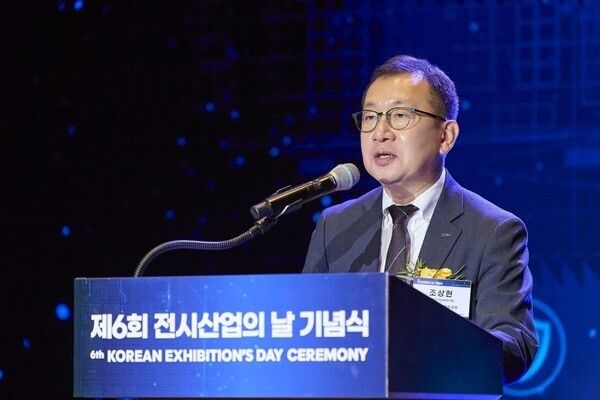
That transition took center stage at the sixth Exhibition Industry Day, held Sept. 16 at The Westin Seoul Parnas in Samseong-dong, Seoul.
Organized by the Association of Korean Exhibition Industry, the event brought together more than 200 participants, including representatives of the Ministry of Trade, Industry and Resources, four major exhibition-industry organizations, a delegation from UFI, the Global Association of the Exhibition Industry, and professionals across Korea’s exhibition sector.
This year’s theme, “AI, Beyond Connection, Scaling Value,” reflected an industry looking beyond the traditional function of assembling companies and visitors in one physical venue.
As artificial intelligence and digital services become embedded in exhibition planning and operations, the sector is increasingly being asked to deliver measurable business outcomes — identifying buyers, facilitating meetings, extending engagement beyond event dates and helping exhibitors convert participation into contracts and exports.
AI moves into buyer discovery and business matching
The commercial value of an exhibition has long depended on whether the right exhibitors and buyers actually find one another. AI is beginning to reshape that process.
Product portfolios, technologies and business profiles can be analyzed alongside buyer interests and purchasing histories, allowing organizers to identify potentially relevant partners with greater precision than conventional directory searches or on-site networking alone.
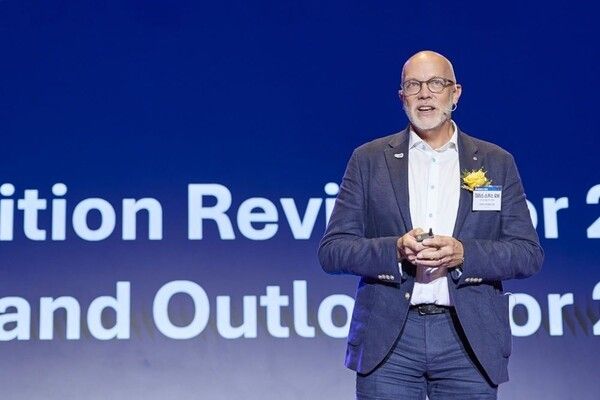
Chris Skeith, CEO of UFI, addressed that shift in a keynote presentation on global exhibition trends and the growing use of AI across the industry.
His presentation examined how organizers worldwide are expanding AI- and data-based services aimed at improving exhibitor performance and sustaining business interaction after an exhibition closes. The trend points toward a model in which the value of a trade show is measured not simply by attendance or booth sales, but by the commercial activity it helps generate.
Yoon-seok Choi, Tech PM at Microsoft Korea, followed with a special presentation titled “Where Is AI?” introducing AI-agent technologies that can be applied to exhibition planning, operations and business matchmaking.
Potential applications now span much of the exhibition cycle — pre-event preparation, buyer targeting, on-site management and post-event follow-up — widening the role of digital tools well beyond event administration.
The push toward AI also reflects pressure on Korea’s exhibition industry to strengthen its export-support function.
Trade shows remain one of the few channels where small and midsize companies and microbusinesses can meet overseas buyers directly, demonstrate products and test demand in new markets. That makes the ability to convert exhibition participation into actual negotiations, contracts and overseas sales increasingly important to the sector’s competitiveness.
The question is no longer simply how many exhibitors or visitors an event can attract. Organizers are being pushed to demonstrate how effectively they can identify commercially relevant buyers and move those connections toward transactions.
Korean trade shows face a global competitiveness test
Technology alone, however, will not determine whether Korea’s exhibition industry becomes more competitive internationally.
Domestic organizers also face the larger challenge of defining which industries can support globally distinctive exhibitions and how exhibition infrastructure outside Seoul can be connected to regional economic strengths.
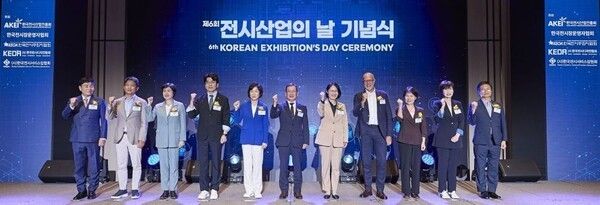
National Assembly member Se-hee Oh, who serves on the Trade, Industry, Energy, SMEs and Startups Committee, described exhibitions as platforms that can expand sales channels for smaller companies and generate new business opportunities. She also underscored the need to strengthen support for Korean exhibitions competing internationally.
Sung-hwa Na, director general for trade policy at the Ministry of Trade, Industry and Resources, characterized the exhibition sector as an export platform supporting Korean companies entering overseas markets.
The ministry plans to support innovation based on AI and digital technologies while promoting regional exhibition industries and strengthening the international competitiveness of Korean trade shows.
The visit by a UFI delegation adds another international dimension to that effort. In addition to talks with the ministry, the delegation is scheduled to visit major Korean exhibition venues including COEX, Songdo Convensia and BEXCO to discuss opportunities for cooperation with the domestic industry.
Regional development remains one of the more complicated pieces of the strategy.
Much of Korea’s exhibition demand remains concentrated in the Seoul metropolitan area. Building competitive events elsewhere will require more than exhibition halls themselves.
Successful regional exhibitions must be tied to industries already embedded in their host cities and provinces, while transportation, hotels, tourism and related service infrastructure must be capable of supporting domestic and international exhibitors and buyers.
That makes exhibition policy part of a wider regional business ecosystem rather than an isolated event-industry issue.
Technology must translate into commercial results
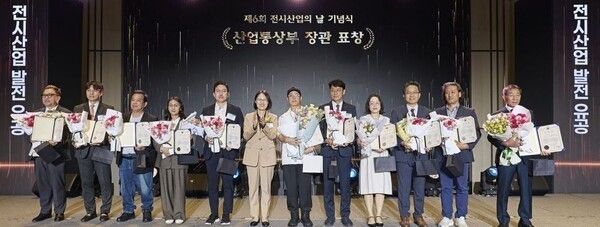
The ceremony also recognized 10 professionals with commendations from the Minister of Trade, Industry and Resources for contributions to the development of Korea’s exhibition industry.
Recipients represented exhibition venues, organizers, design companies, service providers and supporting institutions. Their work included attracting overseas buyers, expanding exports by participating companies, developing regionally specialized exhibitions, creating environmentally conscious exhibition booths and introducing AI and digital technologies into venue operations.
The event also presented the top award of the Korea Exhibition Design Annual, which recognizes outstanding exhibition-booth design.
Exhibition Industry Day was established in 2021 to commemorate Korea’s first national trade fair, held on Sept. 9, 1968. The annual event serves as a forum for discussing the industry’s future direction while recognizing professionals who have contributed to its development.
The central issue emerging this year is less about AI itself than what the technology can produce.
A recommendation engine may identify a promising buyer, and an AI agent may streamline scheduling or follow-up. Neither automatically produces a sale.
Turning better connections into negotiations, contracts and exports will also require reliable industry data, skilled exhibition professionals and stronger international networks.
That is where Korea’s exhibition industry now faces its next test: whether digital transformation can move beyond operational efficiency and become a measurable source of business growth.
Reported by News Culture M.J._mj94070777@nc.press
Copyright ⓒ 뉴스컬처 무단 전재 및 재배포 금지


